The Best Organic & Whole Food Multivitamins
A Complete Guide for Every Stage of Life
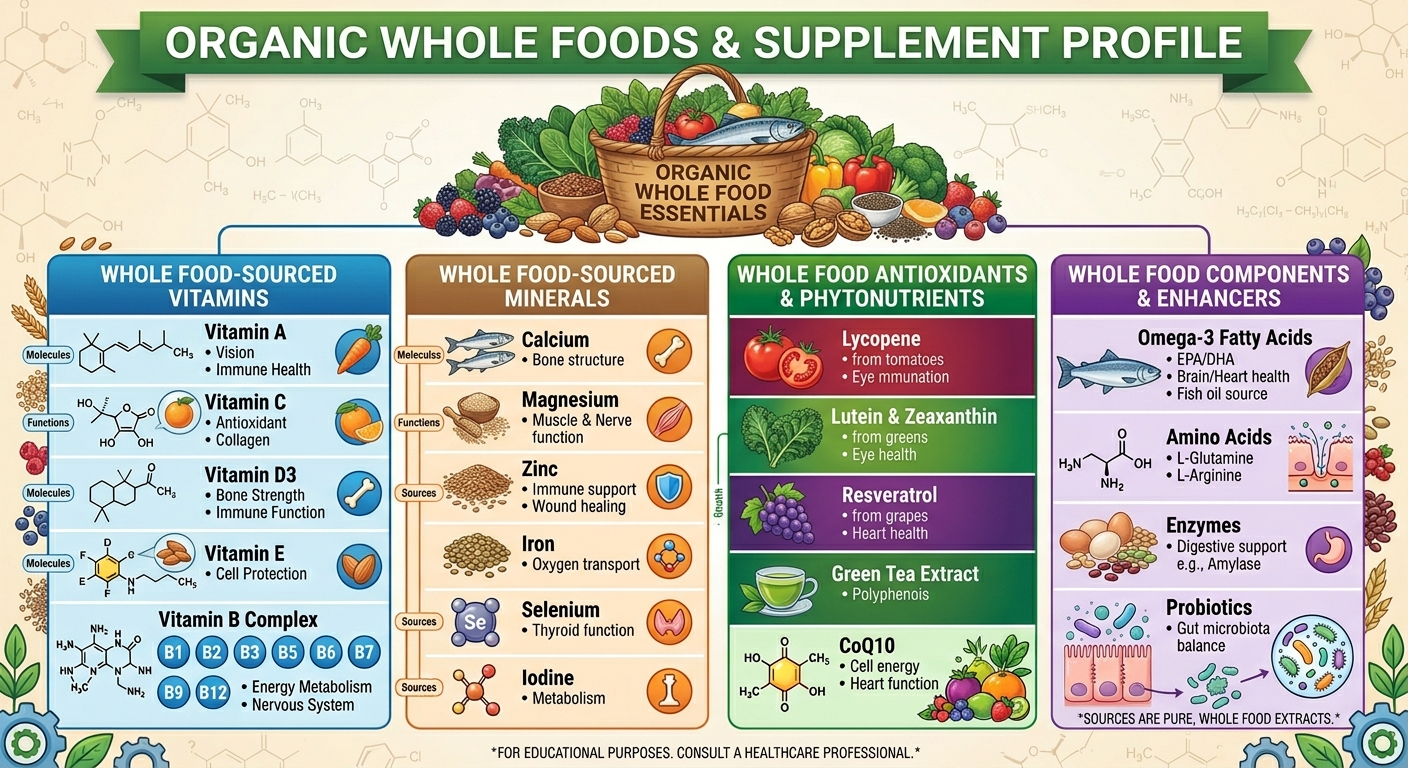
Here's a dirty secret the supplement industry would rather you not think about too carefully: the vast majority of multivitamins on pharmacy shelves are made from the same handful of synthetic chemicals, manufactured in the same Chinese and Indian chemical plants, pressed into tablets with the same industrial binders and fillers, and sold under hundreds of different brand names at wildly different prices.
That $7 bottle of "Complete Multivitamin" at the drugstore and the $15 one next to it? Probably the same stuff with different labels. And your body is probably ignoring most of it.
But not all multivitamins are created equal. Over the past two decades, a quiet revolution has been happening in supplement manufacturing. Companies have figured out how to grow vitamins in food — literally culturing nutrients in organic fruits, vegetables, and yeast — producing supplements that your body recognizes and absorbs the way it absorbs a meal rather than a chemical.
The difference matters. And choosing the right multivitamin for your specific age, sex, and life stage matters even more, because what a 30-year-old woman needs from a daily supplement is dramatically different from what a 70-year-old man or a 6-year-old child needs.
This guide will walk you through all of it: what makes a multivitamin great, why the form matters as much as the dose, and the best organic and whole food options for every category — with honest assessments of what each product does well and where it falls short.
Part I: What Actually Makes a Great Multivitamin?
The Five Things That Separate Good from Bad
Before we compare a single product, you need to understand the five factors that determine whether a multivitamin is actually working or just making expensive urine.
1. Nutrient Forms — The Single Most Important Factor
This is where most cheap multivitamins fail catastrophically. The form of a nutrient determines whether your body can actually use it:
| Nutrient | Cheap/Synthetic Form | Superior/Bioavailable Form | Why It Matters |
|---|---|---|---|
| Folate | Folic acid | 5-MTHF (methylfolate) | ~40% of people have MTHFR variants and can't convert folic acid efficiently |
| B12 | Cyanocobalamin | Methylcobalamin or adenosylcobalamin | Cyano- must be converted and contains a cyanide molecule (tiny, but still) |
| Vitamin E | dl-alpha-tocopherol | d-alpha-tocopherol + mixed tocopherols | The "dl-" form is synthetic and ~50% less bioavailable |
| Magnesium | Magnesium oxide | Mg glycinate, citrate, or malate | Mg oxide has ~4% absorption; glycinate absorbs at 80%+ |
| Iron | Ferrous sulfate | Ferrous bisglycinate or whole food iron | Sulfate causes GI distress in many people |
| Zinc | Zinc oxide | Zinc bisglycinate or picolinate | Oxide is cheap but poorly absorbed |
| Vitamin D | D2 (ergocalciferol) | D3 (cholecalciferol) | D3 raises blood levels 2-3× more effectively than D2 |
| Vitamin K | K1 only | K1 + K2 (as MK-7) | K2 directs calcium to bones (not arteries); K1 alone misses this |
| Calcium | Calcium carbite | Calcium citrate or algae-derived | Carbonate requires stomach acid; citrate absorbs regardless |
If your multivitamin uses folic acid, cyanocobalamin, magnesium oxide, and dl-alpha-tocopherol, it's failing on the basics — regardless of what the front of the bottle says.
2. Whole Food vs. Synthetic
There are three tiers of multivitamin sourcing:
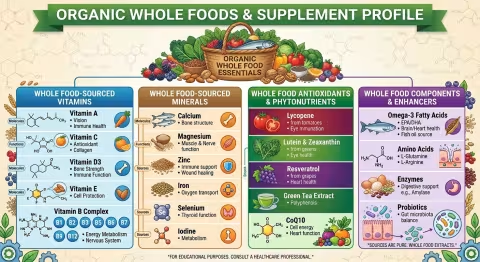
Tier 1 — Synthetic isolates: Individual chemicals (ascorbic acid, thiamine mononitrate, etc.) mixed together. This is what 90% of multivitamins are. They provide the molecule but none of the co-factors, enzymes, or phytonutrients that help your body use it.
Tier 2 — Food-cultured / fermented: Synthetic vitamins are fed to a culture of Saccharomyces cerevisiae (baker's yeast) or Lactobacillus bacteria, which metabolize and incorporate the nutrients into their cellular matrix. The result is a whole food complex that includes the nutrient plus its natural co-factors. MegaFood and New Chapter use this approach.
Tier 3 — Genuinely food-derived: Vitamins extracted directly from organic fruits, vegetables, herbs, and superfoods — no synthetic inputs at all. Garden of Life's mykind Organics and Pure Synergy use this approach. USDA Organic certified. This is the gold standard, but it's harder to achieve high potencies.
3. What's NOT in It
A quality multivitamin should be free of:
- Artificial colors (FD&C dyes — looking at you, Red #40 and Blue #2)
- Titanium dioxide (whitening agent, nanoparticle concerns)
- Hydrogenated oils (sometimes used as tablet lubricants)
- High-fructose corn syrup (common in cheap gummies)
- Soy lecithin (used as emulsifier — relevant for soy-sensitive individuals)
- Talc, BHT, and artificial preservatives
4. Dose Appropriateness
More is not better. A great multivitamin provides nutrients in amounts that complement a healthy diet — not megadoses that stress the liver and kidneys. Watch out for:
- Vitamin A as preformed retinol above 3,000 IU (toxicity risk; beta-carotene is safer)
- Iron in men's or senior formulas (most men and post-menopausal women don't need supplemental iron)
- Folic acid above 400-800 mcg (masks B12 deficiency signs)
- Calcium above 500 mg per dose (reduces absorption; interferes with iron/zinc)
5. Third-Party Testing
Reputable brands submit to independent verification:
- NSF International — Tests for contaminants and label accuracy
- USP (United States Pharmacopeia) — Gold standard for purity and potency
- Non-GMO Project Verified — Confirms no genetically modified ingredients
- USDA Organic — Certifies organic sourcing
- B Corp — Certifies social and environmental responsibility
Part II: Understanding Nutrient Needs by Life Stage
Why One Multivitamin Doesn't Fit All
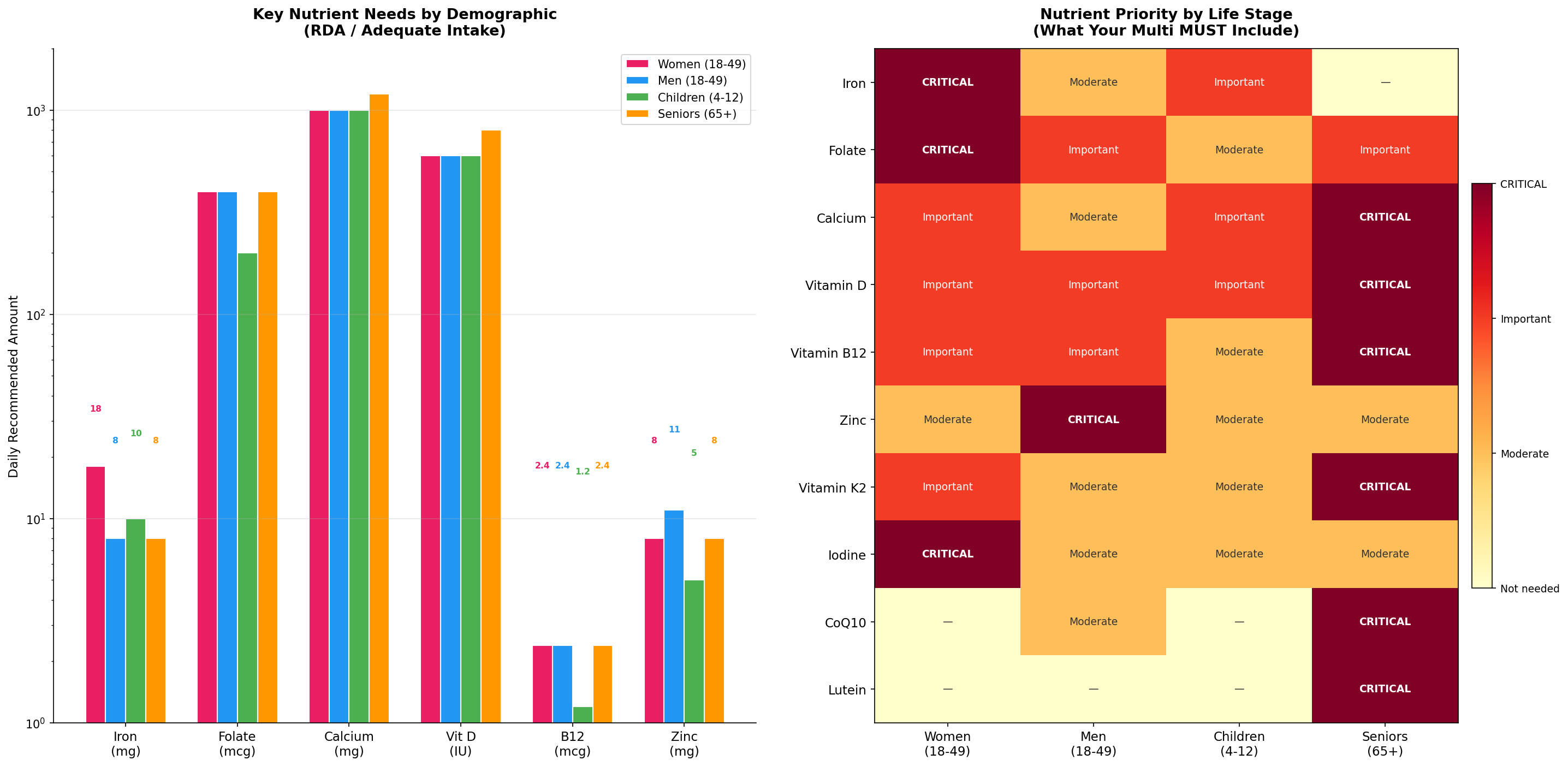
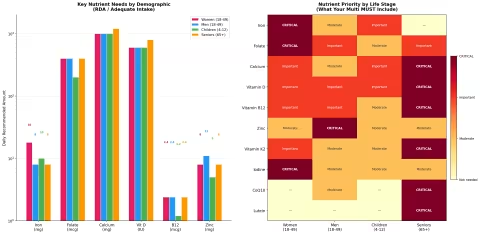
The reason we need different multivitamins for different people isn't marketing — it's biology. Nutrient requirements change dramatically based on age, sex, reproductive status, and metabolic changes.
Women (18-49): The Iron and Folate Years
Women of reproductive age have unique nutritional demands that make a generic multivitamin inadequate:
Iron — Menstruation creates an ongoing iron demand. The RDA for women 19-50 is 18 mg/day, compared to just 8 mg for men. Iron deficiency is the most common nutritional deficiency worldwide, affecting an estimated 30% of premenopausal women. A women's multi must include iron in an absorbable form (bisglycinate, not sulfate).
Folate — Critical for DNA synthesis and, most urgently, for preventing neural tube defects in pregnancy. The RDA is 400 mcg for all women of childbearing age, rising to 600 mcg during pregnancy. This should be as methylfolate (5-MTHF), not synthetic folic acid, because of the high prevalence of MTHFR polymorphisms.
Calcium & Vitamin D — Bone density peaks around age 30. Adequate calcium (1,000 mg/day, ideally from diet + supplement) and vitamin D (600-2,000 IU) during these years is an investment against osteoporosis later.
B Vitamins — Hormonal contraceptives deplete B6, B12, and folate. Women on the pill have higher B-vitamin needs.
What to avoid: Excessive vitamin A as retinol (teratogenic at high doses — dangerous in early pregnancy before many women know they're pregnant).
Men (18-49): The Zinc and No-Iron Years
Men's nutritional profile is simpler in some ways, but specific:
No iron (or very low iron) — Men lose very little iron daily. The RDA is just 8 mg, and most men get this easily from diet. Supplemental iron in men can accumulate and cause oxidative damage. A men's multivitamin should contain zero or minimal iron.
Zinc — Critical for testosterone production, immune function, and prostate health. The RDA is 11 mg. Many men are marginally zinc-deficient, especially athletes (zinc is lost in sweat).
Selenium — Supports thyroid function and may be protective for prostate health. 55 mcg is the RDA; many men's formulas include 100-200 mcg.
Lycopene — The carotenoid from tomatoes, included in some men's formulas for prostate support. Evidence is suggestive but not definitive.
B Vitamins — Important for energy metabolism, especially for active men. Methylated forms preferred.
Vitamin D — Men are just as prone to deficiency as women, especially in northern latitudes and with indoor lifestyles. 1,000-2,000 IU is a reasonable supplemental dose.
Children (4-12): The Growth Years
Children's multivitamins require a completely different philosophy:
Lower doses across the board — Children need 30-75% of adult nutrient levels depending on age, but many children's vitamins actually overdose certain nutrients while missing others.
Iron — Children ages 4-8 need 10 mg/day; ages 9-13 need 8 mg/day. Iron deficiency is common in picky eaters and can affect cognitive development. Include it, but in a gentle form.
Vitamin D — The AAP recommends 600 IU daily for children. Many kids, especially those with limited outdoor time, are deficient.
Calcium — Growing bones need 1,000-1,300 mg/day (ages 4-18), but this mostly needs to come from diet. Supplemental calcium in a multi is modest.
What to avoid in children's vitamins:
- Artificial colors and flavors (behavioral concerns; many children react to FD&C dyes)
- Excessive sugar (some gummies contain 3-4g sugar per serving)
- Adult-level doses of fat-soluble vitamins (A, D, E, K can accumulate)
- Folic acid in synthetic form (methylfolate is safer for developing nervous systems)
The gummy problem: Most kids won't swallow pills, so gummies dominate the market. But gummies can't hold minerals well (especially iron and calcium), require sweeteners and binders, and stick to teeth. Liquid multivitamins are often the better choice for children — better absorption, complete mineral profiles, and adjustable dosing.
Seniors (65+): The Absorption Challenge
Aging changes everything about how you absorb and use nutrients:
B12 — Gastric acid and intrinsic factor production decline with age, making B12 absorption from food increasingly unreliable. Up to 30% of adults over 50 have difficulty absorbing food-bound B12. Supplemental B12 (as methylcobalamin) bypasses this problem. The RDA is 2.4 mcg, but many geriatric specialists recommend 500-1,000 mcg.
Vitamin D — Aging skin produces 75% less vitamin D from sunlight than young skin. Seniors spend less time outdoors. Deficiency rates above age 65 are estimated at 40-60%. Most geriatric guidelines recommend 1,000-2,000 IU daily, some suggest 4,000 IU.
Calcium + Vitamin K2 — Osteoporosis risk increases dramatically. But calcium supplementation without K2 may increase cardiovascular risk by depositing calcium in arteries rather than bones. Always pair calcium with K2 (as MK-7).
No iron (usually) — Post-menopausal women and men over 50 rarely need supplemental iron. Excess iron is pro-oxidant and associated with increased cardiovascular risk.
CoQ10 — Not technically a vitamin, but endogenous production drops significantly with age. Involved in mitochondrial energy production. Often included in premium senior formulas.
Lutein & Zeaxanthin — Carotenoids that protect against age-related macular degeneration, the leading cause of vision loss in seniors.
Digestive support — Some senior formulas include digestive enzymes or are pre-fermented/food-cultured for easier absorption, recognizing that digestive efficiency declines with age.
Part III: The History of the Multivitamin
From Scurvy to Centrum — A Surprisingly Recent Invention
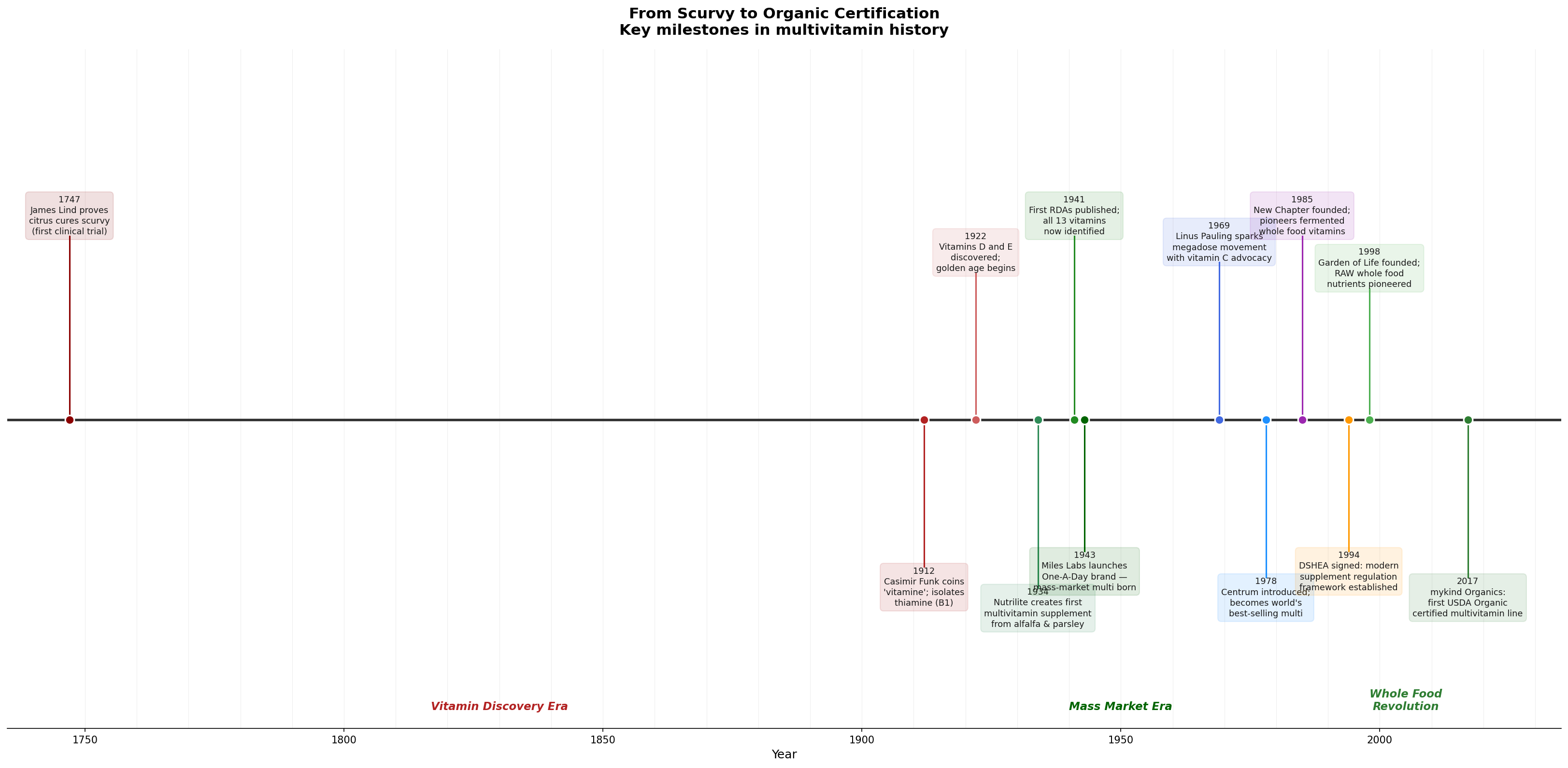
The idea that you could put all essential nutrients into a single pill is barely a century old — and the journey from "we don't know what vitamins are" to a $50 billion global industry is one of the stranger stories in modern medicine.
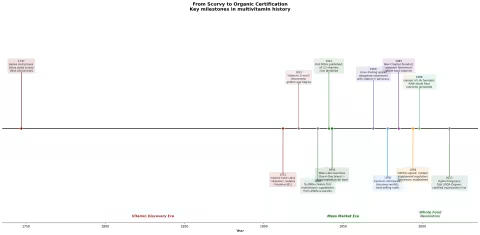
1747 — Scottish physician James Lind conducts the first controlled clinical trial in history, proving that citrus fruits cure scurvy. He doesn't know why — vitamin C won't be identified for another 185 years.
1912 — Polish biochemist Casimir Funk coins the term "vitamine" (vital amine) after isolating thiamine (B1) from rice bran. He hypothesizes that diseases like scurvy, pellagra, beriberi, and rickets are all caused by deficiency of these "vitamines." He is essentially right.
1913-1941 — The golden age of vitamin discovery. In rapid succession, researchers isolate and identify vitamins A (1913), D (1922), E (1922), K (1929), C (1932), B2 (1933), B6 (1934), B12 (1948), and folate (1941). Most win Nobel Prizes. By 1941, all 13 essential vitamins are known.
1934 — Nutrilite (later acquired by Amway) creates what is generally considered the first multivitamin supplement, derived from alfalfa, parsley, and watercress. It's crude by modern standards, but the concept — multiple vitamins in a single product — is revolutionary.
1941 — The first Recommended Dietary Allowances (RDAs) are published by the US National Research Council, giving manufacturers targets for the first time.
1943 — Miles Laboratories introduces One-A-Day brand vitamins, one of the first mass-market multivitamins. The concept of a single daily pill for nutritional insurance enters mainstream American culture.
1969 — Linus Pauling, double Nobel laureate, publishes his controversial advocacy for megadose vitamin C, sparking the modern supplement movement and the megadose philosophy that still dominates many brands today.
1978 — American Health introduces Centrum, which will become the best-selling multivitamin in the world. Centrum's formula is built entirely on synthetic isolates — cheap to manufacture, consistent in dosing, but questionable in absorption.
1985 — New Chapter is founded in Connecticut with a radical idea: fermenting vitamins with beneficial microorganisms to create "whole food" supplements. This launches the food-cultured vitamin movement.
1994 — The Dietary Supplement Health and Education Act (DSHEA) is signed into law, establishing the modern regulatory framework. Supplements are categorized as foods, not drugs — meaning they don't require FDA approval before sale but cannot make disease treatment claims.
1998 — Garden of Life is founded, pioneering the use of RAW whole food nutrients and becoming one of the first major supplement companies to pursue USDA Organic certification for vitamins.
2010s — The fermented/whole food multivitamin revolution goes mainstream. MegaFood, New Chapter, Garden of Life, and Pure Synergy establish the premium tier. USDA Organic certified vitamins become widely available for the first time.
2017 — Garden of Life launches mykind Organics, the first comprehensive multivitamin line certified USDA Organic, Non-GMO Project Verified, and Certified Vegan — setting a new industry standard.
Today — The global multivitamin market exceeds $50 billion. The divide between synthetic commodity vitamins and whole food/organic premium products continues to widen, with consumers increasingly demanding transparency about sourcing, testing, and manufacturing.
Part IV: Whole Food vs. Synthetic — Does It Actually Matter?
The Bioavailability Question
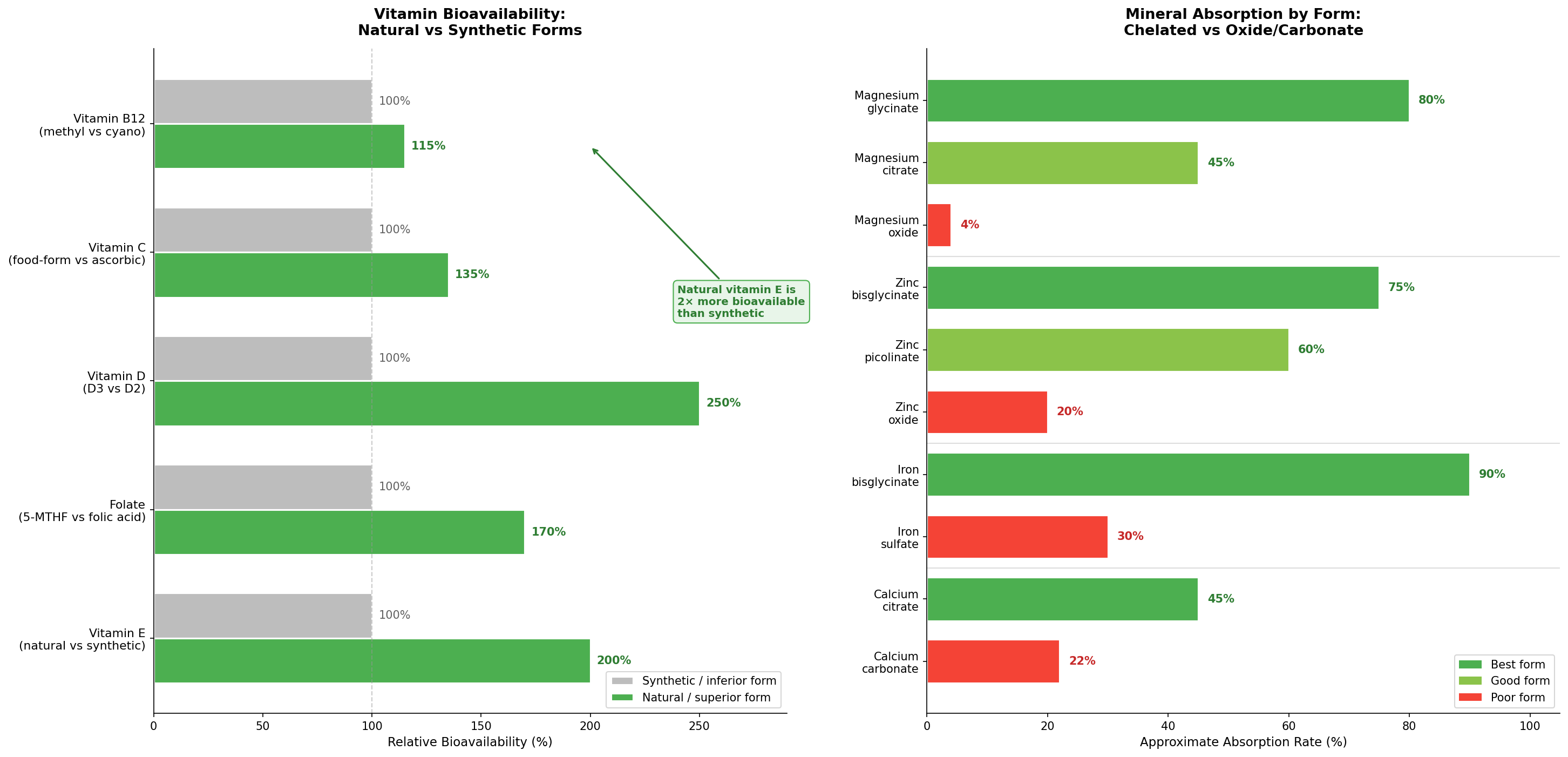
The supplement industry's most heated debate: does your body absorb vitamins from whole food supplements better than synthetic ones?
The case for whole food forms:
Nutrients in food don't exist in isolation. Vitamin C in an orange comes packaged with bioflavonoids, fiber, and dozens of phytonutrients that may enhance absorption and activity. Vitamin E in a sunflower seed comes with all eight tocopherols and tocotrienols, not just the alpha-tocopherol isolate.
The theory behind whole food supplements is that by growing vitamins in food matrices (yeast cultures, organic fruits, vegetables), you preserve these co-factors — creating a supplement your body treats more like food than like a chemical.
What the research shows:
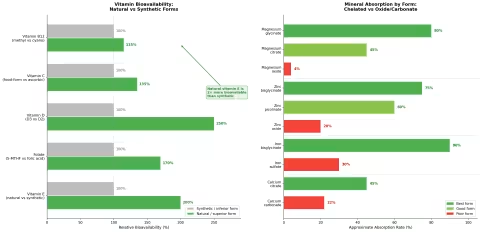
- Folate: Methylfolate (5-MTHF) produces higher, more sustained blood folate levels than folic acid, especially in individuals with MTHFR polymorphisms. (PMID: 24494987)
- Vitamin C: Studies comparing food-form vitamin C to ascorbic acid show mixed results. Some show equivalent bioavailability; others show enhanced retention of food-form C. A 2014 study found whole food vitamin C had 35% greater cellular uptake. (PMID: 24915543)
- Vitamin E: Natural d-alpha-tocopherol is absorbed approximately twice as efficiently as synthetic dl-alpha-tocopherol. This is one of the clearest bioavailability differences in nutrition science. (PMID: 9844997)
- Vitamin B12: Methylcobalamin and adenosylcobalamin are the body's native forms. Cyanocobalamin must be converted, requiring additional metabolic steps. For most people the difference is modest, but for those with impaired methylation, it matters significantly.
- Minerals: Chelated minerals (bound to amino acids like glycine) consistently outperform oxide and carbonate forms in absorption studies. Magnesium glycinate absorbs at roughly 80% vs. ~4% for magnesium oxide. (PMID: 30587329)
The honest summary: For some nutrients (vitamin E, folate, minerals), the form makes a dramatic, well-documented difference. For others (vitamin C, some B vitamins), the difference is more modest. But across the board, whole food and properly chelated forms are never worse — and they're often significantly better.
The real question isn't whether whole food forms are superior. The question is whether the premium price (typically 2-4× more than synthetic) is justified for your situation. If you eat a nutrient-rich diet and supplement as insurance, the form matters less. If you rely on your multivitamin to fill real gaps, the form matters a great deal.
Part V: The Best Women's Multivitamins
What to Look For
A great women's multivitamin (ages 18-49) should include:
- Iron (15-18 mg as bisglycinate)
- Folate as methylfolate (400-800 mcg)
- Vitamin D3 (1,000-2,000 IU)
- Calcium (modest — 200-500 mg; you need dietary sources too)
- Vitamin K2 as MK-7 (to work with D and calcium)
- B-complex with methylated forms
- Iodine (150 mcg — critical for thyroid, often missing)
- No excessive retinol (beta-carotene preferred)
Our Top Picks
Best Overall: Garden of Life mykind Organics Women's Multi
This is the gold standard for women's organic multivitamins. USDA Organic, Non-GMO Project Verified, Certified Vegan. Every nutrient is derived from real organic fruits, vegetables, and herbs — not synthetic chemicals fed to yeast, but genuinely food-sourced.
- Methylfolate from organic lemon peel
- Whole food iron from organic curry leaf
- Vitamin D3 from organic lichen (vegan source)
- 2 tablets daily; 60-count (30-day supply)
- Includes organic turmeric, organic ashwagandha, and organic cranberry
- Tablet format — no junk ingredients
The one gap: calcium is modest. Pair with dietary sources (leafy greens, fortified plant milk, almonds).
Best Fermented: New Chapter Every Woman's One Daily Multi
New Chapter pioneered the fermented whole food approach, and their women's formula is excellent. Each vitamin and mineral is fermented with beneficial probiotics, making the nutrients more bioavailable and gentle on the stomach — you can take this one on an empty stomach without nausea.
- Fermented methylfolate, fermented iron (9 mg — gentle but modest)
- Vitamin D3 from fermented sources
- Includes stress-support herbs: organic chamomile, organic maca
- True one-daily format (a real convenience advantage)
- Non-GMO Project Verified, B Corp Certified
- Contains soy-free fermentation media (important — older New Chapter formulas used soy)
Note: Iron is only 9 mg, which may not fully cover menstrual losses for heavy-flow women. Otherwise excellent.
Best Liquid: MaryRuth Organics Women's Multivitamin Liquid
MaryRuth's specializes in liquid supplements, and their women's multi is ideal for anyone who can't or won't swallow pills. The liquid format means faster absorption and adjustable dosing.
- USDA Organic, vegan, sugar-free
- Methylated B vitamins including methylfolate and methylcobalamin
- Pleasant berry flavor from organic fruit extracts
- No iron in this formula (a drawback for many women — but avoids the taste issue with liquid iron)
- Gluten-free, soy-free, nut-free
Best for: women who hate pills, want organic, and get adequate iron from diet. Not ideal as a sole iron source.
Best Budget: Garden of Life Vitamin Code Women
If the mykind Organics line is out of budget, Vitamin Code is Garden of Life's food-cultured (yeast-based) alternative. It's not USDA Organic, but the nutrients are grown in a whole food matrix with live probiotics and enzymes.
- RAW whole food cultured nutrients
- Methylfolate, iron (8 mg as gentle whole food form)
- Live probiotics and enzymes for digestion
- Vegetarian capsules (4 per day — the main inconvenience)
- Non-GMO Project Verified
Women's Multivitamin Comparison
| Product | Organic | Format | Daily Dose | Iron | Folate Form | Vit D | Price Range |
|---|---|---|---|---|---|---|---|
| GOL mykind Women's | USDA Organic | Tablets | 2/day | Whole food | Methylfolate | 800 IU D3 | $$$ |
| New Chapter Every Woman | No (fermented) | Tablet | 1/day | 9 mg fermented | Methylfolate | 1,000 IU D3 | $$$ |
| MaryRuth Women's Liquid | USDA Organic | Liquid | 1 tbsp/day | None | Methylfolate | 1,000 IU D3 | $$ |
| GOL Vitamin Code Women | No (food-cultured) | Capsules | 4/day | 8 mg whole food | Methylfolate | 300 IU D3 | $$ |
Available at: Amazon, iHerb, Vitamin Shoppe, Target, brand direct websites
Part VI: The Best Men's Multivitamins
What to Look For
A great men's multivitamin should include:
- No iron (or very low — men rarely need supplemental iron)
- Zinc (15-25 mg as bisglycinate or picolinate)
- Selenium (55-200 mcg)
- Vitamin D3 (1,000-2,000 IU)
- B-complex with methylated forms
- Vitamin K2 as MK-7
- Lycopene (optional but beneficial for prostate)
- Saw palmetto or pumpkin seed extract (optional; some men's formulas include these)
Our Top Picks
Best Overall: Garden of Life mykind Organics Men's Multi
The men's counterpart to our top women's pick. Same organic sourcing philosophy — every nutrient from real organic food — with a profile tailored for men.
- Zero iron (appropriate for men)
- Organic whole food zinc and selenium
- Vitamin D3 from organic lichen
- Includes organic saw palmetto, organic ashwagandha
- B vitamins from organic guava, holy basil, and lemon
- USDA Organic, Non-GMO, Certified Vegan
- 2 tablets daily
Excellent across the board. Only gap: lower potency on some B vitamins than synthetic competitors, which is the trade-off with genuinely food-derived nutrients.
Best Fermented: New Chapter Every Man's One Daily Multi
New Chapter's fermented men's formula is one of the best-designed multivitamins on the market. The fermented whole food approach delivers nutrients in a highly bioavailable matrix with complementary herbs.
- Zero iron
- Fermented zinc (15 mg), fermented selenium (200 mcg)
- Organic saw palmetto and organic lycopene for prostate support
- Includes stress-support blend with organic holy basil, organic ginger
- True one-daily tablet (huge convenience factor)
- Can be taken on empty stomach (rare for a multi)
- Non-GMO Project Verified, B Corp
Best for: men who want one-pill simplicity without sacrificing quality.
Best Liquid: MaryRuth Organics Men's Multivitamin Liquid
Same excellent liquid format as the women's version, tailored for men's nutrient needs.
- USDA Organic, vegan
- Methylated B-complex
- No iron (correct for men)
- Organic berry flavor
- Easy to mix into smoothies or take straight
- Soy-free, gluten-free
Best for: men who won't take pills and want organic sourcing.
Best for Active Men: Dr. Mercola Whole Food Multivitamin Plus
Dr. Mercola's formula stands out for using whole food nutrients combined with higher-potency B vitamins and added botanical support. It's designed for the metabolically active man.
- Whole food cultured nutrients
- Higher B-vitamin potencies for energy metabolism
- Includes CoQ10 (important for cardiovascular and mitochondrial health)
- Chromium for blood sugar support
- No iron
- Tablet format, 2/day
A premium option from a brand known for rigorous sourcing standards.
Men's Multivitamin Comparison
| Product | Organic | Format | Daily Dose | Iron | Zinc | Prostate Support | Price Range |
|---|---|---|---|---|---|---|---|
| GOL mykind Men's | USDA Organic | Tablets | 2/day | None | Whole food | Saw palmetto | $$$ |
| New Chapter Every Man | No (fermented) | Tablet | 1/day | None | 15 mg fermented | Saw palmetto + lycopene | $$$ |
| MaryRuth Men's Liquid | USDA Organic | Liquid | 1 tbsp/day | None | Yes | Minimal | $$ |
| Dr. Mercola Whole Food Multi | No (whole food) | Tablets | 2/day | None | Yes | CoQ10 included | $$$ |
Available at: Amazon, iHerb, Vitamin Shoppe, Target, brand direct websites
Part VII: The Best Children's Multivitamins
What to Look For
Children's multivitamins have a unique set of challenges:
- Palatability is king — If a child won't take it, the formula doesn't matter
- Age-appropriate doses — Not just scaled-down adult amounts; ratios differ
- Minimal sugar — Many gummies contain 2-4g sugar per serving
- No artificial colors/flavors — FD&C dyes are linked to behavioral issues in sensitive children
- Iron — Often missing from gummies (iron tastes metallic and gummies can't hold it well)
- Vitamin D — 600 IU minimum (many kids are deficient)
- Gentle forms — Methylated B vitamins, gentle mineral forms
Our Top Picks
Best Overall: MaryRuth Organics Kids Multivitamin Liquid
This is our top pick for children, and it's not close. MaryRuth's liquid format solves virtually every problem with children's vitamins in one bottle.
- USDA Organic, vegan, sugar-free
- Includes iron (a huge advantage over gummies, which almost never contain iron)
- Methylated B vitamins including methylfolate and methylcobalamin
- Vitamin D3 (1,000 IU)
- Adjustable dosing by age — use a smaller dose for younger children
- Pleasant organic berry flavor that kids actually like
- No artificial colors, no artificial flavors, no gelatin
- Soy-free, gluten-free, nut-free
- Dropper makes exact dosing easy
Why this wins: it includes iron (which gummies can't), it's truly organic, the liquid format absorbs faster than any tablet or gummy, and the adjustable dose grows with your child. The sugar-free formulation means no tooth decay concerns.
Best Gummy (When Kids Insist): Garden of Life mykind Organics Kids Gummy
If your child absolutely will not take liquid and demands gummies, this is the best option available. Garden of Life's organic gummies are as clean as the gummy format allows.
- USDA Organic, Non-GMO, Certified Vegan
- Organic fruit flavors (no artificial anything)
- Made with organic tapioca syrup and organic cane sugar (2g per serving — low for gummies)
- 9 organic whole food vitamins
- Pectin-based (not gelatin)
The honest limitation: like all gummies, it's missing iron and has reduced mineral content. If your child takes this, consider a separate liquid iron supplement.
Best for Picky Eaters: Garden of Life Vitamin Code Kids
A chewable whole food multivitamin with a fruit punch flavor that's designed for children who eat a limited diet and need broader nutritional coverage.
- RAW whole food cultured nutrients
- Includes iron, zinc, and a wider mineral profile than gummies
- Live probiotics and enzymes
- Cherry berry flavor from real fruit
- No artificial flavors or preservatives
- Chewable tablet format
Good for: the child who exists on three foods and genuinely needs nutritional gap-filling.
Children's Multivitamin Comparison
| Product | Organic | Format | Iron | Sugar | Artificial Colors | Adjustable Dose | Price Range |
|---|---|---|---|---|---|---|---|
| MaryRuth Kids Liquid | USDA Organic | Liquid | Yes | 0g | None | Yes (dropper) | $$ |
| GOL mykind Kids Gummy | USDA Organic | Gummy | No | 2g | None | No (by piece) | $$ |
| GOL Vitamin Code Kids | No (food-cultured) | Chewable | Yes | <1g | None | No | $$ |
Available at: Amazon, iHerb, Target, Vitamin Shoppe, brand direct websites
Part VIII: The Best Senior Multivitamins
What to Look For
Senior multivitamins (65+) need to address age-related changes in absorption and metabolism:
- High B12 (500-1,000 mcg as methylcobalamin) — declining absorption is nearly universal
- Vitamin D3 (1,000-2,000 IU minimum) — skin production drops dramatically
- Vitamin K2 (MK-7) — directs calcium to bones, away from arteries
- No iron (unless specifically anemic — post-menopausal women and older men rarely need it)
- CoQ10 — endogenous production declines with age
- Lutein/zeaxanthin — macular degeneration prevention
- Gentle on the stomach — digestive capacity decreases
- Easy to swallow — large horse pills are impractical for many seniors
Our Top Picks
Best Overall: Garden of Life mykind Organics Women's / Men's 40+ Multi
Garden of Life makes age-specific formulas for both women and men over 40 that also serve the senior population well. USDA Organic, with adjusted nutrient profiles for aging.
- USDA Organic, Non-GMO, Certified Vegan
- No iron
- Whole food vitamin D3 from organic lichen (1,000 IU)
- Vitamin B12 from organic whole foods
- Includes organic prostate support (men's) or breast health blend (women's)
- 2 tablets daily, reasonably sized
These are designed for 40+ but work well into senior years. The organic whole food sourcing ensures gentle absorption.
Best Fermented: New Chapter Every Woman's / Man's One Daily 55+ Multi
New Chapter's 55+ formulas are specifically designed for the absorption challenges of aging:
- Fermented for gentle digestion — can be taken on an empty stomach
- No iron
- Vitamin D3 (1,000 IU)
- Methylcobalamin B12
- Vitamin K2 as MK-7 (critical for bone-arterial calcium balance)
- Includes organic turmeric for inflammation support
- Astaxanthin for eye health (men's formula)
- True one-daily (easy compliance for seniors)
- Non-GMO, B Corp
Best for: seniors who need maximum simplicity (one pill, no food required) and gentle absorption.
Best Liquid: MaryRuth Organics 60+ Multivitamin Liquid
For seniors who have difficulty swallowing pills — which is a significant percentage — MaryRuth's liquid senior formula is excellent.
- USDA Organic, vegan
- Methylcobalamin B12 in a dose well above RDA
- Vitamin D3
- No iron
- Sugar-free
- Biotin for hair/nail/skin (a common senior concern)
- Liquid absorbs without requiring strong digestive capacity
Best for: seniors with swallowing difficulties, reduced digestive function, or medication polypharmacy (fewer pill-pill interactions to worry about with liquid form).
Best Premium: Pure Synergy Multi Vita-Min
Pure Synergy (The Synergy Company) makes a premium whole food multivitamin that's popular with integrative medicine practitioners. Their sourcing is meticulous — organic superfoods, algae-derived minerals, and food-cultured vitamins.
- Organic supergreen blend (spirulina, chlorella, organic vegetables)
- Algae-derived calcium and minerals
- Methylated B vitamins
- Vitamin K2 as MK-7
- No iron
- Veggie capsules (6/day — the main drawback)
- Made in Moab, Utah from sustainably sourced ingredients
Best for: health-conscious seniors who want the absolute highest quality sourcing and don't mind a higher pill count.
Senior Multivitamin Comparison
| Product | Organic | Format | Daily Dose | Iron | B12 | Vit D3 | K2 | Price Range |
|---|---|---|---|---|---|---|---|---|
| GOL mykind 40+ | USDA Organic | Tablets | 2/day | None | Whole food | 1,000 IU | Yes | $$$ |
| New Chapter 55+ | No (fermented) | Tablet | 1/day | None | Methylcobalamin | 1,000 IU | Yes (MK-7) | $$$ |
| MaryRuth 60+ Liquid | USDA Organic | Liquid | 1 tbsp/day | None | Methylcobalamin | Yes | Limited | $$ |
| Pure Synergy Multi | Partially organic | Capsules | 6/day | None | Methylcobalamin | 1,000 IU | Yes (MK-7) | $$$$ |
Available at: Amazon, iHerb, Vitamin Shoppe, brand direct websites
Part IX: The Best General / Unisex Multivitamins
When You Just Want One Good Multi for the Household
Sometimes you don't need a gender- or age-specific formula. Maybe you're a couple who wants to share one bottle. Maybe you're a healthy adult without specific deficiencies who just wants nutritional insurance. Here are the best general-purpose options.
Best Overall: Garden of Life mykind Organics Whole Food Multi
The unisex version of Garden of Life's flagship organic line. A clean, well-balanced formula suitable for most adults.
- USDA Organic, Non-GMO, Certified Vegan
- All nutrients from real organic food
- No iron (making it safe for men and post-menopausal women)
- Methylated B vitamins from organic foods
- Vitamin D3 from organic lichen
- 2 tablets daily
Best One-Daily: New Chapter Only One Daily Multi
For people who will not take more than one pill per day, this is the best quality option at that dose level.
- Fermented whole food nutrients
- One tablet, can be taken on empty stomach
- Methylated B vitamins
- No iron
- Non-GMO, B Corp
- Reasonably priced for the quality
Best Liquid: MaryRuth Organics Multivitamin Multimineral
MaryRuth's flagship liquid multi works for virtually any adult.
- USDA Organic, vegan
- Comprehensive vitamin and mineral profile
- Methylated B vitamins
- Sugar-free, pleasant flavor
- Adjustable dosing
- Soy-free, gluten-free
Best Value Whole Food: NOW Foods Daily Vits
For budget-conscious shoppers who still want quality, NOW Foods delivers honest formulations at fair prices. Their Daily Vits multi uses a mix of whole food concentrates and high-quality synthetic forms.
- Includes lutein, lycopene, and CoQ10
- Chelated minerals (not oxides)
- One tablet daily
- No iron
- GMP certified facility
- Significantly less expensive than premium organic options
The trade-off: it's not organic and uses some synthetic vitamin forms. But the mineral forms are good, the dose is appropriate, and NOW Foods has an excellent reputation for quality control.
General Multivitamin Comparison
| Product | Organic | Format | Daily Dose | Sourcing | Price Range |
|---|---|---|---|---|---|
| GOL mykind Whole Food | USDA Organic | Tablets | 2/day | Genuinely food-derived | $$$ |
| New Chapter Only One | No (fermented) | Tablet | 1/day | Fermented whole food | $$ |
| MaryRuth Multi Liquid | USDA Organic | Liquid | 1 tbsp/day | Organic food-derived | $$ |
| NOW Foods Daily Vits | No | Tablet | 1/day | Mixed (whole food + quality synthetic) | $ |
Part X: The Master Comparison
Every Recommended Product at a Glance
| Category | Top Pick | Runner-Up | Best Liquid | Best Budget |
|---|---|---|---|---|
| Women (18-49) | GOL mykind Women's | New Chapter Every Woman | MaryRuth Women's | GOL Vitamin Code Women |
| Men (18-49) | GOL mykind Men's | New Chapter Every Man | MaryRuth Men's | Dr. Mercola Whole Food |
| Children (4-12) | MaryRuth Kids Liquid | GOL mykind Kids Gummy | MaryRuth Kids Liquid | GOL Vitamin Code Kids |
| Seniors (65+) | GOL mykind 40+ | New Chapter 55+ | MaryRuth 60+ | New Chapter 55+ |
| General | GOL mykind Whole Food | New Chapter Only One | MaryRuth Multi | NOW Foods Daily Vits |
Brand Overview
| Brand | Philosophy | Organic? | Format Strength | Notable For |
|---|---|---|---|---|
| Garden of Life | Food-derived nutrients from organic farms | USDA Organic (mykind line) | Tablets, capsules, gummies | Gold standard organic vitamins; mykind Organics line |
| New Chapter | Fermented whole food nutrients | No (but non-GMO, B Corp) | One-daily tablets | Can take on empty stomach; excellent formulations |
| MaryRuth Organics | Organic liquid supplements | USDA Organic | Liquids, gummies | Best liquid multis; ideal for children and seniors |
| Pure Synergy | Superfood-based premium supplements | Partially organic | Capsules | Highest sourcing standards; integrative practitioner favorite |
| Dr. Mercola | Whole food with clinical potencies | No (whole food-based) | Tablets | Higher potencies; added CoQ10; strong brand standards |
| NOW Foods | Quality at accessible prices | No | Tablets, capsules | Best value; excellent quality control; GMP certified |
Part XI: How to Read a Multivitamin Label
The 60-Second Label Check
Before buying any multivitamin, flip to the Supplement Facts panel and check these five things:
1. Folate line — Does it say "folic acid" or "methylfolate / 5-MTHF"? Methylfolate is better. This is your first quality signal.
2. B12 line — "Cyanocobalamin" or "methylcobalamin"? Methylcobalamin is the body's native form.
3. Vitamin E line — "dl-alpha-tocopherol" (synthetic, half potency) or "d-alpha-tocopherol" (natural, full potency)? The single letter "l" after the "d" cuts effectiveness in half.
4. Mineral forms — Scan for "oxide" (magnesium oxide, zinc oxide). Oxide forms absorb poorly. Look for "glycinate," "citrate," "bisglycinate," "picolinate," or "chelate."
5. "Other Ingredients" section — This is where fillers, binders, and artificial additives hide. Watch for: titanium dioxide, FD&C colors, hydrogenated oils, talc, BHT, artificial flavors, high-fructose corn syrup.
If a multivitamin fails on items 1 and 4, it's a low-quality product regardless of price or marketing.
Common Label Tricks
"Made with whole foods" — This can mean the product contains a small amount of fruit/vegetable powder alongside synthetic vitamins. It doesn't mean the vitamins themselves are food-derived. Look for "USDA Organic" or detailed sourcing ("vitamin C from organic amla berry") for genuine whole food products.
"Natural" — Unregulated term. Meaningless on a supplement label.
"Pharmaceutical grade" — Means it meets USP purity standards. This is about purity, not about the source being superior.
"100% Daily Value" — Sounds complete but may hide poor forms. 100% DV of magnesium as oxide is essentially useless vs. 50% DV as glycinate.
Part XII: Storage and Shelf Life
Keeping Your Multivitamin Effective
You'd be surprised how many people spend $40 on a quality multivitamin and then store it in the worst possible place.
General rules:
- Store in a cool, dry, dark place — The bathroom medicine cabinet is the worst spot (humidity and temperature swings)
- Keep the lid tightly sealed — Moisture is the #1 enemy of supplement potency
- Don't remove the desiccant packet — It's there to absorb moisture; leave it in the bottle
- Away from heat sources — Not on the kitchen windowsill, not near the stove, not in the car
Format-specific storage:
| Format | Shelf Life | Best Storage | Refrigerate? |
|---|---|---|---|
| Tablets | 2-3 years | Cool, dry cabinet | Not necessary |
| Capsules | 2-3 years | Cool, dry cabinet | Not necessary (may attract moisture) |
| Gummies | 1-2 years | Cool, dry; reseal tightly | Optional (prevents sticking in summer) |
| Liquids | 1-2 years (unopened); 30-90 days opened | Refrigerate after opening | Yes — always refrigerate liquid supplements |
| Softgels | 2-3 years | Cool, dry; avoid heat | Not necessary (heat can cause leaking) |
Probiotics in multivitamins — Some products (Garden of Life Vitamin Code, New Chapter) include live probiotics. These are generally shelf-stable strains selected to survive at room temperature, but refrigeration extends their viability.
The Bottom Line
The multivitamin industry ranges from genuinely helpful products to expensive placebos in pretty bottles. The difference comes down to three things: forms (methylfolate vs. folic acid, chelated minerals vs. oxides), sourcing (organic whole food vs. synthetic isolates), and appropriateness (the right nutrients for your age, sex, and life stage).
If you remember nothing else from this guide, remember this:
- Choose the right category — Women need iron and folate. Men don't need iron. Seniors need extra B12 and D. Children need lower doses.
- Check the forms — Methylfolate, methylcobalamin, D3, chelated minerals. If a product uses folic acid and magnesium oxide, keep walking.
- Whole food sourcing matters most when absorption matters most — For seniors with declining digestive function, for children with developing systems, and for anyone with known nutrient deficiencies, the premium for whole food forms is worth paying.
- Liquid beats gummy beats tablet — For absorption, liquid wins. Gummies taste great but sacrifice minerals and add sugar. Tablets are fine if your digestion is strong.
- A multivitamin is insurance, not a substitute — The best supplement in the world can't make up for a poor diet. Eat your vegetables first, then supplement the gaps.
Your body is remarkably good at extracting nutrients from real food. The closer your supplement is to real food, the better your body will use it. That's not marketing — it's biology.
Key References
- Bailey RL, et al. Dietary supplement use in the United States, 2003-2006. J Nutr. 2011;141(2):261-6. PMID: 21178089
- Ward E. Addressing nutritional gaps with multivitamin and mineral supplements. Nutr J. 2014;13:72. PMID: 25031059
- Scaglione F, Panzavolta G. Folate, folic acid and 5-methyltetrahydrofolate are not the same thing. Xenobiotica. 2014;44(5):480-8. PMID: 24494987
- Carr AC, Vissers MC. Synthetic or food-derived vitamin C — are they equally bioavailable? Nutrients. 2013;5(11):4284-304. PMID: 24915543
- Burton GW, et al. Human plasma and tissue alpha-tocopherol concentrations in response to supplementation with deuterated natural and synthetic vitamin E. Am J Clin Nutr. 1998;67(4):669-84. PMID: 9844997
- Uysal N, et al. Timeline of the "vitamine" concept. J Nutr Sci Vitaminol. 2019;65(Suppl):S212-4.
- Blancquaert L, et al. Predicting and testing bioavailability of magnesium supplements. Nutrients. 2019;11(7):1663. PMID: 30587329
- National Institutes of Health Office of Dietary Supplements. Multivitamin/Mineral Supplements Fact Sheet. Updated 2024.
- Institute of Medicine. Dietary Reference Intakes. National Academies Press; various years.
- Fairfield KM, Fletcher RH. Vitamins for chronic disease prevention in adults. JAMA. 2002;287(23):3116-26. PMID: 12069675
- Gaziano JM, et al. Multivitamins in the prevention of cancer in men: the Physicians' Health Study II. JAMA. 2012;308(18):1871-80. PMID: 23162860
- Linus Pauling Institute. Micronutrient Information Center. Oregon State University. Updated 2024.
This article is for educational purposes. It does not constitute medical advice. Supplement needs vary by individual — consult a qualified healthcare provider before starting any new supplement regimen, especially if you are pregnant, nursing, taking medications, or have a medical condition.