Capsules, Tablets, Powders, Liquids, or Gummies
The Complete Guide to Supplement Delivery Methods
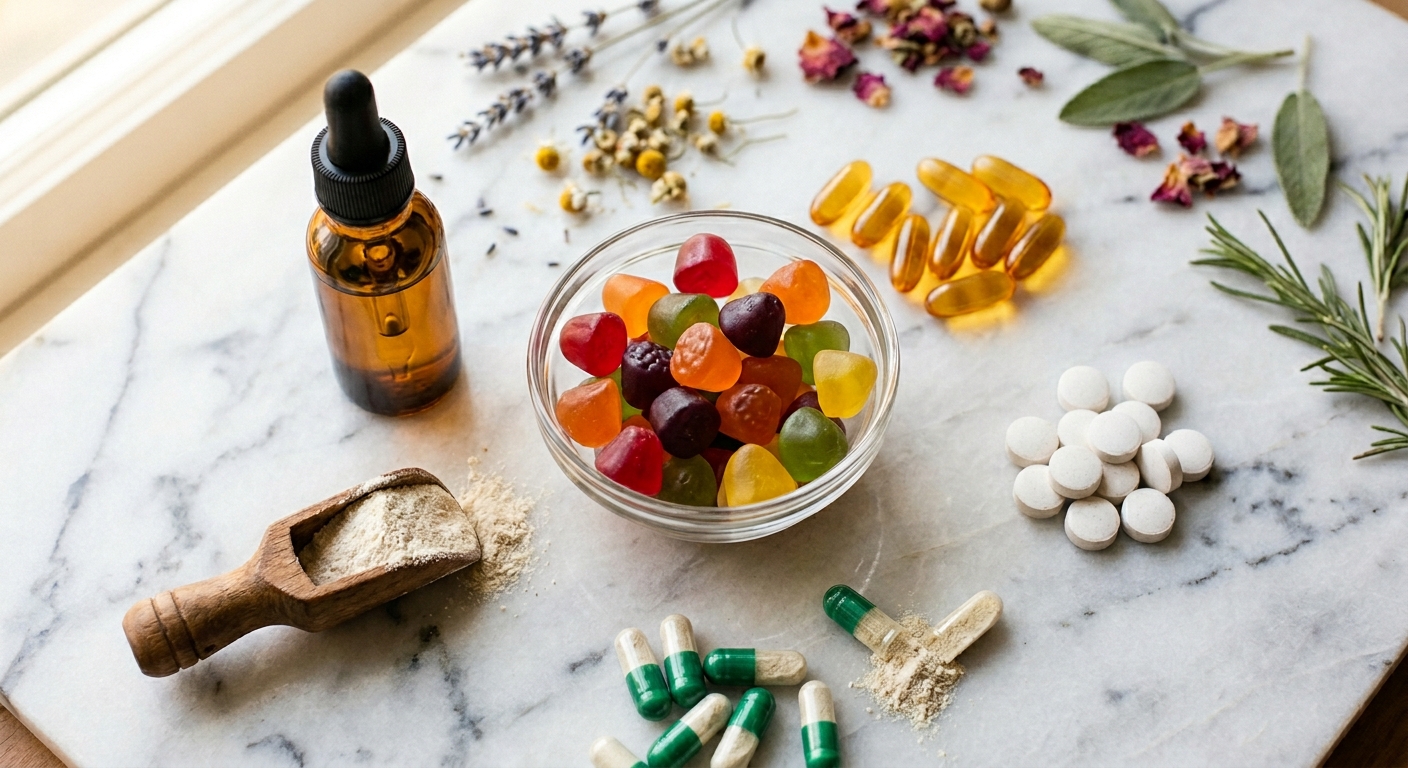
You've done the research. You've found the right supplement — the right nutrient, the right dose, the right brand. You're standing in the supplement aisle (or scrolling through Amazon), and you notice something: the same supplement comes in six different formats. Capsules. Tablets. Softgels. Powder. Liquid. Gummies. Lozenges. Chewables.
Same ingredient. Wildly different prices. Confusingly different doses. And nobody has explained which one you should actually buy.
Here's the thing the supplement industry doesn't make obvious: the delivery method isn't just packaging — it's pharmacology. The format determines how quickly the nutrient reaches your bloodstream, how much of it survives the journey through your digestive system, how stable it remains on the shelf, and what else you're swallowing alongside it (binders, fillers, sugars, coatings, flow agents, and sometimes things you'd rather not think about).
A magnesium supplement in tablet form might deliver 15% of its stated dose. The same magnesium in powder dissolved in water might deliver 40%. A probiotic in a standard capsule might arrive in your gut 90% dead. The same probiotic in an enteric-coated capsule might arrive 90% alive.
Same supplement. Same dose on the label. Dramatically different outcomes.
This guide will walk you through every major delivery format — what it's good for, what it's bad for, and which supplements work best in each — followed by a master comparison table covering 40+ of the most popular supplements and their optimal delivery method.
Part I: A Brief History of Putting Medicine Into Things
3,500 Years of Making Pills Swallowable

The problem of delivering a therapeutic substance into a human body is as old as medicine itself. The history of supplement delivery is really the history of pharmaceutical manufacturing — and it's far more interesting than you'd expect.
The Ancient World: Honey, Bread, and Wine
Egypt (~1500 BCE) — The Ebers Papyrus, one of the oldest medical documents in existence, describes medicines mixed into bread dough, honey pills, and wine-based tinctures. Egyptian physicians understood intuitively what modern pharmacology confirms: a bitter drug goes down easier when wrapped in something palatable, and a medicine dissolved in wine absorbs faster than one chewed raw.
Honey was the original capsule — antimicrobial, shelf-stable, and sweet enough to mask the taste of nearly anything. Some Egyptian pill formulations prescribed specific pill sizes rolled by hand, making them arguably the first "dosage forms."
Greece and Rome (400 BCE - 200 CE) — Hippocrates prescribed powdered herbs mixed into wine, honey, or vinegar. Galen of Pergamon (129-216 CE) systematized pharmaceutical preparation, creating standardized pastilles (lozenges), pills rolled from plant extracts and wax, and katapotia — small pills designed to be swallowed whole without chewing. Galen's pharmaceutical system dominated Western medicine for 1,300 years.
Traditional Chinese Medicine (200 BCE onward) — Chinese physicians developed wan (pills made from herbal powders bound with honey or rice paste), san (fine powders taken with warm water), tang (decoctions — herbs boiled in water), and gao (pastes and plasters for topical application). The sophistication of TCM dosage forms was remarkable — practitioners selected delivery methods based on the speed of action needed and the target organ.
Ayurveda (1000 BCE onward) — Indian physicians created vati (tablets), churna (fine powders mixed with ghee or honey), asava/arishta (fermented herbal wines), kashaya (decoctions), and bhasma (calcined mineral preparations processed through elaborate purification rituals). The Ayurvedic system may be the most format-diverse traditional pharmacy in history.
The Islamic Golden Age and Medieval Europe
Rhazes (854-925 CE) — The Persian polymath is credited with inventing the sugar-coated pill — coating bitter medicines in a sugar shell for palatability. This innovation would take 900 years to reach industrial scale, but the concept was revolutionary.
Avicenna (980-1037 CE) — In The Canon of Medicine, Avicenna described silver- and gold-coated pills, establishing metal coating as a method for protecting medicines from stomach acid — an early precursor to enteric coating.
The Industrial Revolution: Machines Take Over
1833 — The first gelatin capsule is patented by French pharmacist François Achille Barnabé Mothes and apothecary Joseph Gérard Augustin Dublanc. The original design: a one-piece capsule made by dipping a leather-covered metal mold into liquid gelatin solution. It was a eureka moment — for the first time, an exact dose of medicine could be sealed inside a tasteless, swallowable shell.
1834 — Mothes receives a patent for two-piece gelatin capsules — the hard capsule design still used today. The fundamental design has changed almost nothing in 190 years.
1843 — The first tablet press is patented by William Brockedon, a British artist and inventor who wasn't even a pharmacist. Brockedon designed the machine to compress graphite for pencils and then realized it could compress powdered medicine into solid pills. His hand-operated punch-and-die press is the ancestor of every modern tablet machine.
1874 — Robert P. Scherer invents the rotary die process for manufacturing soft gelatin capsules (softgels), enabling mass production of liquid-filled capsules. This is the technology that makes modern fish oil capsules and vitamin E softgels possible.
1897 — The concept of the enteric coating is refined by German chemist Heinrich Dreser (the same chemist who developed aspirin for Bayer). Enteric coatings resist stomach acid and dissolve only in the alkaline environment of the small intestine, protecting acid-sensitive ingredients and reducing stomach irritation.
The 20th Century: Everything Gets Faster
1931 — The first commercial vitamin tablet is produced — a compressed B-complex vitamin. Tablets rapidly become the dominant supplement format because they're cheap to manufacture, shelf-stable, and easy to dose.
1960s — Timed-release technology is developed, allowing a single tablet to release nutrients gradually over 8-12 hours rather than dumping everything at once. This is particularly valuable for water-soluble vitamins (B and C) that are quickly excreted.
1968 — The first commercial vegetarian capsule (made from hydroxypropyl methylcellulose, HPMC, instead of gelatin) is developed, though widespread adoption doesn't occur until the 1990s. Today, veggie caps have captured roughly 40% of the capsule market.
1990s — Gummy vitamins emerge as a mainstream format, initially for children. The format — gelatin or pectin candy with added vitamins — solves the palatability problem at the cost of nutritional completeness (gummies can't hold iron, calcium, or most minerals effectively).
2000s-Present — Innovation accelerates: liposomal delivery systems (wrapping nutrients in phospholipid bubbles for enhanced absorption), microencapsulation, nanoemulsions, effervescent tablets, sublingual strips, and even transdermal vitamin patches enter the market. The delivery method revolution is far from over.
Part II: Tablets
The Workhorse of the Supplement World
What they are: Powdered ingredients compressed under enormous pressure (several tons per square inch) into a solid, uniform shape using a tablet press. The resulting tablet is hard, dense, and holds its shape without a shell.
How they're made: The active ingredient is mixed with excipients — binders (hold it together), disintegrants (help it break apart in the stomach), lubricants (prevent sticking to the die), glidants (improve powder flow), and sometimes coatings (for taste, appearance, or controlled release). The blend is fed into a rotary tablet press that stamps out thousands of tablets per minute.
The Good
- Highest dose capacity — Tablets can hold more active ingredient per unit than any other format. If you need 1,000 mg of calcium or 500 mg of magnesium, tablets are often the only practical single-dose option.
- Cheapest to manufacture — Tablet presses are fast, efficient, and produce enormous volumes. This translates to lower consumer prices.
- Most shelf-stable — Low moisture content means long shelf life (2-3+ years) without refrigeration.
- Easy to score — Many tablets have a score line, allowing you to split the dose in half. Try that with a capsule.
- Enteric coating available — Tablets can be coated to survive stomach acid, ideal for probiotics, enzymes, and acid-sensitive nutrients.
- Time-release formulations — Matrix tablets and multi-layer designs can release nutrients over hours.
The Bad
- Hardest to digest — The compression that makes tablets durable also makes them resistant to breakdown. Some tablets pass through the GI tract substantially intact — "bedpan bullets" is the unglamorous term from hospital pharmacology. A poorly manufactured tablet can deliver as little as 10-20% of its stated dose.
- Requires strong stomach acid — People with low stomach acid (common in seniors, those on PPIs/antacids) may not dissolve tablets efficiently.
- Most excipients — Tablets require the most binders, lubricants, and flow agents of any format. Common additives include magnesium stearate (flow agent), stearic acid, silicon dioxide, microcrystalline cellulose, and various coating polymers. None of these are dangerous, but purists prefer fewer inactive ingredients.
- Difficult to swallow — Large supplement tablets (calcium, magnesium, multi-vitamins) can be genuinely hard to swallow, especially for seniors and children.
- Can cause GI irritation — Iron tablets, in particular, are notorious for causing nausea, constipation, and stomach pain because the entire dose hits one spot in the stomach lining.
Best For
Calcium, magnesium (large doses), multi-vitamins (when dose count matters), time-release B-complex, time-release vitamin C, enteric-coated supplements.
Worst For
Probiotics (unless enteric-coated), fat-soluble vitamins (A, D, E, K — better in softgels with fats), fish oil (better in softgels), any nutrient where rapid absorption matters.
Quality Test
Drop a tablet in a glass of warm water. A well-made tablet should begin to disintegrate within 30 minutes (USP standard). If it's still intact after an hour, your body isn't doing much better.
Part III: Capsules
The Clean, Quick-Dissolving Alternative
What they are: Two-piece hard shells (either gelatin or HPMC/vegetarian) filled with powdered or granulated ingredients. The shell dissolves in stomach fluid, releasing the contents.
Types:
- Gelatin capsules — Made from animal-derived gelatin (bovine or porcine). Dissolve quickly (5-10 minutes in stomach conditions). The original and still the most common.
- Vegetarian capsules (HPMC/veggie caps) — Made from hydroxypropyl methylcellulose, a plant-derived cellulose polymer. Dissolve slightly slower (10-15 minutes). Suitable for vegetarians, vegans, and those with religious dietary restrictions.
- Enteric-coated capsules — Either type with an additional acid-resistant coating. Dissolve only in the small intestine (pH > 5.5).
The Good
- Faster dissolution than tablets — No compression to fight; the shell dissolves and releases powder directly. Typical dissolution time: 5-15 minutes vs. 20-45 minutes for tablets.
- Fewer excipients — Capsules need far fewer binders and lubricants because the shell provides structure. The fill is often just the active ingredient plus a minimal flow agent.
- Can be opened — If you can't swallow pills, open the capsule and mix the powder into food or drink. This is a significant advantage for children (over age where appropriate), seniors, and anyone with dysphagia.
- Vegetarian/vegan options — HPMC capsules are widely available and functionally equivalent to gelatin.
- Better for sensitive stomachs — Faster release means less concentrated contact with the stomach lining compared to tablets.
- Good bioavailability — Studies comparing capsule vs. tablet delivery consistently show capsules releasing their contents more completely.
The Bad
- Lower dose capacity — Capsules hold less material than tablets of equivalent size. A standard "00" capsule holds about 735 mg of powder. For high-dose supplements (1,000 mg calcium, 500 mg magnesium), you need multiple capsules where one tablet might suffice.
- More expensive than tablets — Capsule manufacturing is slightly costlier, and the shells themselves add to the price.
- Moisture sensitive — Capsule shells absorb moisture, which can soften them or cause sticking. Store in dry conditions with lid tightly sealed.
- Not suitable for liquids — Hard capsules are for powders only. Liquid ingredients need softgels.
- Can stick in throat — The smooth gelatin surface can adhere to a dry esophagus. Always take with a full glass of water.
Best For
Herbal extracts, probiotics (especially enteric-coated), mineral supplements, B-complex, CoQ10, most single-nutrient supplements.
Worst For
Very high-dose minerals (need too many capsules), oils and fat-soluble vitamins (softgels are better), any supplement needing time-release delivery.
Part IV: Softgels
The Fat-Soluble Vitamin's Best Friend
What they are: One-piece gelatin shells filled with a liquid or oil-based ingredient. Made by the rotary die process — two continuous sheets of warm gelatin are pressed together around a measured dose of fill material, forming a sealed, hermetic capsule.
How they differ from hard capsules: Softgels contain liquid fills (oils, dissolved nutrients, suspensions), while hard capsules contain powders. Softgels are seamless and hermetically sealed; hard capsules have a visible seam where the two halves meet.
The Good
- Superior for fat-soluble nutrients — Vitamins A, D, E, and K, fish oil, CoQ10, and other lipophilic compounds are already dissolved in oil inside the softgel. This means they don't need to be dissolved by your digestive system — a significant absorption advantage.
- Best bioavailability for oils — Fish oil in a softgel delivers significantly more EPA/DHA to the bloodstream than fish oil powder in a tablet.
- Hermetically sealed — The one-piece shell protects the fill from oxygen, moisture, and light — the three enemies of oil-based supplements. This is why fish oil softgels don't go rancid as quickly as liquid fish oil after opening.
- Easy to swallow — The smooth, oval shape and flexible shell slide down more easily than hard tablets.
- No taste — The sealed shell completely masks the taste and smell of the fill. This is why fish oil is tolerable in softgels but deeply unpleasant in liquid form for many people.
- Precise dosing — Each softgel contains an exact liquid dose, more precise than measuring liquid from a dropper.
The Bad
- Not vegetarian/vegan — Traditional softgels are made from animal gelatin. Vegetarian softgels (using carrageenan or modified starch) exist but are less common and more expensive.
- Heat sensitive — Softgels can melt, stick together, or leak in high temperatures. Don't leave them in your car or near heat sources.
- Can't be split or opened easily — Unlike hard capsules, softgels aren't designed to be opened and mixed with food.
- Limited to oil-soluble fills — Water-soluble nutrients (vitamin C, B vitamins, minerals) generally can't be delivered in softgels unless dissolved in an oil carrier.
- Larger than equivalent tablets — The liquid fill plus shell makes softgels bulkier.
- Higher cost — Rotary die manufacturing is more complex and slower than tablet pressing.
Best For
Fish oil/omega-3s, vitamin D3, vitamin E, vitamin A, CoQ10 (ubiquinol), curcumin (lipid-based), vitamin K2, evening primrose oil, astaxanthin, lutein — essentially any oil-based or fat-soluble supplement.
Worst For
Water-soluble vitamins (B-complex, vitamin C), minerals (calcium, magnesium, iron, zinc), probiotics, amino acids, fiber supplements.
Part V: Liquids
Maximum Absorption, Maximum Inconvenience
What they are: Nutrients dissolved or suspended in a liquid base — typically water, glycerin, alcohol (tinctures), or oil. Delivered via dropper, measuring spoon, or pre-measured dose cups.
The Good
- Fastest absorption — No shell to dissolve, no tablet to disintegrate. Liquid supplements begin absorbing as soon as they hit mucous membranes in the mouth and stomach. For sublingual (under the tongue) liquids, absorption can begin within seconds, bypassing the digestive system entirely.
- Highest bioavailability — Studies consistently show liquid supplements achieving higher peak blood levels faster than equivalent tablet or capsule doses. For vitamin B12, sublingual liquid delivers comparable blood levels to injections in some studies. (PMID: 16918875)
- Adjustable dosing — The only format where you can easily adjust the dose up or down. Give a child half a dropper, an adult a full dropper. Try doing that with a tablet.
- No swallowing pills — Critical advantage for children, seniors with dysphagia, post-surgical patients, and anyone who simply hates pills.
- Can combine with food/drinks — Mix into smoothies, juice, water, or food. This makes compliance much easier, especially for children.
- Fewer fillers — Liquid supplements don't need binders, lubricants, flow agents, or coating polymers. The ingredient list is typically shorter and cleaner.
The Bad
- Shortest shelf life — Once opened, most liquid supplements must be refrigerated and used within 30-90 days. Water-based liquids are particularly vulnerable to microbial growth.
- Taste — There's no shell hiding the flavor. Some liquid supplements taste fine (berry-flavored multivitamins). Others are challenging (liquid iron tastes metallic, liquid fish oil is an acquired taste, herbal tinctures can be intensely bitter).
- Stability issues — Some nutrients degrade faster in liquid form. Vitamin C in solution oxidizes more rapidly than ascorbic acid powder. Probiotics in liquid must be very carefully stabilized.
- Portability and mess — Bottles can leak, droppers can drip, measuring spoons need washing. Traveling with liquid supplements is less convenient than tossing a bottle of capsules in your bag.
- Alcohol content — Many herbal tinctures use alcohol as a solvent and preservative. This is a concern for children, those avoiding alcohol for religious or health reasons, and those in recovery. Glycerin-based (glycerite) alternatives exist but have shorter shelf lives.
- Cost per dose — Often more expensive than tablets or capsules on a per-serving basis.
- Staining — Liquid iron, liquid chlorophyll, and some herbal tinctures can stain teeth, clothing, and countertops.
Best For
Children's supplements (especially MaryRuth Organics liquid multis), B12 (sublingual), iron (for those who tolerate it — gentle bisglycinate forms), herbal extracts and tinctures, senior supplements (swallowing difficulty), probiotics (some strains), vitamin D drops (for infants/children), melatonin (sublingual for faster onset), homeopathic remedies (liquid dilutions).
Worst For
Calcium (chalky suspension; large dose volumes), fiber supplements (too viscous), most high-dose minerals (metallic taste), any supplement where taste is unbearable without masking, situations requiring portability.
A Note on Liposomal Liquids
A newer category worth mentioning: liposomal supplements wrap the active nutrient inside tiny phospholipid bubbles (liposomes) that protect it through digestion and facilitate direct cellular absorption. Liposomal vitamin C, for example, achieves blood levels significantly higher than standard oral vitamin C — approaching intravenous levels in some studies. (PMID: 27419684)
Liposomal delivery is expensive and currently limited to a few nutrients (vitamin C, glutathione, curcumin, B12), but it represents the cutting edge of oral supplement bioavailability.
Part VI: Powders
The Underrated Powerhouse
What they are: Loose or finely milled supplement ingredients, typically measured with a scoop and mixed into water, juice, smoothies, or food. No shell, no compression, no coating — just the ingredient (plus sometimes flavoring, sweetener, or a flow agent).
The Good
- Highest dose flexibility — Need 200 mg of magnesium today and 400 mg tomorrow? Adjust the scoop. No other format offers this level of dose control.
- Best for high-dose supplements — When you need grams rather than milligrams (vitamin C, collagen, creatine, protein, fiber, electrolytes), powder is the only practical format. Taking 5,000 mg of vitamin C in tablets means swallowing 5-10 pills. In powder, it's one scoop.
- Excellent absorption — Already in dissolved/dispersed form when it hits the stomach, so dissolution time is essentially zero.
- Most economical — No shells, no compression, no coatings = lowest manufacturing cost. Powder supplements are typically the cheapest format per dose.
- Minimal fillers — Often just the active ingredient plus a flow agent (like silicon dioxide). Clean-label products can be literally single-ingredient.
- Mixable — Add to smoothies, protein shakes, oatmeal, yogurt, baking, or plain water. Versatile integration into daily routine.
The Bad
- Requires measuring — Scoops are imprecise. For nutrients where exact dosing matters (vitamin D, selenium, iodine), the variability of scooping is a real problem. This is why you don't see vitamin D or selenium powders — the doses are in micrograms, far too small for a scoop.
- Taste and texture — Some powders dissolve cleanly (vitamin C, electrolytes). Others are gritty, chalky, or foul-tasting (greens powders, some minerals, unflavored collagen).
- Inconvenient — You need a glass, liquid, and a spoon or shaker bottle. Not something you can take at your desk without attracting attention.
- Moisture vulnerability — Powder clumps and degrades when exposed to humidity. Desiccant packets and tight seals are essential.
- Not portable — Traveling with a tub of powder and a measuring scoop is impractical. Some brands offer single-serve packets, which helps.
- Not for microdose nutrients — Vitamins and minerals needed in microgram quantities (D, K2, B12, selenium, iodine, chromium) are too small to measure accurately with a scoop.
Best For
Vitamin C (high-dose), magnesium (glycinate or citrate powder), collagen peptides, protein supplements, creatine, greens powders, electrolytes, fiber (psyllium, acacia), adaptogens that need larger doses (ashwagandha, maca), prebiotics (inulin), amino acids (L-glutamine, glycine).
Worst For
Fat-soluble vitamins (A, D, E, K — don't dissolve in water), fish oil (goes rancid quickly as exposed powder), probiotics (exposure kills them), any micronutrient dosed in micrograms, any situation requiring precise, consistent dosing.
Part VII: Gummies
The Delicious Compromise
What they are: Chewy, candy-like supplements made from a gelling base (gelatin or pectin), sweeteners, flavors, colors, and added vitamins or minerals. They're essentially candy with vitamins mixed in.
Let's be honest about what gummies are: they are the supplement industry's answer to the question, "How do we get people who won't swallow pills to take their vitamins?" The answer was: make them candy. And it worked spectacularly — gummies are the fastest-growing supplement format, with sales growing 25%+ annually.
But this success comes with real trade-offs.
The Good
- Compliance king — People actually take them. This is gummies' killer advantage. The best supplement in the world does nothing if it stays in the bottle. Gummies taste good, feel like a treat, and create a positive daily habit. For children especially, this is transformative.
- No swallowing pills — Obvious but important for a large segment of the population.
- Pleasant experience — Taking your vitamins doesn't feel like a medical act. Some people genuinely look forward to their daily gummy.
- Good for some vitamins — Vitamins C, D, B12, and a few others survive the gummy manufacturing process well and deliver effective doses.
The Bad
- Can't hold minerals — This is gummies' fatal flaw. Iron, calcium, magnesium, and zinc don't work well in gummy formulations — they create metallic tastes, grainy textures, and color changes. Most gummy multivitamins contain zero iron and minimal calcium. If you're relying on a gummy multi as your sole supplement, you're almost certainly missing key minerals.
- Sugar content — Most gummies contain 2-4 grams of sugar per serving (some as high as 8g). Multiply by daily servings and you're eating candy bars worth of sugar monthly in "vitamins." Sugar-free gummies exist but use sugar alcohols (which cause GI distress in many people) or alternative sweeteners.
- Lower nutrient doses — The gummy matrix takes up most of the volume, leaving limited room for active ingredients. A typical gummy multivitamin delivers 30-60% of the nutrients found in an equivalent tablet or capsule product.
- Shorter shelf life — Gummies absorb moisture, stick together, and degrade faster than tablets or capsules. Typical shelf life: 12-18 months (vs. 2-3 years for tablets).
- More inactive ingredients — Gummies require: gelling agent (gelatin or pectin), sweetener (sugar, tapioca syrup, or alternatives), citric acid, natural or artificial flavors, natural or artificial colors, coating agents (like carnauba wax to prevent sticking). The inactive ingredient list is always longer than the active one.
- Dental concerns — Sticky, sweet, and often taken before bed. Gummies adhere to tooth surfaces and can promote cavities, especially in children.
- Dosing inconsistency — Studies have found more batch-to-batch variability in gummy supplements compared to tablets and capsules. Vitamins can degrade during the heating process used to make gummies, and the distribution of nutrients through the gummy matrix may not be perfectly uniform.
- Overuse risk — Because they taste like candy, children (and some adults) may eat more than the recommended dose. Vitamin A and iron gummies pose particular overdose risks in children, which is one reason most gummy formulas exclude them.
Best For
Children's vitamins (when liquid isn't accepted), vitamin C, vitamin D, B12, elderberry, apple cider vinegar, melatonin, biotin — basically, supplements where the dose is small enough to fit and the nutrient survives the manufacturing process.
Worst For
Multivitamins (can't deliver a complete formula), iron, calcium, magnesium, zinc, probiotics, fish oil (fish-oil gummies exist but deliver far less EPA/DHA than softgels), any supplement where a full clinical dose is needed.
Part VIII: Other Delivery Formats
The Supporting Cast
Beyond the big five, several specialized formats deserve mention:
Chewable Tablets
A hybrid between tablets and gummies — compressed tablets designed to be chewed rather than swallowed. They hold minerals better than gummies (you can get iron and calcium in chewables) but taste worse than gummies. Common for children's vitamins and antacids. Garden of Life Vitamin Code Kids uses this format effectively.
Lozenges and Sublingual Tablets
Designed to dissolve slowly in the mouth, delivering nutrients through the oral mucosa directly into the bloodstream. Bypasses the digestive system entirely — no stomach acid degradation, no first-pass liver metabolism.
Best for: Vitamin B12 (sublingual B12 is one of the most effective delivery methods), zinc lozenges (for colds — direct contact with throat tissue is part of the mechanism), melatonin (faster onset than swallowed tablets).
Effervescent Tablets
Drop-in-water tablets that fizz and dissolve, creating a flavored drink. The effervescence (from citric acid + sodium bicarbonate reaction) aids dissolution and can enhance mineral absorption.
Best for: Vitamin C, electrolytes, magnesium. Popular in Europe (Berocca, Airborne). Drawback: Often high in sodium. Not ideal for people on sodium-restricted diets.
Sprays (Oral/Sublingual)
Fine-mist sprays delivered into the mouth. Ultra-fast absorption through oral mucosa. Convenient and portable.
Best for: B12, vitamin D, melatonin. Drawback: Small doses only; expensive per serving.
Topical / Transdermal
Creams, oils, and patches that deliver nutrients through the skin. Bypasses the digestive system entirely.
Best for: Magnesium (topical magnesium chloride/Epsom salt), vitamin D (some evidence for transdermal delivery), certain CBD products. Drawback: Absorption through skin is variable and generally lower than oral routes for most nutrients. Transdermal vitamin patches are marketed aggressively but lack strong clinical evidence for most nutrients.
Injectables
Intramuscular or intravenous delivery. The gold standard for bioavailability (100% by definition for IV).
Best for: Severe B12 deficiency, iron deficiency (IV iron infusions), glutathione, high-dose vitamin C therapy. Obviously: Requires medical supervision. Not a daily supplement format.
Part IX: The Master Delivery Method Comparison
Format vs. Format: Head-to-Head
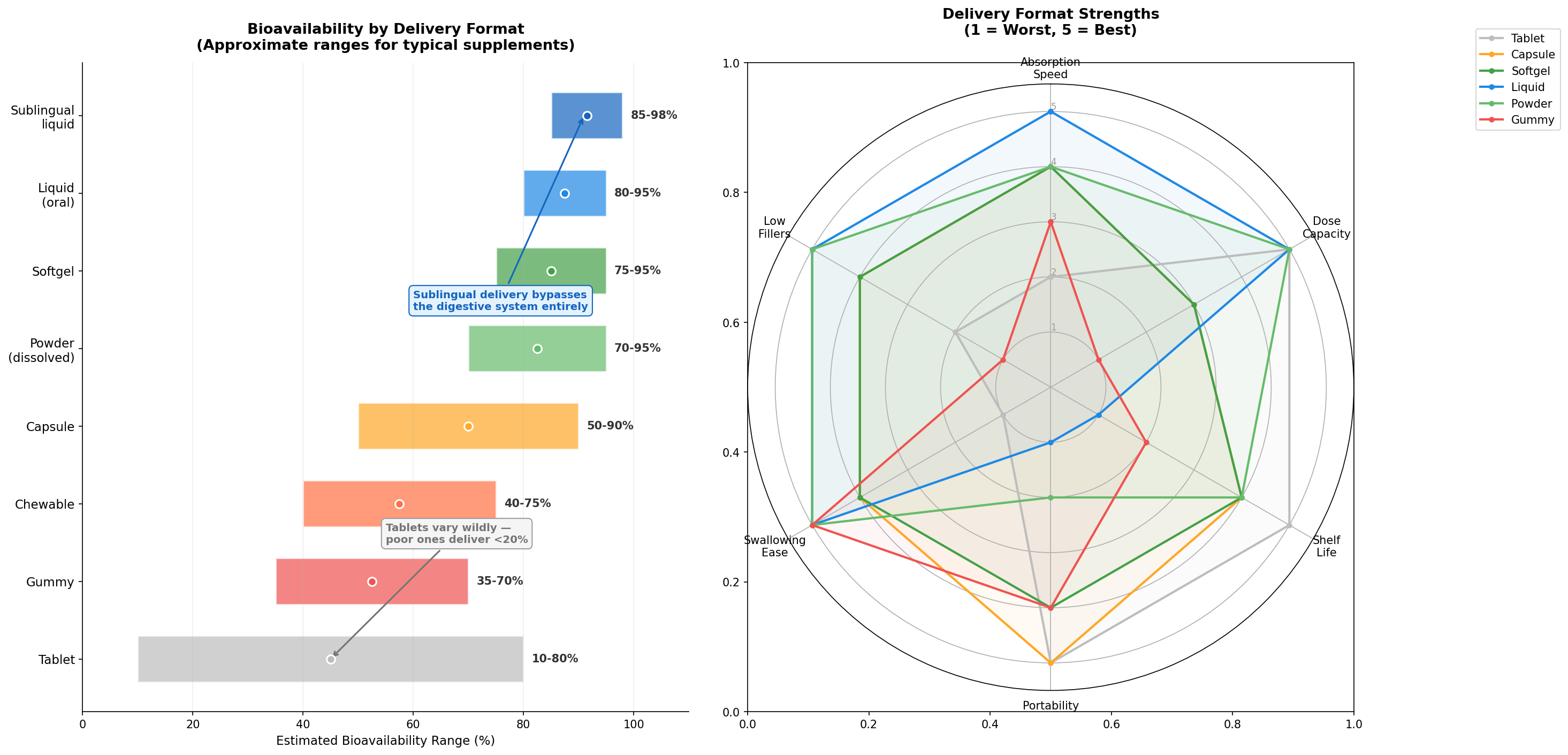
| Factor | Tablet | Capsule | Softgel | Liquid | Powder | Gummy |
|---|---|---|---|---|---|---|
| Absorption speed | Slowest | Moderate | Fast | Fastest | Fast | Moderate |
| Bioavailability | Variable (10-80%) | Good (50-90%) | Excellent for fats (80%+) | Highest (80-98%) | Very good (70-95%) | Variable (40-70%) |
| Dose capacity | Highest | Moderate | Moderate | Unlimited | Highest | Lowest |
| Shelf life | Longest (2-3 yr) | Good (2-3 yr) | Good (2 yr) | Shortest (30-90 days open) | Good if dry (2 yr) | Short (1-1.5 yr) |
| Excipients needed | Most | Few | Few | Fewest | Fewest | Most |
| Swallowing ease | Hardest | Easy | Easy | None required | None required | None required |
| Portability | Excellent | Excellent | Good | Poor | Poor | Good |
| Taste masking | Good (coated) | Excellent | Excellent | Poor | Variable | Excellent |
| Mineral delivery | Yes | Yes | No (oils only) | Yes | Yes | Poor |
| Fat-soluble delivery | Poor | Poor | Excellent | Good (oil-based) | Poor | Moderate |
| Cost per dose | Lowest | Moderate | Higher | Higher | Lowest | Higher |
| Kid-friendly | No | No | No | Yes (flavored) | Smoothie-mixable | Yes |
| Senior-friendly | Often too large | Good | Good | Excellent | Good | Fair (dental concerns) |
Part X: The Master Supplement Table
Every Popular Supplement and Its Optimal Delivery Method
This is the table you came here for. For each of the most popular supplements, here's the optimal delivery method, an acceptable alternative, what to avoid, and specific storage guidance.

Vitamins
| Supplement | Optimal Format | Good Alternative | Avoid | Why | Storage |
|---|---|---|---|---|---|
| Multivitamin | Capsule or tablet | Liquid | Gummy (incomplete) | Gummies can't hold full mineral profile | Cool, dry, sealed; liquid: refrigerate |
| Vitamin A | Softgel | Capsule (with oil) | Tablet, gummy | Fat-soluble; needs lipid carrier for absorption | Cool, dark; away from heat |
| Vitamin B-Complex | Capsule | Sublingual liquid | — | Water-soluble; dissolves easily from capsules | Cool, dry cabinet |
| Vitamin B12 | Sublingual liquid/lozenge | Capsule (methylcobalamin) | Tablet (cyanocobalamin) | Sublingual bypasses GI absorption issues; methyl form is body-ready | Room temperature; liquid: refrigerate after opening |
| Vitamin C | Powder | Capsule, liposomal liquid | — | High doses impractical in pills; powder dissolves instantly; liposomal reaches highest blood levels | Sealed airtight; powder oxidizes with moisture |
| Vitamin D3 | Softgel | Liquid drops, spray | Tablet | Fat-soluble; softgel provides oil carrier; drops ideal for infants/children | Room temperature; stable |
| Vitamin E | Softgel | — | Tablet, gummy | Fat-soluble; must be in oil; synthetic (dl-) form is half as effective | Cool, dark; oil goes rancid with heat |
| Vitamin K2 (MK-7) | Softgel | Capsule (with oil/fat) | Tablet | Fat-soluble; needs lipid co-ingestion | Cool, dark |
| Folate | Capsule (as 5-MTHF) | Sublingual | Tablet (folic acid) | Methylfolate is the bioactive form; capsule dissolves quickly | Cool, dry |
Minerals
| Supplement | Optimal Format | Good Alternative | Avoid | Why | Storage |
|---|---|---|---|---|---|
| Calcium | Tablet (citrate) | Powder (citrate) | Gummy, carbonate tablets | Citrate absorbs without stomach acid; high dose needs tablet/powder volume; split doses (≤500mg) | Cool, dry |
| Magnesium | Powder (glycinate/citrate) | Capsule | Tablet (oxide) | Powder allows dose adjustment; glycinate absorbs at 80% vs 4% for oxide | Sealed airtight; clumps with moisture |
| Iron | Capsule (bisglycinate) | Liquid (gentle form) | Tablet (sulfate), gummy | Bisglycinate minimizes GI distress; liquid for those who can't swallow pills; sulfate causes nausea/constipation | Cool, dry; liquid: refrigerate |
| Zinc | Capsule (bisglycinate/picolinate) | Lozenge (for colds) | Tablet (oxide) | Chelated forms absorb 3-4× better than oxide; lozenges provide direct throat contact for cold relief | Cool, dry |
| Selenium | Capsule | — | Gummy | Microgram dosing too precise for gummies or powder scoops | Cool, dry |
| Iodine | Capsule (from kelp) | Liquid drops | Tablet | Kelp provides organic iodine; drops allow precise mcg dosing | Cool, dry; drops: dark bottle |
| Chromium | Capsule (picolinate) | — | — | Microgram dosing; picolinate is the most-studied form | Cool, dry |
Fats and Oils
| Supplement | Optimal Format | Good Alternative | Avoid | Why | Storage |
|---|---|---|---|---|---|
| Fish Oil / Omega-3 | Softgel (triglyceride form) | Liquid (if tolerated) | Gummy (low dose), tablet | Softgel hermetically seals oil from oxidation; triglyceride form absorbs better than ethyl ester | Refrigerate for freshness; softgels: cool dark place |
| Algal Oil (Vegan Omega-3) | Softgel (vegan) | Liquid | Gummy | Same as fish oil — oil needs sealed delivery | Refrigerate |
| Evening Primrose Oil | Softgel | — | — | GLA is an oil; needs sealed lipid delivery | Cool, dark |
| Flaxseed Oil | Softgel | Liquid (refrigerated) | — | Highly oxidation-prone; softgel protects from air | Refrigerate always |
| MCT Oil | Liquid | Softgel, powder | — | Typically used in larger doses (tbsp); liquid is practical | Room temperature; stable |
| Coconut Oil | Softgel | Liquid (culinary use) | — | Softgel for supplement dosing; liquid for cooking | Room temperature |
Herbal Supplements
| Supplement | Optimal Format | Good Alternative | Avoid | Why | Storage |
|---|---|---|---|---|---|
| Turmeric / Curcumin | Softgel (lipid-based) or capsule (with piperine) | Liposomal liquid | Tablet, gummy | Curcumin is fat-soluble and poorly absorbed alone; lipid delivery or piperine increases bioavailability 2,000% | Cool, dry, dark |
| Ashwagandha | Capsule | Powder | Gummy | Standard doses (300-600mg) fit capsules well; powder for smoothies | Cool, dry |
| Elderberry | Liquid (syrup) | Gummy, capsule | — | Traditional syrup form; pleasant tasting; adjustable dosing | Refrigerate after opening |
| Echinacea | Liquid tincture | Capsule | Tablet | Tincture provides rapid onset; traditional delivery method | Cool, dark; alcohol-based: shelf-stable |
| Milk Thistle | Capsule (standardized extract) | — | — | Silymarin concentrate needs precise dosing | Cool, dry |
| Saw Palmetto | Softgel | Capsule | Tablet | Fat-soluble extract; oil-based softgel is ideal | Cool, dry |
| Valerian | Capsule | Liquid tincture | Tablet | Capsule masks the notoriously foul smell; tincture for rapid effect | Cool, dry, sealed tightly |
| Ginger | Capsule | Liquid, powder (culinary) | — | Capsule for standardized dose; powder for tea/cooking | Cool, dry |
| Berberine | Capsule | — | Tablet, gummy | Needs precise dosing (500mg); capsule dissolves well; see our berberine guide | Cool, dry |
| Gaia Herbs products | Liquid phytocaps | Liquid extract | — | Gaia's signature Liquid Phytocap format delivers concentrated herbal extract in a liquid-filled capsule — combining the bioavailability of liquid with the convenience of a capsule | Cool, dry |
Probiotics
| Supplement | Optimal Format | Good Alternative | Avoid | Why | Storage |
|---|---|---|---|---|---|
| Probiotics (general) | Enteric-coated capsule | Powder (for food mixing) | Tablet, gummy | Enteric coating protects live bacteria from stomach acid — the #1 cause of probiotic die-off; without it, 60-90% of organisms die before reaching the intestine | Refrigerate (unless shelf-stable strain); sealed |
| Probiotics (children) | Powder (mix in food) | Liquid, chewable | Gummy | Powder mixes into yogurt/applesauce invisibly; adjustable dose | Refrigerate |
| Prebiotics (fiber) | Powder | Capsule | Gummy | Effective doses (3-5g) are too large for capsules in reasonable numbers; powder mixes into drinks | Cool, dry, sealed |
Amino Acids and Specialty
| Supplement | Optimal Format | Good Alternative | Avoid | Why | Storage |
|---|---|---|---|---|---|
| Collagen | Powder | Liquid | Capsule (too many), gummy | Effective doses (5-15g/day) are impractical in any other format; dissolves in coffee/tea | Cool, dry, sealed |
| L-Glutamine | Powder | Capsule | — | Clinical doses (5-10g) need powder format | Cool, dry |
| Creatine | Powder (monohydrate) | — | Liquid (unstable), capsule (too many) | 3-5g/day; powder dissolves in water; creatine degrades in liquid over time | Cool, dry; do not pre-dissolve |
| Glycine | Powder | Capsule | — | 3-5g doses; pleasant sweet taste makes powder easy | Cool, dry |
| CoQ10 (Ubiquinol) | Softgel | — | Tablet, capsule (powder form) | Fat-soluble; ubiquinol in oil-based softgel absorbs 3-8× better than ubiquinone powder in capsules | Cool, dark; heat degrades ubiquinol |
| Melatonin | Sublingual liquid/lozenge | Gummy (low dose) | Tablet | Sublingual bypasses digestion for faster sleep onset (10-15 min vs 45-60 min for tablets) | Cool, dry, dark |
| Glutathione | Liposomal liquid | Sublingual | Tablet, capsule | Standard oral glutathione is destroyed by stomach acid; liposomal delivery protects it; sublingual bypasses GI | Refrigerate liposomal; sublingual: cool, dry |
| NAC (N-Acetyl Cysteine) | Capsule | Powder | — | 600mg doses fit capsules well; powder has strong sulfur taste | Cool, dry |
| Quercetin | Capsule | Softgel (with lipid) | — | Better absorbed with fat; some formulations include lipid carriers | Cool, dry |
| Resveratrol | Capsule | Softgel | Liquid (unstable) | Light and oxygen sensitive; sealed capsule protects from degradation | Cool, dark, sealed; very light-sensitive |
Fiber
| Supplement | Optimal Format | Good Alternative | Avoid | Why | Storage |
|---|---|---|---|---|---|
| Psyllium Husk | Powder | Capsule (convenience) | — | Effective doses (5-10g) require powder; capsules for small maintenance doses | Cool, dry |
| Acacia Fiber | Powder | — | — | Dissolves completely in water; no grit; large doses need powder | Cool, dry |
| Inulin (Prebiotic) | Powder | — | — | 3-5g doses; dissolves in any beverage | Cool, dry |
Part XI: Storage Guide by Format
How to Keep Your Supplements Effective
You've spent the money. You've chosen the right format. Don't let improper storage undo everything.
The Universal Enemies
All supplements degrade faster when exposed to:
- Heat — Accelerates chemical breakdown; every 10°C increase roughly doubles degradation rate
- Moisture — Causes clumping, mold growth, and chemical reactions; capsule shells absorb water and soften
- Light — UV radiation breaks down many vitamins, especially B2 (riboflavin), B6, B12, vitamin A, vitamin C, and omega-3 fatty acids
- Oxygen — Oxidizes fats (fish oil, vitamin E, CoQ10) and degrades vitamin C
Format-Specific Storage Rules
| Format | Ideal Location | Temperature | Refrigerate? | Desiccant? | Special Notes |
|---|---|---|---|---|---|
| Tablets | Cool, dry cabinet | 59-77°F (15-25°C) | No | Leave in bottle | Most stable format; bathroom cabinet is worst place (humidity) |
| Capsules | Cool, dry cabinet | 59-77°F (15-25°C) | No (can attract moisture) | Leave in bottle | Don't transfer to pill organizers weeks in advance |
| Softgels | Cool, dark place | 59-77°F (15-25°C) | Optional for fish oil | N/A | Keep away from heat; can melt and stick together above 85°F |
| Liquids | Refrigerator (after opening) | 36-46°F (2-8°C) opened | Yes — always after opening | N/A | Use within 30-90 days of opening; alcohol-based tinctures are shelf-stable |
| Powders | Cool, dry cabinet | 59-77°F (15-25°C) | No | Leave in container | Seal tightly after every use; moisture causes clumping and degradation |
| Gummies | Cool, dry place | 59-77°F (15-25°C) | Optional (prevents sticking) | Leave in bottle | Most temperature-sensitive format; melt above 80°F; stick together in humidity |
| Probiotics | Refrigerator | 36-46°F (2-8°C) | Yes (unless shelf-stable) | N/A | Heat kills live cultures; some strains are shelf-stable (check label) |
The Pill Organizer Warning
Weekly pill organizers are convenient, but they expose supplements to air, light, and humidity every time you open a compartment. For most tablets, this is fine for a week's supply. But don't pre-fill a month's worth — especially for:
- Fish oil softgels (oxidize)
- Probiotics (die without refrigeration)
- Vitamin C (oxidizes in air)
- B-vitamins (light-sensitive)
Travel Tips
- Tablets and capsules — Most travel-friendly. Use a small pill case for a week's supply.
- Softgels — Avoid checked luggage in summer (cargo holds can exceed 100°F). Keep in carry-on.
- Liquids — TSA allows supplements in carry-on; keep under 3.4 oz or pack in checked luggage. Cold-chain supplements need an insulated bag with ice packs.
- Powders — Single-serve packets are ideal for travel. TSA may inspect bulk powder containers.
- Gummies — Melt in heat. Keep in carry-on, not checked bags.
The Bottom Line
The delivery method is the last mile of supplementation — the bridge between the nutrient and your bloodstream. Getting it wrong can mean the difference between a supplement that transforms your health and one that passes through you unchanged.
Here are the rules of thumb:
-
Fat-soluble nutrients (A, D, E, K, CoQ10, curcumin, omega-3s) → softgel or oil-based liquid. These need a lipid carrier to absorb. A dry tablet of vitamin D is pharmacological malpractice.
-
High-dose supplements (vitamin C, magnesium, collagen, creatine, fiber) → powder. When you need grams, not milligrams, powder is the only practical option.
-
Precise-dose, water-soluble supplements (B-complex, folate, NAC, herbal extracts) → capsule. Clean, quick-dissolving, minimal fillers, exact dose.
-
Probiotics → enteric-coated capsule. Without acid protection, most of your expensive probiotics die in your stomach.
-
Children and seniors → liquid. Adjustable dosing, no swallowing difficulty, fastest absorption, complete mineral profiles that gummies can't match.
-
Sublingual nutrients (B12, melatonin, glutathione) → sublingual liquid, lozenge, or spray. Bypassing the digestive system isn't just convenient — for these specific nutrients, it's measurably more effective.
-
Gummies are a last resort, not a first choice. They solve the compliance problem beautifully, but at the cost of incomplete nutrition, added sugar, and shorter shelf life. If gummies are the only way you'll take your vitamins, they're infinitely better than nothing — but if you can tolerate any other format, you'll get more for your money.
Your body doesn't care about marketing. It cares about what actually makes it through your gut wall and into your bloodstream. Choose the format that gets the job done.
Key References
- Ansel HC, et al. Pharmaceutical Dosage Forms and Drug Delivery Systems. 11th ed. Wolters Kluwer; 2017.
- Augsburger LL, Hoag SW. Pharmaceutical Dosage Forms: Tablets. 3rd ed. CRC Press; 2008.
- Jones D. Pharmaceutical Capsules. 2nd ed. Pharmaceutical Press; 2004.
- Sharif A, et al. Evolution of oral solid dosage forms: from ancient to modern pharmaceutical innovations. Int J Pharm. 2023;635:122756.
- Carrier J, et al. Bioavailability of micronutrient supplements in different oral dosage forms. Nutrients. 2022;14(6):1278.
- Davis JL, et al. Liposomal-encapsulated ascorbic acid: influence on vitamin C bioavailability and capacity to protect against ischemia-reperfusion injury. Nutr Metab Insights. 2016;9:25-30. PMID: 27419684
- Sharabi A, et al. Oral vitamin B12 supplementation compared with intramuscular injection. Clin Ther. 2003;25(12):3124-34. PMID: 14749150
- Kuzminski AM, et al. Effective treatment of cobalamin deficiency with oral cobalamin. Blood. 1998;92(4):1191-8. PMID: 9694707
- Thakkar R, et al. The evolution of pharmaceutical dosage forms: a historical perspective. J Pharm Innov. 2021;16:545-57.
- Blancquaert L, et al. Predicting and testing bioavailability of magnesium supplements. Nutrients. 2019;11(7):1663. PMID: 30587329
- USP General Chapter ⟨2040⟩ — Disintegration and Dissolution of Dietary Supplements.
- Mishra A, et al. Gummy bear vitamins: market growth, consumer preferences, and formulation challenges. J Food Sci Technol. 2023;60(3):741-55.
This article is for educational purposes. It does not constitute medical advice. Supplement needs vary by individual — consult a qualified healthcare provider before starting any new supplement regimen.