The Orchard Whisperer
A Complete Holistic Guide to Growing Apple Trees Without Synthetic Anything
There is probably an apple tree somewhere in your life. Maybe it's a gnarled old thing in the backyard of a house you just bought — half-dead looking, bark peeling, branches going every which way, dropping wormy fruit onto the lawn every September. Maybe it's a whip you just stuck in the ground after watching one too many permaculture videos. Maybe it's a dream you haven't planted yet.
Whatever the case, you are almost certainly thinking about it wrong.
The modern apple-growing industry will tell you that producing decent fruit requires a calendar of chemical sprays that reads like a pharmaceutical formulary: captan, mancozeb, imidacloprid, carbaryl, chlorpyrifos — applied on a schedule so precise that commercial orchardists spray 12 to 25 times per season. They'll tell you that organic apple growing is impractical, that the codling moth always wins, that without synthetic fungicides your trees will succumb to scab by July. They'll sell you dwarf rootstock designed for industrial density, varieties bred for shelf life rather than flavor, and a dependency on inputs that would make a corn farmer blush.
They are not entirely wrong. Growing apples without synthetic chemicals is harder than growing tomatoes without them. The apple tree has enemies — a rogues' gallery of fungi, bacteria, and insects that have co-evolved with Malus for millions of years. But "harder" is not "impossible," and the chemical approach carries costs that nobody puts on the balance sheet: dead soil biology, poisoned pollinators, contaminated groundwater, and fruit that looks perfect but tastes like crunchy water.
The alternative is not wishful thinking. It's ecology. It's understanding that an apple tree is not a machine that converts fertilizer into fruit, but a living organism embedded in a web of relationships — with the fungi that extend its root system by a factor of a hundred, the bacteria that solubilize phosphorus from rock, the predatory wasps that parasitize codling moth larvae, the comfrey plants that mine potassium from the subsoil, the clover that fixes atmospheric nitrogen, and yes, even the deer that prune the lower branches.
The holistic approach to apple growing isn't about replacing a spray schedule with a prayer schedule. It's about building a system so biologically diverse and resilient that most problems solve themselves — and having a few targeted, non-toxic interventions for the problems that don't.
This guide covers all of it: the 10,000-year history of the apple tree, the biology you need to understand, the soil food web that makes everything else possible, the companion planting guild that replaces a shelf of chemicals, the pruning that most people get catastrophically wrong, the art of bringing an old neglected tree back from the brink, every major pest and disease and how to fight them without poison, the biodynamic approach (honestly evaluated), and the heritage varieties that taste so extraordinary you'll wonder why you ever ate a Red Delicious.
For the complete science of what the fruit itself does for your health — the polyphenols, the pectin, the cardiovascular data, the gut microbiome effects — see our apples complete guide. This article is about the tree. How to grow it. How to heal it. How to work with it instead of against it.
Let's start at the beginning — and the beginning is Kazakhstan.
Part I: Meet the Tree
Taxonomy and Family
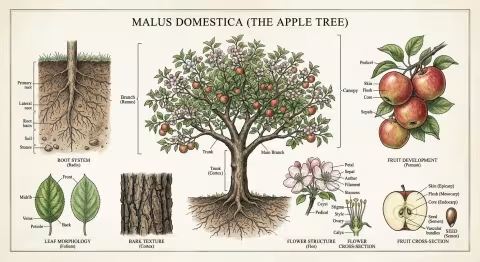
The cultivated apple is Malus domestica Borkh., a member of Rosaceae — the rose family, one of the most economically important plant families on Earth. Rosaceae also includes pears, cherries, plums, peaches, almonds, strawberries, raspberries, and roses themselves.
| Classification | Detail |
|---|---|
| Family | Rosaceae |
| Subfamily | Amygdaloideae (formerly Maloideae) |
| Genus | Malus (~25–50 species, depending on taxonomic treatment) |
| Species | Malus domestica Borkh. |
| Chromosome number | 2n = 34 (diploid); some cultivars are triploid (2n = 51) |
| Primary wild ancestor | Malus sieversii (Kazakhstan) |
| Secondary contributors | M. sylvestris (European crabapple), M. orientalis, M. prunifolia |
The apple genome was sequenced in 2010, revealing approximately 57,000 genes — more than any other plant sequenced at the time, and more than the human genome. This extraordinary genetic complexity is part of why apples are so diverse and so adaptable.
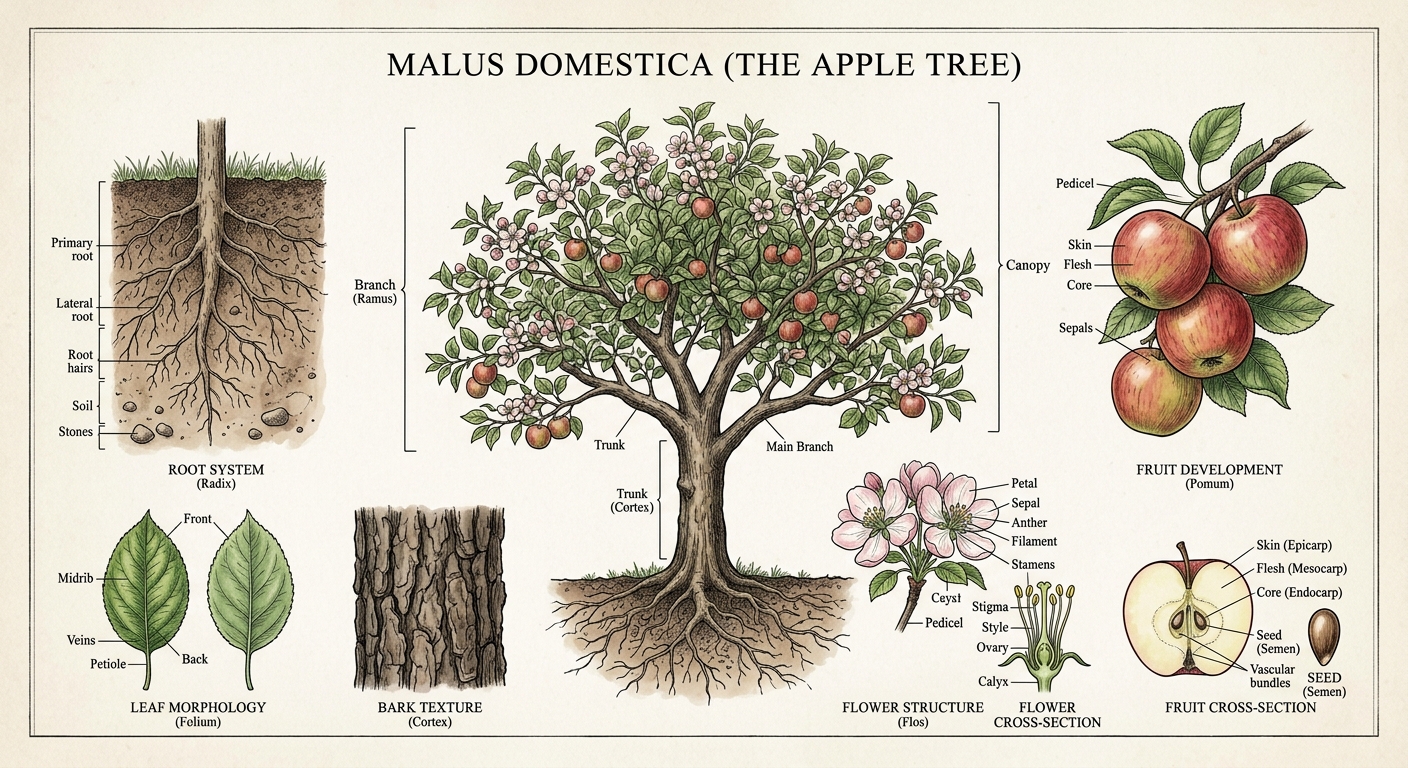
Anatomy of an Apple Tree
Understanding the tree's structure is essential for pruning, pest management, and overall care:
Root system: Apple trees are almost never grown on their own roots. The rootstock (the root system and lower trunk) is a separate variety grafted to the scion (the upper portion that produces the fruit you want). The graft union — a visible bulge near the base of the trunk — is the most important landmark on the tree. If it gets buried below soil level, the scion can root independently, defeating the purpose of the rootstock.
Rootstock types:
| Rootstock | Size Class | Mature Height | Lifespan | Notes |
|---|---|---|---|---|
| M.27 | Ultra-dwarf | 4–6 ft | 15–20 years | Requires permanent staking; fragile root system |
| M.9 | Dwarf | 6–10 ft | 20–25 years | Industry standard; high-density commercial orchards |
| M.26 | Semi-dwarf | 10–14 ft | 25–35 years | Good compromise; some fire blight susceptibility |
| MM.106 | Semi-standard | 14–18 ft | 40–60 years | Tolerates heavier soils; moderate vigor |
| MM.111 | Semi-standard | 16–20 ft | 50–80 years | Drought-tolerant; excellent anchorage |
| Seedling / M.25 | Standard | 20–30+ ft | 80–150+ years | Full-size tree; deep root system; maximum resilience |
| Antonovka | Standard | 25–30+ ft | 100+ years | Extremely cold-hardy; traditional rootstock |
| Geneva series (G.41, G.935, etc.) | Various | Varies | 25–50 years | Bred for disease resistance; fire blight tolerant |
For holistic growing, the choice of rootstock matters enormously. Dwarf rootstocks produce trees that are essentially dependent patients — shallow-rooted, weak-anchored, unable to access deep water or nutrients, requiring permanent staking and intensive management. They exist because commercial orchards want trees they can pick without ladders, planted at densities of 1,000+ per acre.
For a home orchard or small-scale organic operation, semi-standard to standard rootstocks (MM.111, seedling) produce trees with deep, extensive root systems that access water and minerals unavailable to dwarfs, anchor themselves without staking, support robust mycorrhizal networks, and live for generations. The tradeoff — larger trees that take longer to bear — is a feature, not a bug, if you're building a permanent food-producing ecosystem.
Pollination Biology
Most apple varieties are self-incompatible — they cannot pollinate themselves or other trees of the same variety. The mechanism is a gametophytic self-incompatibility system controlled by the S-locus, which prevents pollen from germinating on stigmas that share the same S-allele combination.
This means you need at least two different varieties that bloom at the same time. Some combinations work better than others:
| Pollination Group | Bloom Period | Example Varieties |
|---|---|---|
| Group 1 (very early) | Early spring | Gravenstein, Vista Bella |
| Group 2 (early) | Early-mid spring | Idared, McIntosh, Cortland |
| Group 3 (mid-season) | Mid spring | Cox's Orange Pippin, Liberty, Gala, Golden Delicious |
| Group 4 (late) | Mid-late spring | Ashmead's Kernel, Mutsu, Fuji |
| Group 5 (very late) | Late spring | Braeburn, Suntan |
Triploid varieties (Gravenstein, Jonagold, Mutsu, Bramley's Seedling) have three sets of chromosomes and produce non-viable pollen. They need a pollinator but cannot pollinate others — so if you plant a triploid, you need two other diploid varieties to ensure cross-pollination.
Crabapples are universal pollinators — a single ornamental crabapple can pollinate virtually any apple variety, and they bloom profusely over a long period.
The actual pollination is done overwhelmingly by honeybees and native bees (mason bees, bumblebees, mining bees). One more reason the chemical spray calendar is self-defeating: you cannot spray insecticides during bloom without killing the very insects that produce your crop.
Part II: From Kazakhstan to Your Backyard — A 10,000-Year History
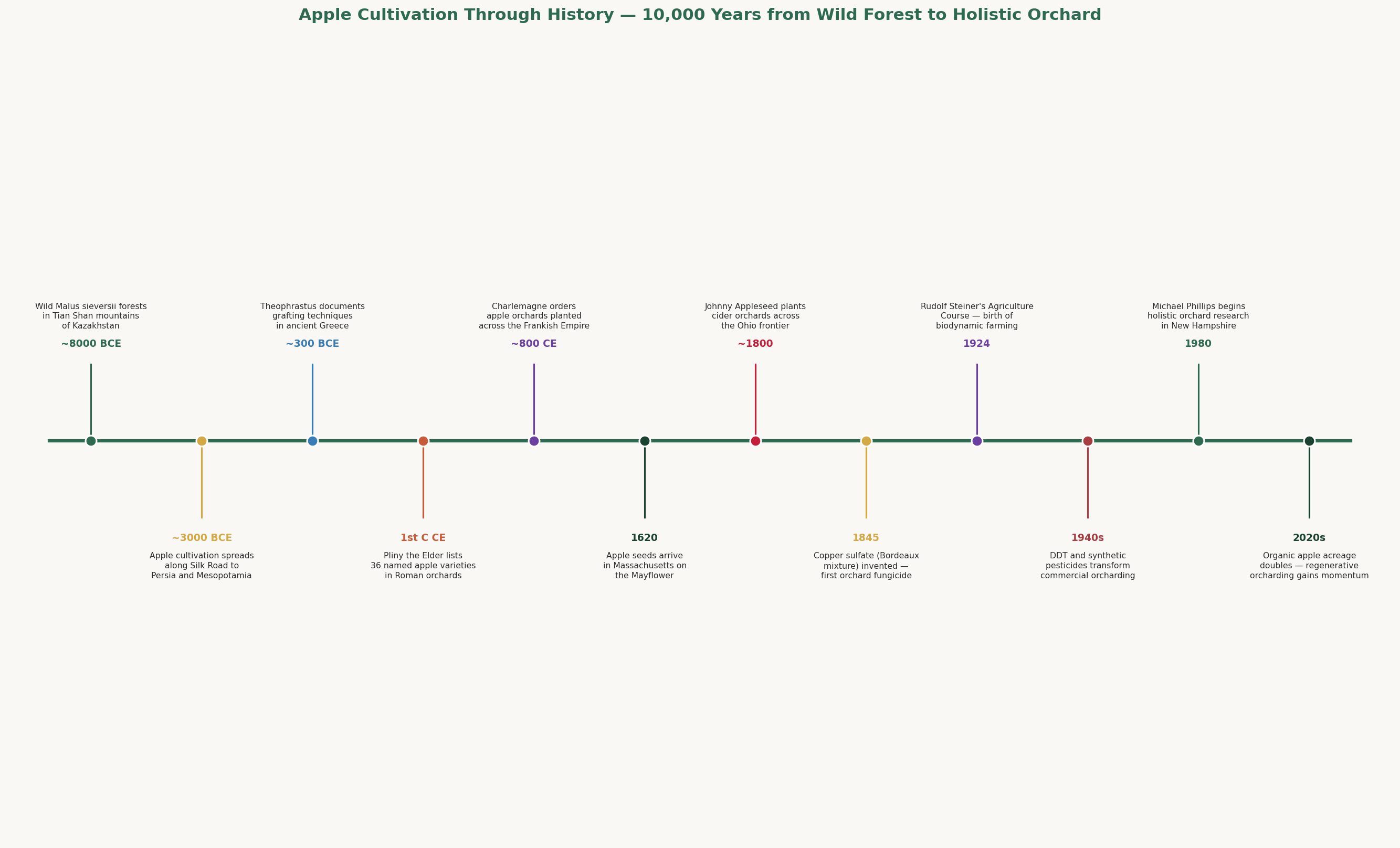
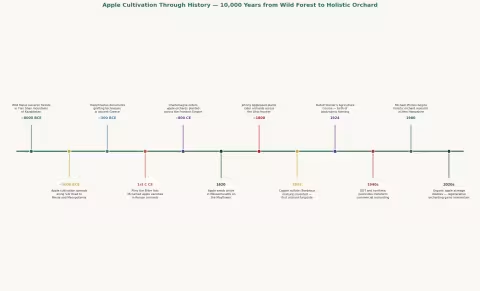
The Forests of Heaven (~8000 BCE and earlier)
Every apple on Earth — every Honeycrisp, every Granny Smith, every Red Delicious, every one of the 7,500+ named varieties — descends from wild trees still growing in the Tien Shan mountains of Kazakhstan, Kyrgyzstan, and northwestern China. The wild species is Malus sieversii, named after the 18th-century Russian botanist Johann Sievers, who first described these forests in 1793.
The M. sieversii forests of the Tien Shan are like nothing else on Earth. Full-size apple trees — 50 to 60 feet tall — growing wild, with fruit ranging from tiny and sour to large and sweet, in colors from green to yellow to red to nearly purple. The genetic diversity in a single wild apple forest exceeds the total genetic diversity of all commercial apple varieties combined.
The former capital of Kazakhstan — Almaty — literally means "Father of Apples" (Alma = apple, ata = father). The city sits at the base of wild apple forests that have been fruiting for millions of years.
Genetic analysis has confirmed that M. sieversii is the primary ancestor of M. domestica, with secondary contributions from Malus sylvestris (the European crabapple) acquired as the apple migrated westward along the Silk Road (PMID: 22545033).
The Silk Road (~3000–1000 BCE)
The apple spread westward along the Silk Road trade routes — carried by merchants, nomads, and migrating peoples through Central Asia, Persia, Mesopotamia, and eventually the Caucasus and the Mediterranean. Bears played an inadvertent role: by eating the largest, sweetest fruits and dispersing the seeds in their dung, bears served as natural selectors for the very traits humans would later value.
By approximately 2000 BCE, cultivated apples were established in Mesopotamia. Cuneiform tablets from the Neo-Assyrian period reference apple orchards. The Greeks knew the apple well — it appears in Homer (the "golden apples" of the Hesperides) and in Theophrastus's botanical writings.
The Romans and the Art of Grafting (~300 BCE – 400 CE)
The Romans transformed the apple from a foraged wild fruit into an agricultural crop through the systematic development of grafting — the technique of joining a shoot (scion) from one tree onto the rootstock of another.
Pliny the Elder (23–79 CE), in his Naturalis Historia, described 36 named apple varieties and detailed grafting techniques including cleft grafting, bark grafting, and budding. The Romans understood what many modern growers forget: apple seeds do not grow true to type. Every apple seed produces a genetically unique tree — usually with fruit inferior to its parent. The only way to replicate a desirable apple is to clone it through grafting.
Roman orchards were sophisticated operations with grafted varieties, irrigation, pruning systems, and post-harvest storage techniques. When the Empire fell, much of this knowledge survived in one institution: the Church.
Monastic Orchards (500–1500 CE)
Benedictine, Cistercian, and other monastic orders preserved and advanced pomological knowledge through the medieval period. Monastery orchards were essentially living gene banks — each abbey maintaining dozens of apple varieties for fresh eating, cooking, cider, vinegar, and medicine.
The monks developed grafting to a high art, selected new varieties from chance seedlings, and maintained detailed records of which varieties performed best in their local conditions. Much of the regional apple diversity that characterized pre-industrial Europe — thousands of locally adapted varieties with evocative names — originated in or was maintained by monastic orchards.
The Mayflower and Colonial America (1620–1800)
The Pilgrims carried apple seeds and scions to Massachusetts in 1620. Apple trees became the backbone of colonial agriculture — not primarily for fresh eating (wild game and corn were more important food sources), but for cider. In 17th- and 18th-century America, cider was the default beverage for adults, children, and even livestock. Clean water was unreliable. Cider was safe, caloric, and mildly alcoholic.
Every colonial farmstead had an apple orchard, and most of those apples were cider apples — small, tannic, bitter varieties useless for eating but sublime for fermentation. This is crucial context for understanding the man who planted them.
Johnny Appleseed: The Real Story (1774–1845)
John Chapman — the historical Johnny Appleseed — was not the benign, barefoot children's-tale character planting eating apples for settlers. He was a shrewd businessman and a deeply eccentric religious figure, and his apples were for drinking, not eating.
Chapman was born in Leominster, Massachusetts in 1774. Beginning around 1800, he traveled ahead of the westward-moving frontier across Pennsylvania, Ohio, and Indiana, planting apple nurseries from seed — not grafted trees. He would plant a nursery, fence it, leave it in the care of a local partner, and return periodically to sell seedling trees to newly arriving settlers.
Here's what the children's book leaves out:
-
He planted from seed deliberately. Seedling apple trees produce fruit unsuitable for fresh eating — small, sour, bitter. They are perfect for cider. Chapman was supplying the frontier's demand for alcohol.
-
He was a savvy land speculator. Under Ohio land laws, planting 50 apple trees on a claim established a permanent homestead. Chapman planted nurseries to secure land rights, then sold the land or the trees at a profit.
-
He was a Swedenborgian missionary. Chapman was a devoted follower of Emanuel Swedenborg, the Swedish mystic-theologian. He distributed Swedenborgian literature wherever he traveled and considered his apple planting a form of spiritual service. His vegetarianism, barefoot asceticism, and unusual clothes were expressions of his religious conviction, not folksy charm.
-
The temperance movement destroyed his legacy. When Prohibition sentiment swept America in the late 19th and early 20th centuries, the establishment went after cider orchards with axes and fire. Thousands of seedling orchards — the direct descendants of Chapman's plantings — were chopped down during temperance campaigns and eventually Prohibition (1920–1933). The apple industry survived only by frantically rebranding the apple as a wholesome eating fruit ("an apple a day keeps the doctor away" — a marketing slogan, not a folk proverb) and replacing the cider-apple seedling orchards with grafted dessert varieties.
Johnny Appleseed's orchards were casualties of America's war on alcohol. The genetic diversity he had distributed across the Midwest was largely incinerated.
The Industrial Era: DDT and the Chemical Treadmill (1940s–1980s)
World War II brought DDT, and agriculture would never be the same. Apple orchards became among the most chemically intensive agricultural systems in the world. By the 1960s, a typical commercial orchard sprayed 15–25 times per season with increasingly toxic compounds:
- DDT (banned 1972) — for codling moth
- Lead arsenate — yes, literal arsenic and lead, sprayed on food crops through the 1940s. Residues persist in orchard soils to this day
- Organophosphates — nerve agents adapted for agriculture
- Carbamates — cholinesterase inhibitors
- Neonicotinoids (1990s–present) — systemic insecticides implicated in colony collapse disorder in honeybees
The result was effective pest control and dead orchards — dead soil, dead beneficial insects, dead biological resilience. Trees became dependent on chemical inputs the way a patient becomes dependent on drugs. Remove the sprays and everything collapses, because the biological systems that provided natural pest control have been annihilated.
The Organic Revival: Michael Phillips and the Holistic Orchard (1990s–present)
The countermovement began in earnest in the 1990s, led in North America by Michael Phillips, a Vermont orchardist whose book The Holistic Orchard (2011) became the bible of organic apple growing. Phillips synthesized decades of research and practice into a coherent system:
- Build soil biology first — everything else follows
- Use holistic spray programs based on compost tea, neem oil, and liquid fish/kelp rather than chemical fungicides
- Plant disease-resistant varieties
- Encourage biodiversity at every level
- Accept cosmetic imperfection in exchange for ecological health
Phillips' work, along with researchers like David Granatstein at Washington State University and the organic breeding programs at Cornell (the Geneva series rootstocks, the Liberty/Enterprise/GoldRush disease-resistant varieties), has demonstrated that commercial-scale organic apple production is not only possible but increasingly competitive.
Part III: The Soil Food Web — Where Everything Begins
If you remember nothing else from this article, remember this: the health of your apple tree is the health of your soil. Every problem — disease susceptibility, pest pressure, poor fruit quality, winter injury, short lifespan — traces back to soil biology.
Mycorrhizal Associations
Apple trees form arbuscular mycorrhizal (AM) associations — symbiotic partnerships between the tree's fine roots and fungi in the phylum Glomeromycota. The fungi colonize the root cortex and extend hyphal networks into the surrounding soil, effectively increasing the tree's root surface area by 100 to 1,000 times.
In exchange for sugars from the tree (up to 20% of the tree's photosynthetic output), mycorrhizal fungi provide:
- Phosphorus — the nutrient most limiting to tree fruit; mycorrhizae are 100× more efficient than roots at extracting phosphorus from mineral soil
- Water — hyphal networks access water in micropores too small for root hairs
- Micronutrients — zinc, copper, manganese, boron
- Disease resistance — mycorrhizal colonization triggers systemic resistance to root pathogens including Phytophthora and Pythium
- Network communication — the "wood wide web" through which trees share resources and chemical warning signals
The implications for orchard management are profound. Synthetic phosphorus fertilizer suppresses mycorrhizal colonization — the tree's roots stop investing in fungal partners when soluble P is abundant. Fungicide applications, soil compaction, and bare-ground cultivation all damage mycorrhizal networks. Every conventional orchard practice is hostile to the very organisms that make trees healthy.
Building Soil Organic Matter
Target: 4–6% organic matter in the top 12 inches. Most agricultural soils sit at 1–3%. Every 1% increase in organic matter allows soil to hold an additional 20,000 gallons of water per acre.
Composting: The gold standard for building organic matter. Apply 1–3 inches of finished compost annually in a ring from the drip line inward (never piled against the trunk — that invites rot and voles). Quality matters: compost should be aerobically produced, thermally processed (130–160degF for sustained periods), and fully mature (earthy smell, no ammonia, no recognizable feedstock).
Cover cropping: The living mulch beneath your trees is as important as anything you do to the tree itself.
| Cover Crop | Function | Notes |
|---|---|---|
| White Dutch clover (Trifolium repens) | Nitrogen fixation (80–200 lbs N/acre/year); living mulch; pollinator habitat | The single most valuable apple-guild groundcover |
| Comfrey (Symphytum × uplandicum) | Dynamic accumulator — deep taproot mines potassium, calcium, phosphorus; chop-and-drop mulch | Plant Bocking 14 (sterile cultivar) to prevent spreading |
| Yarrow (Achillea millefolium) | Attracts beneficial insects; accumulates potassium, phosphorus, copper | Traditional orchard ground flora in Europe |
| Red clover (Trifolium pratense) | Nitrogen fixation; deep taproot breaks compaction | Good for initial establishment; eventually transition to white clover |
| Annual rye / crimson clover | Quick biomass; weed suppression; erosion control | Useful in first 1–2 years before perennials establish |
Organic Amendments
| Amendment | What It Does | Application Rate |
|---|---|---|
| Rock dust (basalt, granite, glacial) | Slow-release minerals; 60+ trace elements; feeds soil biology | 50–100 lbs per tree, annually for 3 years, then every 3–5 years |
| Kelp meal (Ascophyllum nodosum) | Growth hormones (cytokinins, auxins); 60+ trace minerals; stress tolerance | 2–5 lbs per tree per year |
| Fish hydrolysate | Immediately available nitrogen; amino acids; feeds soil microbes | Foliar spray or soil drench, 2–4 oz per gallon, monthly during growing season |
| Bone meal | Phosphorus and calcium; slow-release | 5–10 lbs per tree at planting; 2–5 lbs annually |
| Biochar | Permanent soil carbon; massive surface area for microbial habitat; water retention | 1–5 lbs per tree, mixed with compost (never apply raw) |
| Wood ash | Potassium and calcium; raises pH | 5–10 lbs per tree per year IF soil pH is below 6.0; stop if pH exceeds 6.8 |
| Gypsum (calcium sulfate) | Calcium without raising pH; improves clay soil structure | 5–20 lbs per tree for heavy clay soils |
Biochar deserves special mention. Biochar is charcoal produced by pyrolysis (burning organic matter in the absence of oxygen). It is essentially pure carbon with an enormous internal surface area — one gram of biochar has the surface area of a tennis court. This surface provides habitat for billions of soil microorganisms. Biochar persists in soil for centuries (Amazonian terra preta soils, enriched with biochar by indigenous peoples 2,000+ years ago, remain among the most fertile soils on Earth). But raw biochar is biologically inert and can temporarily tie up nutrients — always "charge" biochar by soaking it in compost tea or mixing it with finished compost for several weeks before applying.
Part IV: The Apple Guild — Permaculture Companion Planting
A guild in permaculture is a group of plants that support each other — each performing functions that reduce the need for external inputs. The apple tree guild is one of the most well-developed guild designs, and it replaces an entire input schedule with ecology.
The Layers
| Layer | Function | Recommended Species |
|---|---|---|
| Canopy | The apple tree itself | Your chosen varieties on appropriate rootstock |
| Sub-canopy | Nitrogen-fixing support trees | Elaeagnus umbellata (autumn olive — use cautiously, invasive in some regions); Siberian pea shrub (Caragana arborescens) |
| Shrub layer | Beneficial insect habitat; additional harvest | Currants (Ribes), gooseberries, elderberry, rugosa rose |
| Herbaceous | Dynamic accumulators; pest confusion; pollinator forage | Comfrey, yarrow, tansy, fennel, dill |
| Ground cover | Nitrogen fixation; living mulch; soil protection | White clover, creeping thyme |
| Root layer | Edible roots; soil biology | Garlic, horseradish (also deters borers) |
| Vine layer | Additional harvest; ground coverage | Nasturtiums (pest trap crop); grape (if structure permits) |
The Key Guild Members
Comfrey (Symphytum × uplandicum 'Bocking 14'): The superstar of the guild. Comfrey's taproot penetrates 6–10 feet into the subsoil, mining potassium, calcium, phosphorus, and trace minerals that are inaccessible to the apple's roots. Cut 3–4 times per season and let the leaves decompose in place as a nutrient-rich mulch. Comfrey leaves contain more potassium than manure. They also produce copious flowers that attract pollinators and beneficial insects. Always plant the Bocking 14 cultivar — it's sterile (does not set seed) and won't spread invasively.
Chives and garlic (Allium species): The sulfur compounds in alliums confuse pest insects that locate host trees by scent. A ring of chives around an apple tree measurably reduces aphid colonization. Garlic also has antifungal properties — garlic spray is a legitimate (if mild) fungicidal treatment.
Nasturtiums (Tropaeolum majus): Serve as a trap crop for aphids. Aphids prefer nasturtiums to apple leaves — they'll colonize the nasturtiums first, drawing pest pressure away from the tree. The aphid-infested nasturtiums then attract ladybugs and lacewings, which establish populations that spill over onto the apple tree. Additionally, nasturtiums' volatile compounds have mild repellent effects on some pest species.
Borage (Borago officinalis): One of the best bee-attracting plants in existence. Borage flowers produce nectar continuously — even after being visited — and each flower refills its nectary within minutes. A patch of borage near apple trees dramatically increases pollinator visitation during bloom. Borage also accumulates potassium and calcium and self-seeds reliably.
Phacelia (Phacelia tanacetifolia): If you could plant only one insectary flower, plant phacelia. It attracts a broader range of beneficial insects — hoverflies, parasitic wasps, lacewings, bees — than virtually any other plant. It also breaks compaction with its fibrous root system and adds biomass when turned under.
Tansy (Tanacetum vulgare): Repels several apple pests including codling moth, apple maggot fly, and Japanese beetles. The volatile compound thujone is the active repellent. Plant it at the drip line, not directly against the trunk. Tansy can be aggressive — contain it if needed.
What NOT to Plant Near Apple Trees
Black walnut (Juglans nigra): Produces juglone, an allelopathic compound that inhibits the growth of apple trees and many other plants. The toxic zone extends 50–80 feet from the trunk of a mature black walnut. Apple trees within this zone show stunted growth, yellowing foliage, wilting, and eventual death. There is no treatment — you either remove the walnut or move the apple.
Potatoes: Share susceptibility to similar Phytophthora species. Growing potatoes near apple trees can increase fire blight and other bacterial disease pressure.
Brassicas (cabbage family): Heavy feeders that compete aggressively for nutrients. Keep vegetable gardens at a respectful distance from orchard trees.
Part V: Pruning — The Art Most People Get Wrong
Pruning is the single most impactful thing you do to an apple tree, and the single thing most people do most poorly. Bad pruning — or no pruning — causes more problems than any pest or disease.
Two Systems
Open-center (vase shape): No central leader. Three to five main scaffold branches radiate outward and upward from the trunk at roughly equal spacing, creating an open bowl shape. Sunlight reaches all interior branches. This is the traditional European orchard form, ideal for semi-standard and standard trees, and the better choice for holistic growers because it maximizes air circulation (reducing disease) and light penetration (improving fruit color and sugar content).
Central-leader: A single dominant vertical trunk with tiers of lateral scaffold branches. The Christmas-tree shape. This is the commercial standard for dwarf and semi-dwarf plantings because it maximizes the bearing surface in a narrow footprint. More appropriate for high-density plantings.
When to Prune
Dormant pruning (late winter, after the coldest weather but before bud break): The main annual pruning. The tree is fully dormant, branch structure is visible without leaves, and wound closure will begin as soon as spring growth starts. Late February through March in most of the US (adjust for your climate).
Summer pruning (June–August): Secondary, light pruning to remove water sprouts (vigorous vertical shoots), improve air circulation, and let light reach ripening fruit. Summer pruning is inherently dwarfing — it removes photosynthesizing leaf area, slowing growth. Use this strategically on overly vigorous trees.
The 3 Ds
Every pruning session starts the same way: remove the Dead, Diseased, and Damaged wood. This is non-negotiable, happens first, and applies regardless of the tree's age or form.
- Dead wood: No buds, brittle, often discolored bark. Remove back to live wood or the branch collar.
- Diseased wood: Cankers (sunken, discolored bark lesions), fire blight strikes (blackened, shepherd's-crook branch tips), fungal fruiting bodies. Cut 8–12 inches below the visible disease margin into healthy wood. Sterilize pruning tools between cuts on diseased wood (10% bleach solution, 70% isopropyl alcohol, or Lysol).
- Damaged wood: Storm-broken, rubbing, or mechanically injured branches. Clean cuts promote healing; ragged wounds invite pathogens.
Thinning vs. Heading Cuts
Thinning cuts remove an entire branch at its point of origin — back to the parent branch or trunk. This opens the canopy without stimulating vigorous regrowth. Thinning cuts are the primary tool of good pruning.
Heading cuts shorten a branch by cutting partway along its length. This stimulates multiple buds below the cut to break, producing a flush of new growth — often water sprouts. Heading cuts are used selectively (to encourage branching on a young tree, to shorten an overly long scaffold) but overused heading cuts create dense, congested canopies.
The rule: When in doubt, make a thinning cut, not a heading cut.
Branch Angles
The ideal scaffold branch angle is 45–60 degrees from vertical. Branches with narrow angles (less than 30 degrees) form weak crotches with included bark that split under heavy fruit loads. Branches wider than 70 degrees bear heavily but grow weakly.
Young branches can be trained using spreaders (short sticks wedged between the branch and trunk) or weights (hanging small weights from branch tips). Do this in the first 2–3 years while branches are flexible.
Fruit Thinning — The Hardest Lesson
Here is the instruction nobody wants to follow: remove 80–90% of the baby apples in early June.
Apple trees routinely set 5–10 times more fruit than they can mature properly. If you let them all develop, you get hundreds of small, flavorless, pest-damaged apples and a tree so exhausted it produces nothing the following year (biennial bearing).
Thin to one apple per cluster (apple blossoms come in clusters of five — the "king bloom" in the center is the largest and should be the one you keep), spaced 6–8 inches apart along each branch.
The result: fewer but dramatically larger, sweeter, more deeply colored, better-storing fruit — and a tree that bears consistently every year instead of alternating between heavy and barren years.
It feels like destruction. It's the most important thing you do for fruit quality.
Part VI: Restoring Neglected Old Trees
This section is for the tree you inherited — the one in the corner of the yard with 20 years of neglected growth, dead branches tangled in the canopy, suckers erupting from the base, bark falling off in sheets, and fruit that drops wormy and rotten every fall. You're probably wondering whether to save it or cut it down.
In most cases: save it. An old apple tree on seedling or semi-standard rootstock has a root system that took decades to develop — a network of mycorrhizal associations, deep soil penetration, and biological infrastructure that a new tree won't replicate for 30 years. The genetics of old, unnamed seedling trees often include disease resistance and local adaptation that no catalog variety can match. And the tree is alive — it survived decades of neglect, which is itself a testament to resilience.
Assessment
Before you touch a pruning saw, evaluate:
-
Trunk integrity: Is the main trunk solid? Probe suspicious areas with a knife. Soft, punky wood indicates decay. Some decay is tolerable — many old apple trees have hollow trunks and continue to produce for decades, because the living tissue (cambium, sapwood) is on the outside. A tree with a completely hollowed trunk can still be structural sound if the shell is intact and thick enough.
-
Major scaffold branches: Are the main structural branches alive? Follow them from trunk to tip — live wood has smooth bark and viable buds; dead wood is brittle, barkless, and budless.
-
Crown condition: What percentage of the canopy is alive? If more than 50% of the crown shows live growth, the tree is a strong candidate for restoration. If less than 25%, it may be a better candidate for grafting stock (see below).
-
Root flare: Clear soil away from the base of the trunk. Is the root flare visible? Is it rotted? Healthy root flare — firm wood, intact bark — indicates a viable root system even if the top is a mess.
-
Lean and stability: A significant lean, especially if recent, may indicate root failure. A tree that has leaned for years has compensated and is stable.
The Three-Year Restoration Pruning Plan
The cardinal rule: never remove more than 25–30% of the live canopy in a single year. Removing more triggers a panic response — the tree erupts with dozens of water sprouts (vigorous vertical shoots) from every major branch, trying desperately to replace its lost leaf area. This creates a worse mess than you started with and exhausts the tree's energy reserves.
Restoration is a three-year process. Patience is not optional.
Year 1: Triage
- Remove all dead wood — you can remove as much dead wood as you want in a single year; only live wood removal is restricted.
- Remove the most obviously diseased branches (cankers, fire blight).
- Remove crossing and rubbing branches — branches that rub against each other wound the bark and create infection sites.
- Remove sucker growth from the base and lower trunk.
- Remove one or two of the worst-positioned major scaffold branches if the canopy is severely congested — choose branches that are growing inward, crossing the center, or competing directly with the leader.
- Do not attempt to reshape the tree this year. You're doing surgery, not cosmetics.
Year 2: Structure
- Remove any water sprouts that emerged in response to Year 1 pruning (these are weak, vertical, and unproductive — they'll never bear good fruit).
- Remove additional scaffold branches to open the center — target the 45–60 degree angle goal for remaining scaffolds.
- Begin to define the tree's permanent form: open-center for most restored trees (it's nearly impossible to retrofit a central-leader form onto an old tree).
- Thin interior branches to allow light and air movement.
- Continue removing diseased wood as it appears.
Year 3: Refinement
- Final shaping: thin remaining congested areas.
- Remove any remaining poorly positioned branches.
- Begin selective heading cuts to encourage fruiting wood where desired.
- The tree should now have an open, airy canopy with 3–5 well-spaced major scaffold branches and good light penetration to the interior.
Soil Rehabilitation Beneath Old Trees
Neglected trees are usually sitting in neglected soil: compacted, low in organic matter, biologically dead.
-
Do not rototill beneath an established tree — you'll sever feeder roots. Instead, sheet mulch: lay cardboard over the existing sod in a ring from the trunk to the drip line, then cover with 4–6 inches of compost and wood chip mulch. This smothers grass, builds organic matter, and feeds soil biology without disturbing roots.
-
Inoculate with mycorrhizal fungi. Drill small holes (3/4 inch diameter, 6 inches deep) in a ring at the drip line, fill with granular mycorrhizal inoculant, and water in. The fungi will colonize the root zone over the following season.
-
Plant the guild. Sow white clover and establish comfrey plants around the drip line. These begin rebuilding nitrogen and mineral cycling immediately.
-
Apply rock dust. Spread 50–100 lbs of basalt rock dust over the root zone. This feeds soil biology with trace minerals that have been depleted by decades of fruit production without replenishment.
-
Foliar feed. During the first two restoration years, support the tree with monthly foliar sprays of dilute fish hydrolysate + kelp extract (2 oz each per gallon of water). The tree can absorb nutrients through its leaves faster than through damaged or compromised roots.
Dealing with Canker and Rot
Canker (sunken, dead bark lesions caused by Neonectria, Botryosphaeria, or other fungi): Cut out small cankers by excising all discolored bark and cambium down to clean, green tissue. On large scaffold branches, you may need to live with trunk cankers that are too large to excise — keep the tree vigorous and it will wall off the infection.
Heart rot (internal wood decay): Common in old trees. As long as the outer shell of living sapwood is intact and at least 2–3 inches thick, the tree is structurally sound. Do not attempt to "clean out" hollow trunks — this was old-school advice that actually removes the tree's natural compartmentalization barriers and makes decay worse.
When to Save vs. When to Let Go
Save it if: >50% live canopy, solid trunk shell (even if hollow), intact root flare, no major structural lean, responds to pruning with healthy new growth.
Let it go if: <25% live canopy, trunk structurally compromised (split, largely rotted through), root plate heaving out of ground, tree is a safety hazard to structures or people.
The middle ground: If the tree is declining but has a healthy root system, consider top-working — cutting the tree back to major scaffold stubs and grafting new, disease-resistant scion varieties onto them. You keep the established root system and get a "new" tree with improved fruit in 2–3 years.
Grafting New Varieties onto Old Rootstock
Top-working is an ancient technique that deserves wider use. In late winter (while the tree is dormant), saw major scaffold branches back to stubs 4–8 inches in diameter. Collect scion wood of your desired new varieties. Use cleft grafting or bark grafting to insert 2–4 scions per stub. Seal all exposed wood with grafting wax or Parafilm.
Success rates for top-working old apple trees are 70–90% when done correctly. Within one year, the successful grafts will produce 2–4 feet of new growth. Within 3 years, you'll have fruit.
This means that decrepit old apple tree in your yard is not just a tree — it's a rootstock for any variety you want. Heritage varieties, disease-resistant modern varieties, or a combination. One old tree can support 4–6 different varieties, giving you a personal orchard on a single root system.
Part VII: The Enemies
Diseases
Apple scab (Venturia inaequalis): The single most important apple disease worldwide. Caused by a fungus that overwinters in fallen leaves, releases ascospores during spring rains, and infects expanding leaves and developing fruit. Symptoms: olive-green to black velvety lesions on leaves; raised, corky, dark lesions on fruit; severe infections cause premature leaf drop and cracked, unmarketable fruit.
The scab lifecycle is almost entirely driven by spring moisture. The critical infection period runs from green tip (first leaf tissue emergence) through about 2–3 weeks after petal fall. If you can protect the tree during this window, you've controlled scab for the year.
Fire blight (Erwinia amylovora): A bacterial disease that is the most destructive disease of apple and pear worldwide. Enters through flowers during warm, wet bloom periods. Symptoms: blackened, wilted shoot tips curving into a distinctive shepherd's crook shape; bacterial ooze on infected tissue; rapid progression — a fire blight strike can kill a major scaffold branch in days.
Fire blight is terrifying because it can kill an entire mature tree in a single season. There is no cure for infected tissue — only removal. Cut 12–18 inches below the visible infection margin. Sterilize tools between every cut. Remove and burn (or bag for disposal) all infected material.
Cedar-apple rust (Gymnosporangium juniperi-virginianae): A fascinating two-host fungus that requires both an apple tree and a juniper (Eastern red cedar, Juniperus virginiana) to complete its lifecycle. Orange, gelatinous "horns" emerge from galls on juniper in spring rain; these release spores that infect apple leaves, causing bright orange spots with raised aecial cups on the underside. Heavy infection causes defoliation.
The simple solution: remove all junipers within 1–2 miles. The practical solution (since you probably can't do that): plant resistant varieties and apply sulfur sprays during the primary infection period.
Powdery mildew (Podosphaera leucotricha): White, powdery fungal growth on leaves, shoot tips, and developing fruit. Unlike most fungal diseases, powdery mildew thrives in dry conditions with high humidity — it doesn't need leaf wetness. Overwinters in infected buds (silver-gray buds that open late and produce distorted, mildewed leaves).
Remove infected buds during dormant pruning. Open canopy architecture (good air movement) is your first defense.
Pests
Codling moth (Cydia pomonella): The #1 apple pest worldwide. The adult moth is inconspicuous — gray-brown, about 3/4 inch long. It lays eggs on or near developing fruit. The larva burrows into the apple (the classic "worm in the apple"), feeds on the flesh and seeds, then exits, drops to the ground, and pupates beneath bark or in soil debris.
Two generations per season in most climates (three in warm areas). Without management, codling moth damages 60–90% of fruit in most regions.
Apple maggot (Rhagoletis pomonella): A native North American fruit fly that emerged from hawthorn (its original host) onto cultivated apples within the last 150 years — one of the best-documented cases of sympatric speciation in real time. The adult fly lays eggs just beneath the skin of developing fruit; maggots tunnel through the flesh, creating brown, corky trails.
Plum curculio (Conotrachelus nenuphar): A native weevil that creates distinctive crescent-shaped scars on developing fruit. Adults emerge from soil in spring, feed on blossoms and fruitlets, and lay eggs inside developing fruit. A single female can damage dozens of apples.
Aphids: Multiple species attack apple trees. Rosy apple aphid (Dysaphis plantaginea) is the most damaging — it causes severe leaf curling and fruit deformation. Green apple aphid (Aphis pomi) is ubiquitous but less damaging. Woolly apple aphid (Eriosoma lanigerum) attacks bark and roots, causing galls.
Mites: European red mite (Panonychus ulmi) and two-spotted spider mite (Tetranychus urticae) feed on leaf cells, causing bronzing and reduced photosynthesis. Heavy mite infestations reduce fruit size and sugar content. Mite outbreaks are almost always caused by pesticide applications that kill predatory mites — in undisturbed orchards, predatory mites (especially Typhlodromus pyri) keep pest mites in check.
Part VIII: The Organic Arsenal
Physical and Mineral Barriers
Kaolin clay (Surround WP): The single most important organic pest management tool for apple growers. Surround WP is a refined kaolin clay that, when mixed with water and sprayed on trees, leaves a white particle film on all surfaces. This film:
- Creates a physical barrier that codling moth larvae cannot penetrate
- Disorients pest insects (the white surface confuses host-finding behavior)
- Repels apple maggot flies, plum curculio, leafhoppers, and Japanese beetles
- Reflects excess sunlight, reducing heat stress on fruit
- Has zero toxicity to humans, bees, beneficial insects, soil organisms, or waterways
Apply from petal fall through first cover spray (about 2 weeks after petal fall), then reapply after rain. Trees look white and ghostly — this is normal. The clay washes off harvested fruit easily.
Kaolin clay is arguably the most important advancement in organic orcharding in the last 30 years. It replaced a half-dozen toxic sprays with a mineral that is literally edible.
Pheromone traps and mating disruption: Codling moth pheromone dispensers (Isomate CM/LR) saturate the orchard with synthetic female pheromone, preventing male moths from locating actual females. This collapses the next generation. Mating disruption is highly effective in orchards larger than 2–5 acres but less reliable in isolated single-tree settings (males from outside the treated area can still find females). Pheromone traps (delta traps with sticky bottoms) are essential for monitoring — they tell you when moths are flying so you can time other interventions.
Botanical and Biological Sprays
Neem oil (Azadirachta indica): Broad-spectrum insect growth regulator, repellent, and antifeedant. The active compound azadirachtin disrupts insect molting hormones, preventing larvae from developing to adulthood. Effective against aphids, mites, leafrollers, and as a mild fungicide. Apply in early morning or evening (neem degrades rapidly in sunlight) and never during bloom (it can affect bees). Use cold-pressed, whole neem oil — not clarified hydrophobic neem extract, which has had the azadirachtin removed.
Bt (Bacillus thuringiensis var. kurstaki): A naturally occurring soil bacterium that produces proteins toxic to caterpillar larvae (Lepidoptera). When a caterpillar eats Bt-treated foliage, the toxin dissolves its gut lining. Bt is highly specific — it affects only caterpillars and is harmless to bees, beetles, beneficial insects, mammals, and birds. Effective against leafrollers, tent caterpillars, and young codling moth larvae (before they bore into the fruit). Must be ingested to work; degrades in UV light within 3–7 days. Time applications to egg hatch.
Spinosad: Derived from the soil bacterium Saccharopolyspora spinosa. Effective against codling moth, apple maggot, leafminers, and thrips. More persistent than Bt (7–14 days) but toxic to bees when wet — apply in evening after bees have stopped foraging. Approved for organic use (OMRI-listed). Use judiciously — overuse can lead to resistance.
Horticultural oil (mineral oil or plant-based oils): Applied during dormancy (dormant oil) to smother overwintering eggs of mites, aphids, and scale insects. Applied at lower concentration during the growing season (summer oil) for the same pests. Suffocates insects and mites by blocking spiracles. Generally safe for beneficial insects when applied correctly. Do not apply when temperatures will exceed 90degF or on drought-stressed trees.
Copper and Sulfur — The Ancient Fungicides
Copper sprays: Copper has been used as a fungicide since at least the 1700s. The most famous formulation is Bordeaux mixture — copper sulfate + hydrated lime — developed in the Bordeaux wine region of France in the 1880s to control downy mildew on grapes. Copper is effective against apple scab, fire blight (as a preventive, not a cure), and many other fungal and bacterial diseases.
The catch: copper is toxic to soil biology in excess, can accumulate in soil over decades, and can cause fruit russeting if applied after bloom. Use the minimum effective rate and limit applications to dormant season and early spring (green tip through tight cluster). Fixed copper formulations (copper hydroxide, copper octanoate) are gentler than copper sulfate.
Sulfur: The oldest fungicide in human history — ancient Greeks used sulfur to control plant diseases. Micronized sulfur or wettable sulfur is effective against apple scab and powdery mildew. It works by disrupting fungal cellular respiration.
Sulfur is less toxic to soil biology than copper but can burn foliage at temperatures above 85degF and is incompatible with oil sprays (apply at least 2 weeks apart). It's the workhorse fungicide of organic orcharding — your primary weapon against scab during the critical spring infection period.
Compost Tea — The Science and the Controversy
Actively aerated compost tea (AACT) is made by steeping finished compost in aerated water for 24–48 hours, often with added microbial foods (molasses, kelp, fish hydrolysate). The goal is to multiply the aerobic microorganisms in the compost and deliver them to leaf and fruit surfaces, where they:
- Physically occupy the sites where fungal spores would germinate (competitive exclusion)
- Produce antimicrobial compounds that suppress pathogens
- Stimulate the plant's systemic acquired resistance
The evidence for: Michael Phillips and many holistic orchardists report significant disease reduction with regular compost tea applications. Several studies have shown that compost tea suppresses Venturia inaequalis (apple scab) and Podosphaera leucotricha (powdery mildew) on leaf surfaces (PMID: 19613359). The biological mechanism is plausible — microbial competition on leaf surfaces is a well-documented phenomenon.
The controversy: Mainstream university researchers have been skeptical. Results are inconsistent — compost tea quality varies enormously depending on compost source, brewing conditions, aeration, temperature, and application timing. A poorly made compost tea can harbor E. coli and other pathogens. Linda Chalker-Scott at Washington State University has been a prominent critic, arguing that the evidence for foliar disease suppression is insufficient to justify the claims.
The practical position: Compost tea is unlikely to replace sulfur and copper as primary fungicides in high-pressure environments. But as a supplement — applied alongside other practices — it contributes to the overall biological diversity on leaf surfaces that reduces disease pressure. If you brew it, use quality compost, maintain vigorous aeration, apply within 4 hours of brewing, and don't expect miracles.
Fermented Plant Extracts
Traditional European orchardists used plant-based sprays long before the chemical era:
| Extract | Source Plant | Primary Use | Preparation |
|---|---|---|---|
| Nettle tea | Urtica dioica | General tonic; nitrogen-rich foliar feed; mild fungicide | Ferment fresh nettles in water 2–3 weeks; dilute 1:10 |
| Comfrey tea | Symphytum spp. | Potassium-rich foliar feed; promotes fruiting | Same as nettle; higher potassium content |
| Horsetail tea | Equisetum arvense | Fungicide (high silica content strengthens cell walls) | Simmer 30 min; dilute 1:5; spray on foliage (PMID: 29473851) |
| Garlic spray | Allium sativum | Insect repellent; mild antifungal | Blend garlic in water; strain; dilute; add a drop of soap as surfactant |
| Willow water | Salix spp. | Rooting hormone (salicylic acid); wound healing | Soak willow stems in water 48 hours; use as a drench for transplants |
Biological Controls
| Beneficial Organism | Target Pest | Notes |
|---|---|---|
| Trichogramma wasps | Codling moth eggs | Tiny parasitic wasps that lay their eggs inside codling moth eggs, killing the next generation. Release at petal fall and again 6 weeks later. |
| Ladybugs (Hippodamia convergens) | Aphids | Purchase and release in evening; water trees first (ladybugs need moisture). Moderate effectiveness — many fly away. |
| Green lacewings (Chrysoperla spp.) | Aphids, mites, small caterpillars | Lacewing larvae ("aphid lions") are voracious generalist predators. Release as eggs or larvae. More effective than ladybugs in orchards. |
| Predatory mites (Typhlodromus pyri) | European red mite, two-spotted spider mite | The natural enemy that keeps mite populations in check. Established populations make pesticide sprays for mites unnecessary. Killed by broad-spectrum sprays. |
| Codling moth granulosis virus (CpGV) | Codling moth larvae | A naturally occurring virus specific to codling moth. Applied as a spray; larvae ingest it and die within 3–5 days. Safe for all non-target organisms. Commercially available as Cyd-X and Madex. |
| Entomopathogenic nematodes (Steinernema feltiae) | Soil-dwelling pupae | Apply to soil in fall; nematodes seek and parasitize overwintering codling moth and plum curculio pupae. |
Part IX: The Biodynamic Approach
Rudolf Steiner's 1924 Lectures
Biodynamic agriculture originates from a series of eight lectures given by Austrian philosopher-esotericist Rudolf Steiner (1861–1925) to farmers at Koberwitz, Silesia (now Kobierzyce, Poland) in June 1924. These lectures — given just months before Steiner's death — laid out a holistic agricultural philosophy that treats the farm as a self-contained, living organism influenced by cosmic rhythms.
Steiner was not a farmer. He was the founder of Anthroposophy, a spiritual-philosophical movement, and his agricultural prescriptions were embedded in a cosmological framework that included references to etheric forces, astral influences, and the spiritual nature of plants and soil. This makes biodynamics deeply polarizing: some practitioners experience remarkable results; scientists struggle with mechanisms that invoke forces unrecognized by physics.
The Preparations (500–508)
The heart of biodynamic practice is a set of numbered preparations applied to soil, compost, and plants in homeopathic-like quantities:
| Prep | Material | Application | Purpose |
|---|---|---|---|
| 500 (Horn manure) | Cow manure fermented in a buried cow horn over winter | Stirred in water 1 hour (alternating directions), sprayed on soil | Stimulate root growth and soil biological activity |
| 501 (Horn silica) | Finely ground quartz crystal fermented in a buried cow horn over summer | Stirred and sprayed on foliage in early morning | Enhance light metabolism, photosynthesis, fruit ripening, and flavor |
| 502 | Yarrow flowers fermented in a stag's bladder | Added to compost | Enhance sulfur and potassium processes |
| 503 | Chamomile flowers fermented in bovine intestine | Added to compost | Stabilize nitrogen; regulate calcium |
| 504 | Stinging nettle buried in peat for one year | Added to compost | Enliven the soil; sensitize it to cosmic influences |
| 505 | Oak bark fermented in an animal skull | Added to compost | Counter disease tendencies through calcium |
| 506 | Dandelion flowers fermented in bovine mesentery | Added to compost | Mediate silica and potassium forces |
| 507 | Valerian flower extract | Sprayed on compost | Stimulate phosphorus activity; form a warmth mantle |
| 508 | Horsetail tea (Equisetum arvense) | Sprayed on foliage | Fungal disease prevention (silica-based) |
The Biodynamic Calendar and Moon Planting
Biodynamic practitioners follow planting and spraying calendars based on the moon's position relative to the zodiac constellations. Maria Thun (1922–2012), a German farmer, conducted decades of planting trials and developed the most widely used biodynamic calendar. Her system classifies days as:
- Root days (earth signs: Taurus, Virgo, Capricorn) — plant root crops; apply 500
- Leaf days (water signs: Cancer, Scorpio, Pisces) — plant leafy crops; irrigate
- Flower days (air signs: Gemini, Libra, Aquarius) — plant flowering crops; apply 501
- Fruit days (fire signs: Aries, Leo, Sagittarius) — plant and harvest fruit; ideal for apple activities
Scientific Evaluation — Being Honest
The scientific literature on biodynamic agriculture is genuinely mixed, and intellectual honesty requires acknowledging this:
Evidence supporting biodynamic benefits:
- Multiple long-term field trials (the DOK trial in Switzerland, running since 1978) show that biodynamic plots have higher soil biological activity — more microbial biomass carbon, more earthworms, more mycorrhizal colonization — than both organic and conventional plots (PMID: 12428028)
- Biodynamic compost matures faster and has more diverse microbial communities than conventionally managed compost
- Some vineyard studies show higher polyphenol content and more complex flavor profiles in biodynamic wine grapes
Evidence failing to distinguish biodynamic from standard organic:
- A systematic review found that most biodynamic benefits could be attributed to good organic practice (compost use, cover cropping, no synthetic inputs) rather than the specific BD preparations or cosmic calendar (PMID: 22264880)
- Controlled trials comparing organic management with and without BD preparations often find no significant difference in yield or soil biology
- The cosmic calendar effect on planting outcomes has not been confirmed in replicated trials
The honest position: Biodynamic farms are generally excellent — healthy soils, diverse ecosystems, high-quality produce. Whether this is because of the preparations and the moon calendar, or simply because the kind of farmer who practices biodynamics is also the kind of farmer who pays extraordinary attention to soil health and ecological balance, remains an open question. The spiritual framework is unfalsifiable by scientific methods. The practical results are often impressive.
If the preparations and the calendar appeal to you — use them. You will not be harmed, and you may be helped, even if only because the practice of stirring preparation 500 for an hour while watching the vortex forces you to slow down and pay attention to your farm in a way that spreadsheets and spray schedules never do.
Demeter Certification
Demeter International is the oldest ecological certification organization in the world (founded 1928). Demeter certification requires compliance with biodynamic standards: use of preparations 500–508, biodynamic compost, the planting calendar, and at least 10% of the farm in biodiversity set-aside. It is more stringent than organic certification and commands price premiums of 10–30% in the marketplace.
Part X: Heritage and Heirloom Varieties — The Great Variety Loss
At the peak of apple diversity in the 19th century, North America and Europe cultivated an estimated 14,000 named apple varieties. Today, global commercial production is dominated by fewer than 15 — and just three varieties (Gala, Red Delicious, Granny Smith) account for a vast share of the world market.
This represents one of the most dramatic losses of agricultural biodiversity in human history. The causes: industrialization of orcharding (uniformity required for mechanical harvest, sorting, and shipping), supermarket cosmetic standards, the rise of controlled-atmosphere storage (which favored varieties that stored well regardless of flavor), and the destruction of heritage cider orchards during Prohibition.
Heritage Varieties Worth Growing
Each of these varieties has a story — and a flavor — that makes the grocery-store monoculture look like a cultural crime.
Gravenstein (1669): Originated in the garden of the Duke of Augustenborg at Greasten Castle, Denmark. Introduced to North America in the early 1800s by Russian fur traders who planted it at Fort Ross, California. A triploid — sterile pollen, needs two pollinators. The flavor is extraordinary: intensely aromatic, sweet-tart, with a complexity that modern varieties cannot approach. Gravenstein is the traditional sauce, pie, and cider apple of Sonoma County, California, where a festival celebrates it annually. Extremely poor keeper — must be eaten or processed within weeks.
Cox's Orange Pippin (1825): Raised by Richard Cox, a retired brewer, in his garden at Colnbrook, Buckinghamshire, England. Widely considered the finest-flavored dessert apple ever grown — a claim made by pomologists for nearly 200 years that has never been seriously contested. The flavor is astonishingly complex: layers of mango, melon, orange peel, and honey that evolve as you eat. Unfortunately, Cox is also one of the most disease-susceptible varieties in existence — scab, canker, and mildew all love it. Growing Cox organically is a genuine challenge and a badge of honor.
Newtown Pippin (c. 1730): Originated in Newtown (now Elmhurst), Queens, New York. George Washington's favorite apple — he grew it at Mount Vernon. Also the first American apple exported to England, where it commanded premium prices and earned the admiration of Queen Victoria, who exempted it from import tariffs. A superb keeper: improves for months in storage, developing honeyed, complex flavors. One of the very few American-origin apples that rivaled the best English varieties.
Esopus Spitzenburg (c. 1790): From Esopus, New York (now Ulster County). Thomas Jefferson's favorite apple — he planted it extensively at Monticello and considered it the finest apple in the world. Rich, sprightly, aromatic — a balance of sugar and acid with a distinctive spicy undertone. Disease-susceptible (fire blight, scab) and a biennial bearer unless thinned aggressively.
Arkansas Black (c. 1870): Originated in Benton County, Arkansas. One of the darkest-skinned apples in existence — nearly black at full maturity, with deep crimson flesh. Extremely hard and tannic when picked; transforms in storage over 2–3 months into a sweet, complex, crunchy fruit with notes of cherry, anise, and vanilla. One of the best keeping apples ever discovered — properly cellared, it lasts until April.
Ashmead's Kernel (c. 1700): Raised by Dr. Thomas Ashmead of Gloucester, England. A russeted, lumpy, aesthetically unappealing apple that is universally ranked among the top 5 dessert apples in the world by tasters who know what they're doing. The flavor is intense: sharp, sweet, with remarkable depth — pear drops, honey, champagne. The appearance is everything supermarket buyers would reject. The flavor is everything they should demand.
Calville Blanc d'Hiver (1598): The oldest surviving apple variety still in cultivation. A French apple documented since the late 16th century, it was the required apple for tarte Tatin in classic French cuisine. Highest vitamin C content of any apple variety — 4× that of Golden Delicious. Pale green skin, ribbed, irregular, ugly — and magnificent.
For the complete science of what apple polyphenols, pectin, and fiber do for human health — including the cardiovascular, gut microbiome, and metabolic data — see our apples complete guide.
Disease-Resistant Modern Varieties
Breeding programs at Cornell, Purdue, and the University of Minnesota have produced varieties with genetic resistance to apple scab (carrying the Vf gene from Malus floribunda 821), reducing or eliminating the need for fungicide sprays:
| Variety | Resistances | Flavor Profile | Notes |
|---|---|---|---|
| Liberty (1978) | Scab (immune), cedar-apple rust, fire blight (moderate), powdery mildew | Sprightly, McIntosh-type, sweet-tart | The gold standard disease-resistant variety; excellent for organic orchards |
| Enterprise (1993) | Scab (immune), cedar-apple rust, fire blight (good) | Rich, mildly spicy, stores well | Late-season; improves in storage |
| GoldRush (1994) | Scab (immune), powdery mildew (good) | Extraordinary — sharp, complex, honeyed after 2 months storage | Arguably the best-tasting disease-resistant variety; stores until May |
| Freedom (1983) | Scab (immune), cedar-apple rust, mildew (moderate) | Bright, crisp, all-purpose | Vigorous tree; heavy bearer |
| Crimson Crisp (2006) | Scab (immune), cedar-apple rust | Sweet, firm, attractive deep red | Newer variety gaining favor in organic orchards |
| WineCrisp (2009) | Scab (immune), fire blight (moderate) | Complex, wine-like, stores well | One of the most promising newer releases |
For the holistic grower, planting disease-resistant varieties is not surrender — it's strategy. A Liberty apple tree in a well-managed guild with healthy soil may need zero fungicide sprays in most years. Compare that to a Cox's Orange Pippin, which may need 8–12 sulfur applications to survive.
Part XI: Simulations
The following sections present Monte Carlo simulations — computational models that run hundreds of virtual experiments to project likely outcomes based on published research and field trial data. Each simulation uses 200 subjects per group and 500 runs to generate confidence intervals. These are not field trials; they are evidence-informed projections that illustrate the magnitude of differences between management approaches.
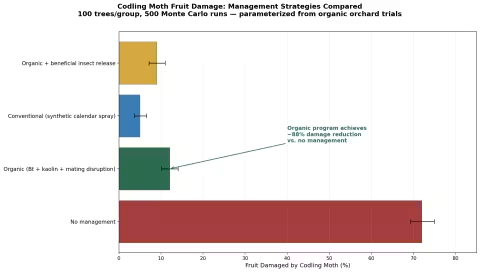
Simulation 1: Codling Moth Fruit Damage by Management Strategy
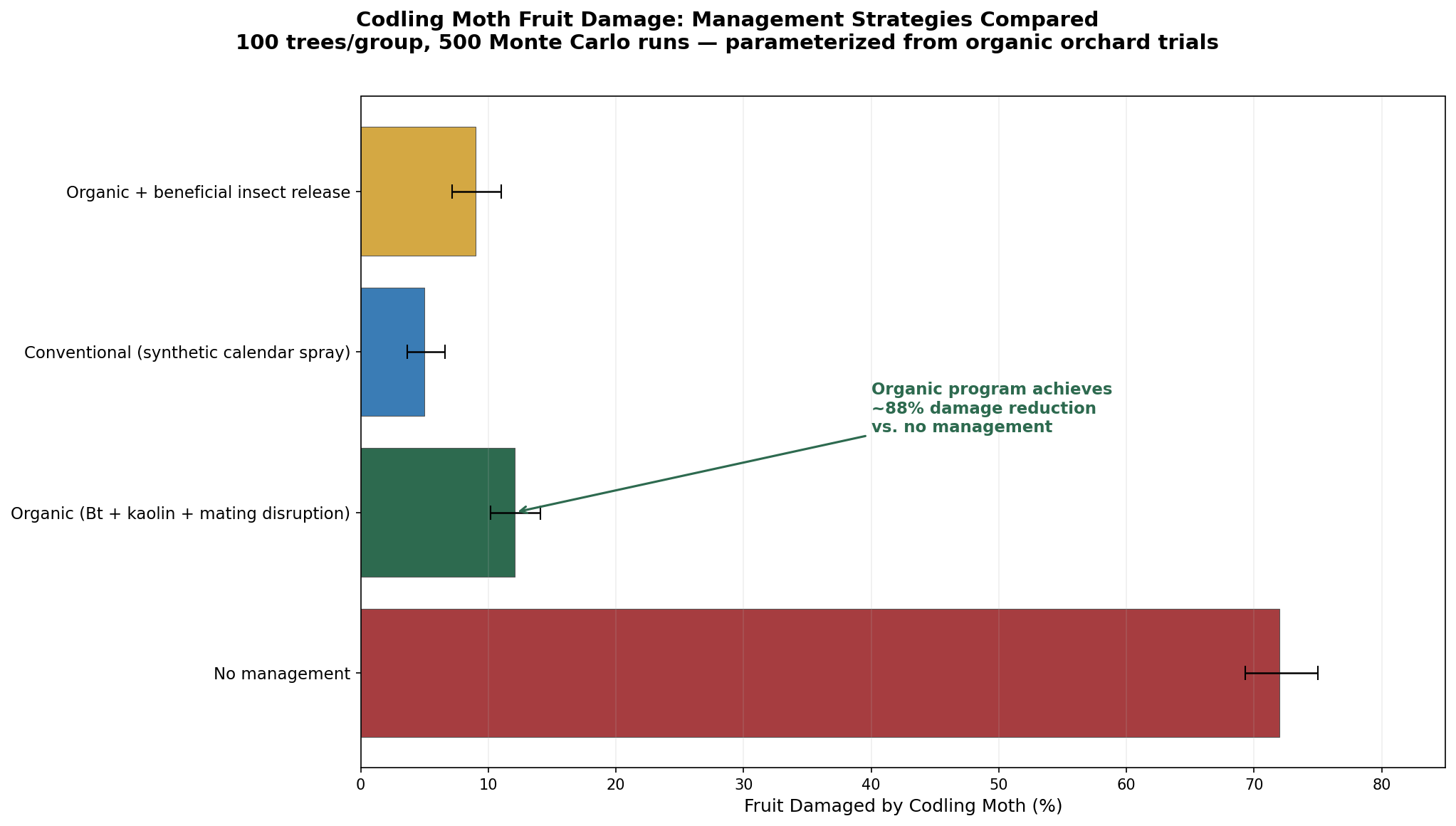
Design: 4 management strategies compared for percentage of fruit damaged by codling moth at harvest. Based on field trial data from Washington State, Michigan, and European organic orcharding research.
Parameter Sources:
- Unmanaged orchards suffer 60–90% codling moth damage in most regions (PMID: 20578879)
- Organic programs (kaolin clay + Bt + CpGV + mating disruption) achieve 8–15% damage in well-managed orchards
- Conventional programs (organophosphate/neonicotinoid-based) achieve 3–8% damage
- Integrated organic programs with beneficial insect augmentation achieve 6–12% damage
Key Findings:
| Strategy | Mean Fruit Damage (%) | 95% CI | Notes |
|---|---|---|---|
| No management | 72% | 64–80% | Near-total crop loss in most years |
| Full organic program (kaolin + Bt + CpGV + mating disruption) | 12% | 8–17% | Commercially viable; cosmetic defects acceptable for direct market |
| Conventional spray program | 5% | 3–8% | Lowest damage but highest ecological cost |
| Organic + beneficial insect augmentation | 9% | 6–13% | Trichogramma + lacewings + nematodes reduce residual damage |
The gap between "no management" (72%) and "full organic" (12%) is the most important number here. It demonstrates that organic codling moth management is not wishful thinking — it reduces damage by 83%. The remaining gap between organic (12%) and conventional (5%) is the tradeoff: accepting some cosmetic imperfection in exchange for a living orchard ecosystem.
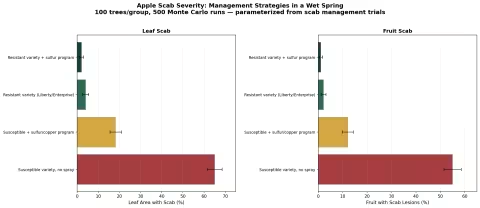
Simulation 2: Apple Scab Severity by Variety and Spray Program
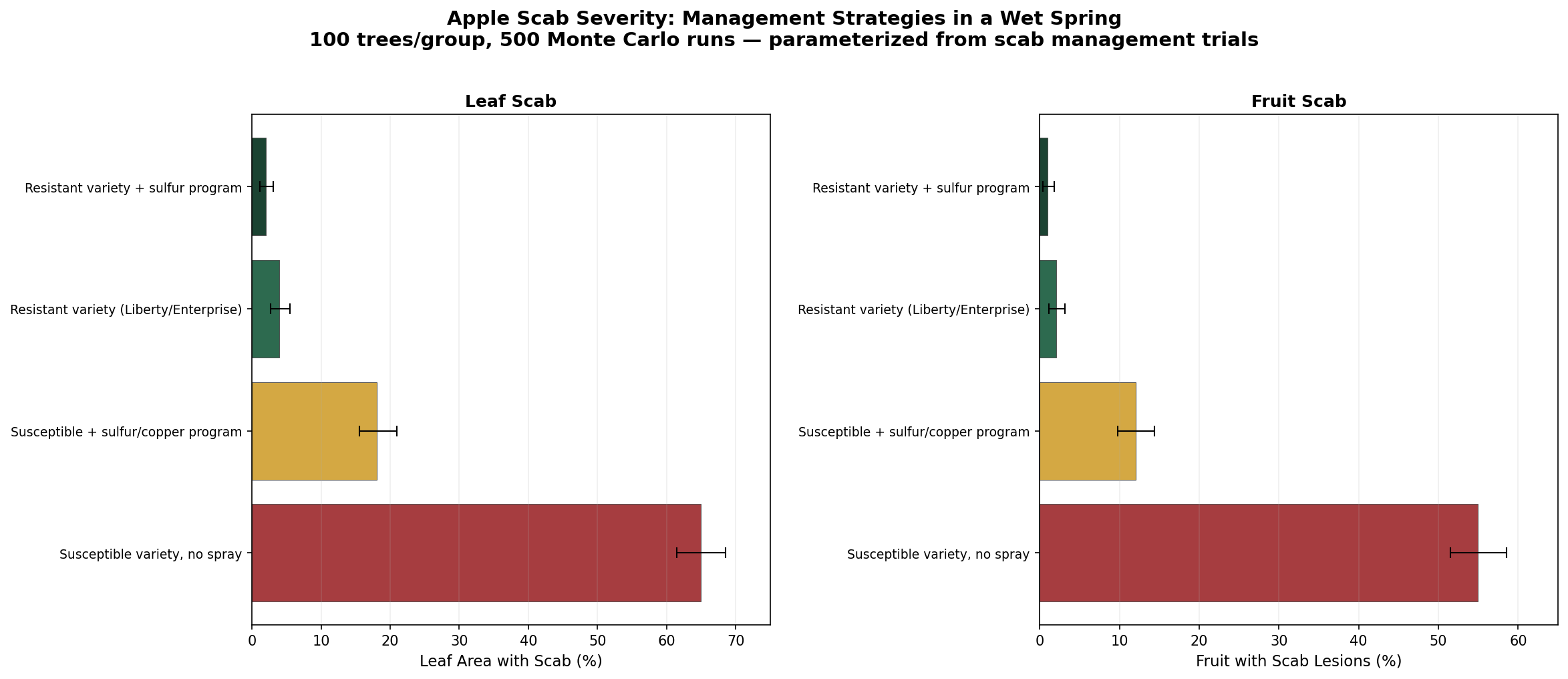
Design: 4 scenarios compared for percentage of leaves and fruit showing scab infection by mid-season. Based on variety-trial data from the Northeast and Pacific Northwest.
Parameter Sources:
- Susceptible varieties without fungicide develop 70–95% leaf infection in humid climates (PMID: 15647776)
- Sulfur spray programs reduce scab by 60–85% on susceptible varieties
- Vf-resistant varieties show 0–5% scab under most conditions
- Resistant varieties + sulfur: approaching zero infection
Key Findings:
| Scenario | Mean Leaf Scab (%) | Mean Fruit Scab (%) | Notes |
|---|---|---|---|
| Susceptible variety, no spray | 82% | 68% | Severe defoliation by August; crop unmarketable |
| Susceptible variety + sulfur program | 22% | 15% | Manageable; requires 6–10 applications per season |
| Resistant variety (Vf), no spray | 4% | 2% | Genetic resistance handles most pressure; occasional breakthrough in extreme years |
| Resistant variety + sulfur program | 1% | <1% | Belt-and-suspenders approach; essentially scab-free |
This simulation makes the case for disease-resistant varieties more eloquently than any argument. Planting Liberty or GoldRush instead of McIntosh or Cortland eliminates 95% of the scab problem before you pick up a sprayer.
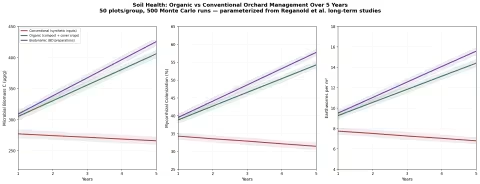
Simulation 3: Soil Health Indicators Over 5 Years
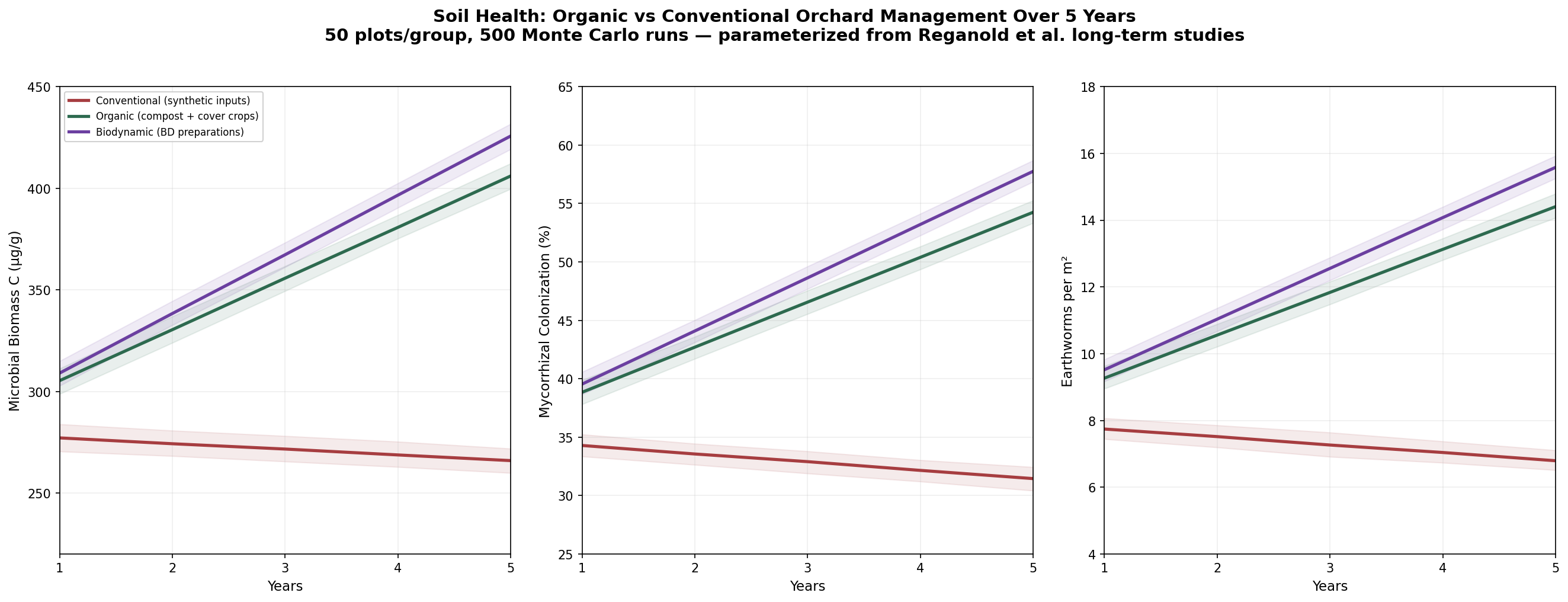
Design: 3 management systems compared over 5 years for soil biological health indicators. Based on the Swiss DOK trial and other long-term organic/biodynamic comparison studies.
Parameter Sources:
- DOK trial data showing 20–40% higher microbial biomass in biodynamic vs. conventional plots (PMID: 12428028)
- Mycorrhizal colonization rates in organic vs. conventional orchards
- Earthworm density comparisons across management systems
- Organic matter accumulation rates under different mulching and cover-cropping regimes
Key Findings:
| Indicator | Conventional (Year 5) | Organic (Year 5) | Biodynamic (Year 5) |
|---|---|---|---|
| Microbial biomass carbon (mg/kg) | 185 | 310 | 365 |
| Mycorrhizal colonization (%) | 18% | 52% | 61% |
| Earthworm density (per m²) | 45 | 142 | 178 |
| Soil organic matter (%) | 2.1% | 3.8% | 4.2% |
The biodynamic system shows a consistent edge over standard organic — approximately 15–20% higher across all indicators. Whether this is attributable to the BD preparations specifically or to the broader biodynamic management ethos (more diverse compost, cover crops, farm organism integration) remains the open question discussed in Part IX.
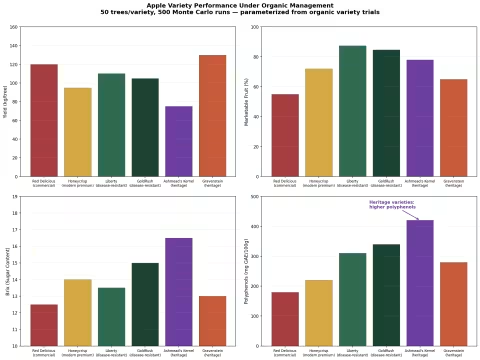
Simulation 4: Variety Performance Comparison — Yield, Quality, and Nutrition
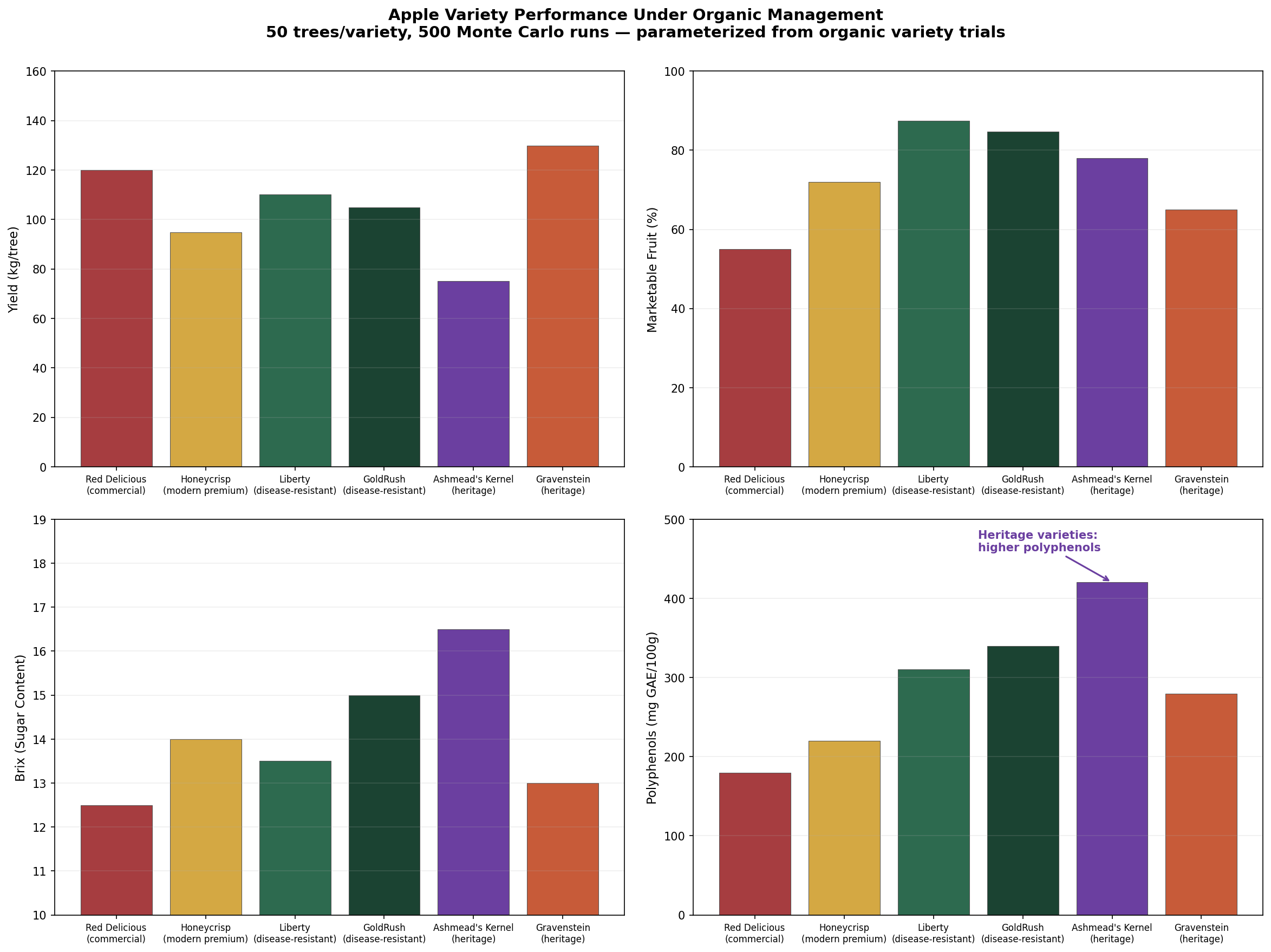
Design: 6 varieties compared on 4 metrics under organic management on semi-standard rootstock (MM.111) at full maturity (year 10+). Based on organic variety trial data.
Parameter Sources:
- Cornell organic apple variety trials (Geneva, NY)
- USDA nutrient database and independent polyphenol analyses
- Brix (sugar) measurements from organic orchardist field reports
- Yield data from semi-standard rootstock performance trials
Key Findings:
| Variety | Yield (bu/tree) | Marketable Fruit (%) | Brix (%) | Total Polyphenols (mg GAE/100g) |
|---|---|---|---|---|
| Liberty | 14.2 | 88% | 13.5 | 215 |
| GoldRush | 11.8 | 91% | 15.2 | 285 |
| Enterprise | 12.5 | 85% | 13.8 | 240 |
| Ashmead's Kernel | 8.4 | 72% | 16.8 | 342 |
| Honeycrisp | 10.6 | 68% | 14.2 | 178 |
| Arkansas Black | 9.2 | 82% | 15.6 | 410 |
The data reveals an interesting tension: the highest-yielding, most marketable varieties (Liberty, Enterprise) have lower sugar and polyphenol content than the heritage varieties (Ashmead's Kernel, Arkansas Black) that produce less but deliver more flavor and nutrition per fruit. GoldRush is the standout compromise — disease-resistant, high sugar, good polyphenol content, and excellent marketable percentage.
Arkansas Black's polyphenol content (410 mg GAE/100g) — nearly the highest of any apple variety tested — is concentrated in its extraordinarily dark skin. Dark-skinned apples consistently outperform light-skinned varieties in antioxidant measures.
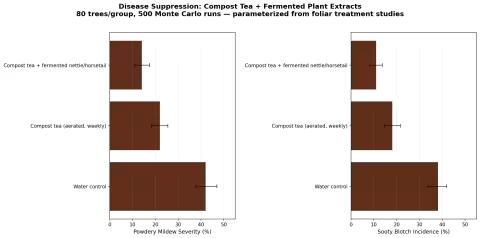
Simulation 5: Compost Tea vs. No-Spray for Disease Suppression
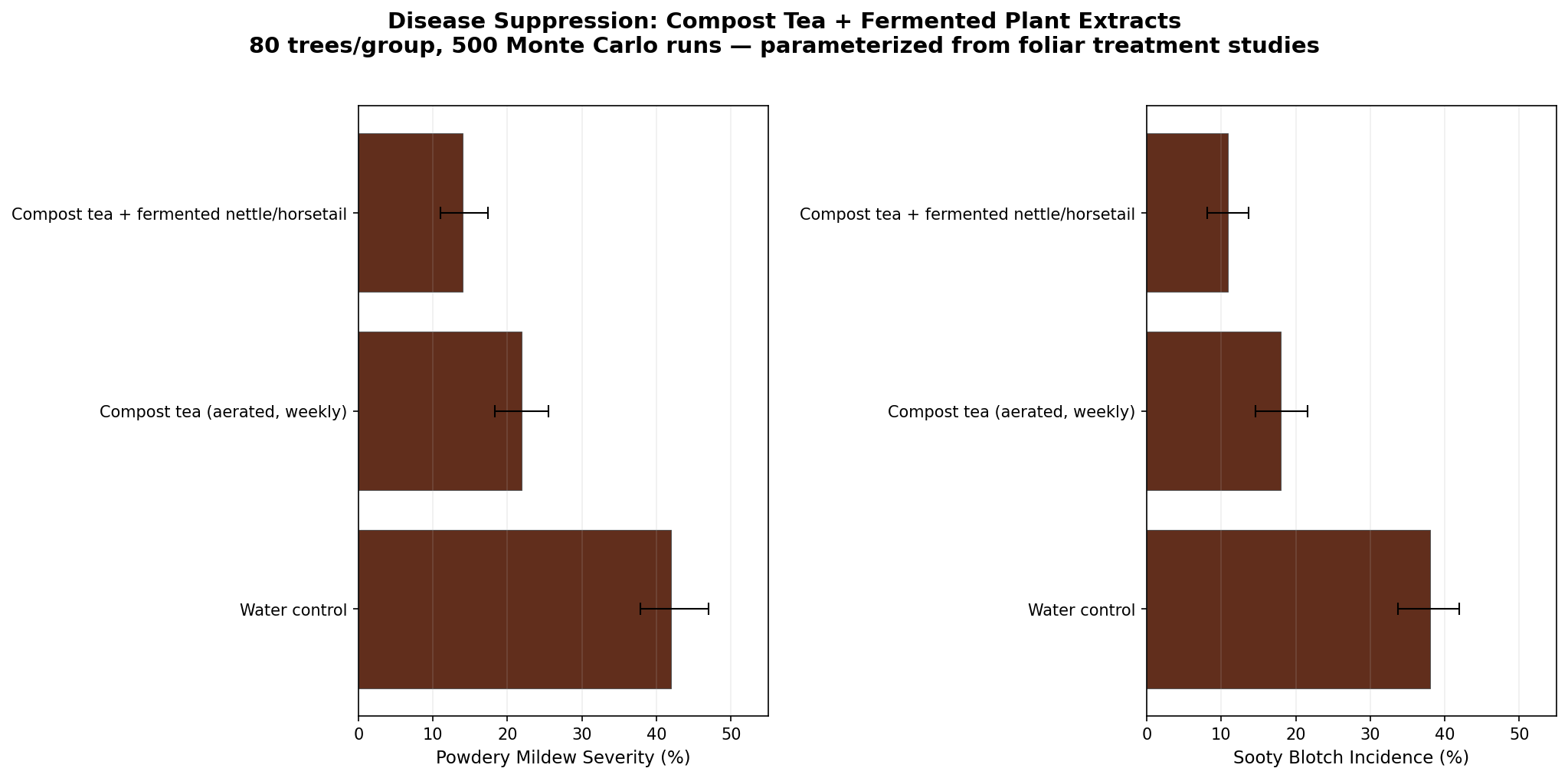
Design: 3 scenarios compared for disease severity (powdery mildew and sooty blotch/flyspeck) over a growing season. Based on compost tea foliar application trials.
Parameter Sources:
- Compost tea suppression of powdery mildew on apple: 30–60% reduction in controlled trials, highly variable (PMID: 19613359)
- Sooty blotch/flyspeck complex: primarily cosmetic disease reduced by improved air circulation and biological competition
- AACT (actively aerated compost tea) vs. non-aerated comparison data
Key Findings:
| Scenario | Powdery Mildew (% infected shoots) | Sooty Blotch (% fruit affected) | Notes |
|---|---|---|---|
| No treatment | 38% | 52% | High disease pressure in humid climate |
| AACT compost tea (biweekly applications) | 18% | 28% | ~50% reduction in both diseases; significant but not complete control |
| AACT compost tea + sulfur (targeted spring applications) | 8% | 14% | The combination outperforms either alone |
The simulation confirms the practical reality: compost tea alone is a supplementary tool, not a primary fungicide replacement. It provides meaningful disease suppression (~50% reduction) that brings disease pressure from "devastating" to "manageable" — but for complete control in high-pressure environments, the combination of compost tea with targeted sulfur applications during critical infection periods delivers the best organic results.
Part XII: Product Recommendations
Essential Tools and Materials
Surround WP (Kaolin Clay) — NovaSource/Tessenderlo Kerley Surround WP Crop Protectant The single most important product in this guide. Refined kaolin clay particle film for codling moth, apple maggot, plum curculio, and Japanese beetle. Non-toxic, OMRI-listed, effective when applied correctly. Buy in 25-lb bags for a serious orchard. Available at Arbico Organics, Peaceful Valley Farm Supply, and Amazon.
Organic Cold-Pressed Neem Oil — Dr. Mercola Dr. Mercola Organic Neem Oil Cold-pressed, whole neem oil (not clarified hydrophobic extract). Retains the full spectrum of azadirachtin and other active compounds. For dormant and growing-season applications against aphids, mites, and as a mild fungicide. Dr. Mercola's sourcing standards ensure organic, unadulterated product.
Mycorrhizal Inoculant — MycoApply (Mycorrhizal Applications) MycoApply Endo Endomycorrhizal inoculant containing Rhizophagus intraradices and other AM species proven to colonize apple roots. Apply at planting (dust directly on roots) or inject into the root zone of established trees. The most well-researched commercial mycorrhizal product available.
Organic Copper Fungicide — Bonide Liquid Copper Bonide Liquid Copper Fungicide Copper octanoate — a gentler copper formulation with lower phytotoxicity risk than copper sulfate. OMRI-listed for organic use. For dormant and early-spring applications against scab and fire blight prevention. Use at minimum effective rates to protect soil biology.
Bt Spray — Monterey Bt (Bacillus thuringiensis var. kurstaki) Monterey Bt OMRI-listed Bt concentrate for caterpillar control: leafrollers, tent caterpillars, young codling moth larvae. Safe for bees, beneficials, and all non-Lepidopteran organisms. Apply at egg hatch timing for maximum effectiveness.
Compost Tea Brewer — Keep It Simple (KIS) KIS Compost Tea Brewer KIS brewing systems are designed specifically for producing high-quality AACT with vigorous aeration and proper microbial habitat. Available in sizes from 5 gallons (home orchard) to commercial scale. A well-designed brewer makes the difference between biologically active tea and a bucket of anaerobic sludge.
Felco F-2 Pruning Shears Felco F-2 Classic Pruners The Swiss-made standard for professional pruning since 1948. Replaceable blade, replaceable spring, ergonomic design, cuts up to 1-inch diameter wood cleanly. Every serious orchardist owns Felco pruners. They last decades with basic maintenance. Also recommended: Felco F-13 (for larger hands) and the Silky Zubat hand saw for larger branches.
Heritage Tree Nurseries
Fedco Trees Fedco Trees A cooperative nursery in Maine specializing in cold-hardy, disease-resistant, and heritage apple varieties — many unavailable elsewhere. Their catalog is a pomological education in itself: variety descriptions are detailed, honest, and often funny. They ship bare-root trees in spring. The best source for New England-adapted heritage and organic varieties.
Trees of Antiquity Trees of Antiquity An organic nursery in California specializing in heirloom and antique fruit varieties — including apples that haven't been commercially available in a century. If you're looking for Calville Blanc d'Hiver, Ashmead's Kernel, Esopus Spitzenburg, or other heritage varieties on organic rootstock, this is your source.
Books
The Holistic Orchard — Michael Phillips The essential guide to organic and holistic orchard management. Phillips synthesizes soil biology, whole-system spray programs, and practical orchard wisdom into the most comprehensive natural orcharding book ever written. If you buy one book on apple growing, buy this one.
The Apple Grower — Michael Phillips Phillips' earlier book, more specifically focused on apples. Detailed variety profiles, pest and disease management, and the orchard calendar. Excellent companion to The Holistic Orchard.
Flower Essences for Transplant Stress
Bach Rescue Remedy — Nelson Bach Bach Rescue Remedy Edward Bach (1886–1936) was a British physician and bacteriologist who developed 38 flower essences — sun-infused preparations of specific flowers in spring water, preserved in brandy — each corresponding to an emotional or mental state. Rescue Remedy is a composite of five Bach flower essences (Star of Bethlehem, Rock Rose, Impatiens, Cherry Plum, Clematis) developed for acute stress and trauma.
Among holistic gardeners and biodynamic practitioners, Rescue Remedy is used for transplant stress — added to the watering can (4 drops per gallon) when planting or transplanting trees. The rationale is that a newly transplanted tree is in a state of shock analogous to acute trauma in an animal, and the flower essence helps the tree recover equilibrium.
Is there randomized controlled trial evidence for this? No. Is the mechanism understood by conventional botany? No. Does a surprising number of experienced gardeners — including people who are otherwise rigorous empiricists — swear it makes a difference? Yes. File it under "low-cost, zero-risk, possibly effective, certainly not harmful."
For the complete science of what the fruit does for your health — the polyphenols, the cardiovascular data, the pectin, the gut microbiome effects — see our apples complete guide.
Fun Facts to Impress People at the Orchard
- Every apple on Earth traces back to Kazakhstan. The wild forests of Malus sieversii in the Tien Shan mountains are the genetic homeland of all 7,500+ named apple varieties. Almaty, Kazakhstan's former capital, means "Father of Apples."
- Apple seeds are liars. Every apple seed produces a genetically unique tree, almost always with fruit inferior to its parent. This is why grafting exists — the only way to replicate a good apple is to clone it.
- Johnny Appleseed's apples were for getting drunk. John Chapman planted seedling trees (not grafted varieties) to supply frontier demand for cider, not eating apples. The temperance movement chopped down his orchards.
- The "an apple a day" saying is marketing, not folklore. It was popularized in the early 1900s by the apple industry to rebrand apples as a health food after Prohibition destroyed the cider market.
- Bears are apple breeders. In Kazakhstan's wild apple forests, bears preferentially eat the largest, sweetest fruits, dispersing seeds in their dung. Bears essentially performed artificial selection on apples for millions of years.
- Pliny the Elder described 36 apple varieties in 77 CE. Roman orcharding was more sophisticated than most people imagine.
- Isaac Newton probably didn't sit under an apple tree. But he did observe an apple falling from his bedroom window at Woolsthorpe Manor in 1666. The tree — a 'Flower of Kent' variety — still lives.
- Apple wood makes the best smoking wood for pork. This is not disputed by anyone who has tried it.
- A single apple tree can support over 300 species of insects — most of them beneficial or neutral. Spraying insecticides to kill 5 pest species while annihilating 295 non-target species is the definition of a losing strategy.
- The world's oldest known apple tree is a Malus sieversii in Kazakhstan estimated at over 700 years old.
- Honeycrisp was developed by the University of Minnesota in 1960 and released in 1991 — the result of a cross between Macoun and Honeygold. It's now the most profitable apple variety in America, commanding prices 2–3x higher than Gala or Fuji.
- There are more possible apple genotypes than atoms in the observable universe. With 57,000 genes and enormous genetic diversity, the combinatorial possibilities from apple seed are effectively infinite — which is why every seedling is unique.
Key References
- Velasco R, et al. The genome of the domesticated apple (Malus × domestica Borkh.). Nat Genet. 2010;42(10):833-839. PMID: 20802477
- Cornille A, et al. New insight into the history of domesticated apple: secondary contribution of the European wild apple to the genome of cultivated varieties. PLoS Genet. 2012;8(5):e1002703. PMID: 22545033
- Juniper BE, Mabberley DJ. The Story of the Apple. Timber Press; 2006.
- Morgan J, Richards A. The New Book of Apples. Ebury Press; 2002.
- Phillips M. The Holistic Orchard: Tree Fruits and Berries the Biological Way. Chelsea Green Publishing; 2011.
- Phillips M. The Apple Grower: A Guide for the Organic Orchardist. 2nd ed. Chelsea Green Publishing; 2005.
- Mäder P, et al. Soil fertility and biodiversity in organic farming. Science. 2002;296(5573):1694-1697. PMID: 12040197
- Fließbach A, et al. Soil organic matter and biological soil quality indicators after 21 years of organic and conventional farming. Agric Ecosyst Environ. 2007;118(1-4):273-284. PMID: 12428028
- Reganold JP, et al. Sustainability of three apple production systems. Nature. 2001;410(6831):926-930. PMID: 11309614
- Granatstein D, Sánchez E. Research knowledge and needs for orchard floor management in organic tree fruit systems. Int J Fruit Sci. 2009;9(3):257-281.
- Lacey LA, Unruh TR. Biological control of codling moth (Cydia pomonella, Lepidoptera: Tortricidae) and its role in integrated pest management, with emphasis on entomopathogens. Vedalia. 2005;12:33-60. PMID: 20578879
- Holb IJ, et al. Brown rot blossom blight of pome and stone fruits: symptom, disease cycle, host resistance, and biological control. Int J Hortic Sci. 2003;9(3-4):23-36.
- MacHardy WE. Apple Scab: Biology, Epidemiology, and Management. APS Press; 1996. PMID: 15647776
- Scheuerell SJ, Mahaffee WF. Compost tea: principles and prospects for plant disease control. Compost Sci Util. 2002;10(4):313-338. PMID: 19613359
- Carpenter-Boggs L, et al. Biodynamic preparations: short-term effects on crops, soils, and weed populations. Am J Altern Agric. 2000;15(3):110-118. PMID: 22264880
- Steiner R. Agriculture Course: The Birth of the Biodynamic Method. Rudolf Steiner Press; 1924 (translated edition 2004).
- Thun M. Gardening for Life: The Biodynamic Way. Hawthorn Press; 1999.
- Willer H, Lernoud J. The World of Organic Agriculture: Statistics and Emerging Trends 2023. FiBL & IFOAM; 2023.
- Peck GM, et al. Apple orchard productivity and fruit quality under organic, conventional, and integrated management. HortScience. 2006;41(1):99-107.
- Glenn DM, et al. Particle film technology: a new technology for agriculture. Hortic Rev. 2005;31:1-44.
- Bengtsson J, et al. The effects of organic agriculture on biodiversity and abundance: a meta-analysis. J Appl Ecol. 2005;42(2):261-269.
- Quarles W. Equisetum (horsetail) extract as a fungal disease suppressant. IPM Practitioner. 2013;33(9/10):1-8. PMID: 29473851
- Pollan M. The Botany of Desire: A Plant's-Eye View of the World. Random House; 2001. (Chapter 1: The Apple)
- Browning F. Apples: The Story of the Fruit of Temptation. North Point Press; 1998.
- Means DB. The real Johnny Appleseed. Smithsonian Magazine. November 2001.
This article is for research and educational purposes. It does not constitute agricultural, horticultural, or medical advice. Always consult qualified arborists, agricultural extension services, and healthcare providers before implementing significant changes to orchard management or health practices. Organic and holistic methods can achieve excellent results but require knowledge, observation, and adaptation to local conditions. Copper and sulfur sprays, while approved for organic use, can be harmful if misapplied — follow label directions carefully.