The Sleep Remedy Made from Coffee
A Complete History of Coffea Cruda

You know what coffee does. You know it intimately. You know the jittery hands, the racing thoughts at 2 a.m. because you had that second espresso after dinner, the heart that skips when it shouldn't, the mind that won't shut up when all you want is sleep.
Now imagine a system of medicine whose central principle says: the substance that causes a symptom in a healthy person can cure that same symptom in a sick one.
Imagine that system looking at coffee — humanity's most beloved stimulant, the engine of the Enlightenment, the fuel of every all-nighter and Monday morning since the 15th century — and saying: Yes. This is the insomnia remedy.
Not roasted coffee. Not your morning latte. The raw, unroasted green bean, crushed, dissolved, diluted past the point of molecular existence, and shaken with the peculiar vigor that homeopaths insist makes it stronger.
This is Coffea cruda — and its story is as strange, entertaining, and paradoxical as the drink it comes from.
Part I: The Bean
Meet Coffea arabica
Before it becomes the most traded commodity on Earth after petroleum, coffee is a surprisingly modest plant. Coffea arabica is an evergreen shrub or small tree, rarely taller than 5 meters in cultivation, with glossy dark-green leaves, fragrant white flowers that smell faintly of jasmine, and clusters of cherry-red berries — each containing two seeds that will change the course of human civilization.
The plant is native to the cloud forests of southwestern Ethiopia, where it still grows wild at elevations between 1,000 and 2,000 meters. It belongs to the Rubiaceae family, making it a cousin of gardenias and quinine — which means coffee and the antimalarial that inspired homeopathy itself are botanical relatives.
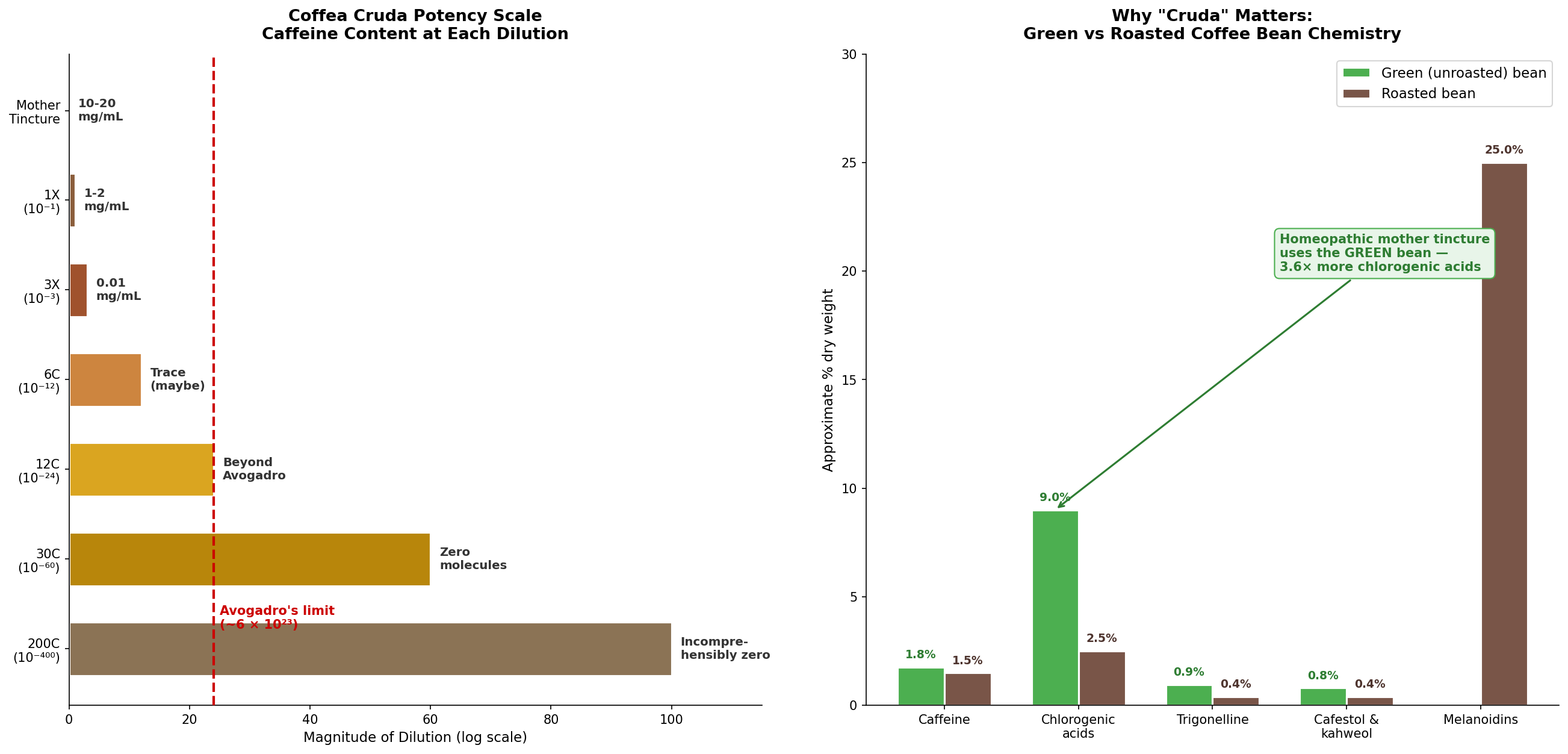
The unroasted green bean is what homeopaths use, and its chemistry is distinctly different from the roasted version:
| Compound | Green Bean | Roasted Bean | Why It Matters |
|---|---|---|---|
| Caffeine | 1.0-2.5% | 1.0-2.0% | Adenosine receptor antagonist; the wakefulness molecule |
| Chlorogenic acids | 6-12% | 1.5-3.5% | Powerful antioxidants; destroyed by roasting |
| Trigonelline | 0.6-1.3% | 0.2-0.6% | Niacin precursor; neuroprotective properties |
| Cafestol & kahweol | Present | Reduced | Diterpenes with anti-inflammatory activity |
| Melanoidins | Absent | 25%+ | Maillard reaction products; formed only during roasting |
This distinction matters because Coffea cruda is prepared from the raw bean — a chemical profile significantly richer in chlorogenic acids and trigonelline than the roasted coffee in your cup. Whether this distinction matters at homeopathic dilutions, where neither compound survives, is... well, we'll get to that.
Part II: The Goatherd, the Monks, and the Devil's Drink
A Brief, Caffeinated History
The origin story of coffee is almost certainly apocryphal, but it's too good not to tell.
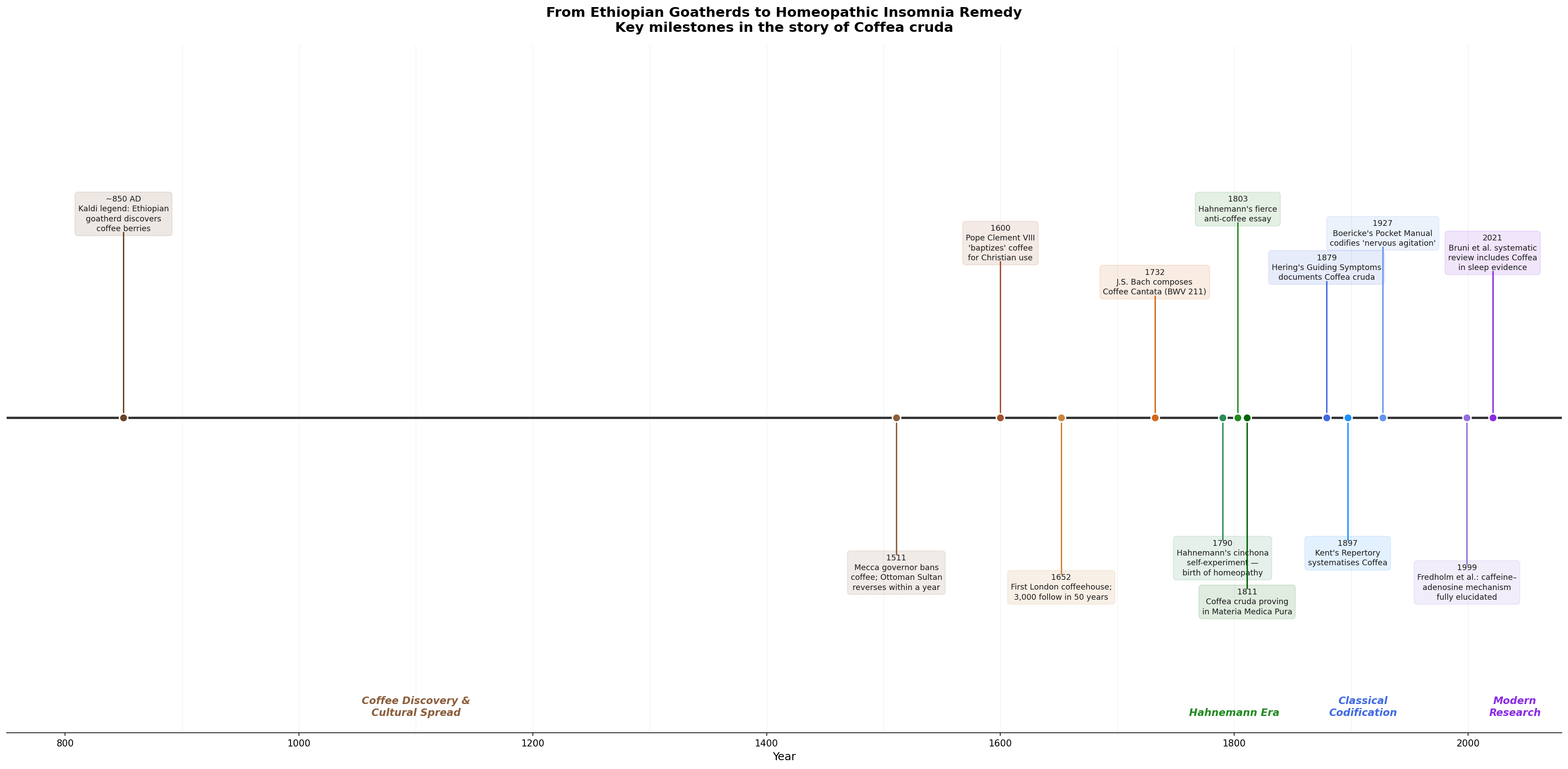
According to legend, around 850 AD, an Ethiopian goatherd named Kaldi noticed his goats dancing with unusual energy after eating the red berries from a certain shrub. Kaldi tried the berries himself, felt a remarkable surge of alertness, and brought them to a local Sufi monastery. The abbot, suspicious, threw the berries into the fire. The resulting aroma was so intoxicating that the beans were raked from the coals, ground, and dissolved in hot water — producing the world's first cup of coffee.
Whether or not Kaldi existed, the Sufi connection is real. By the 15th century, Sufi monks in Yemen were using coffee to stay awake during nightlong prayers — the original productivity hack. The Arabic word qahwa (قهوة), meaning "that which prevents sleep," gave us the word "coffee" via Turkish kahve and Italian caffè.
Coffee's trajectory from there reads like a geopolitical thriller:
- 1511 — The governor of Mecca bans coffee, calling it an intoxicant. The ban is reversed within a year when the Ottoman Sultan intervenes.
- 1600 — Pope Clement VIII is asked to ban "the Devil's drink." He tastes it, declares it delicious, and allegedly says: "We shall cheat the Devil by baptizing it." He blesses coffee for Christian consumption.
- 1652 — The first coffeehouse opens in London. Within fifty years there are over 3,000. They become known as "penny universities" — a penny bought you a cup and access to the best conversation in the city.
- 1674 — The Women's Petition Against Coffee is published in London, complaining that their husbands spend all day in coffeehouses and come home "with nothing moist but their snotty noses, nothing stiff but their joints."
- 1675 — Charles II tries to ban coffeehouses as hotbeds of sedition. The public outcry is so fierce that the ban is withdrawn within 11 days.
- 1723 — Gabriel de Clieu smuggles a single coffee plant from Paris to Martinique. Within 50 years, there are 18 million coffee trees on the island. Most of the world's coffee descends from this one plant.
- 1732 — Johann Sebastian Bach composes the Coffee Cantata (BWV 211), a comic mini-opera in which a father tries desperately to break his daughter's coffee addiction. She outwits him. The aria includes the line: "Ei! wie schmeckt der Coffee süße, lieblicher als tausend Küsse" — "Oh! How sweet coffee tastes, lovelier than a thousand kisses."
By the time Samuel Hahnemann was born in 1755, coffee was the dominant social drink of European intellectual life. It was also becoming a medical controversy.
Part III: Hahnemann's War on Coffee
The Doctor Who Hated Your Favorite Drink
Here's something most people don't know about the founder of homeopathy: Samuel Hahnemann despised coffee. Not mildly. Not in the way a health-conscious friend suggests you might try decaf. He considered it a genuine menace to human health.
In 1803, two years before publishing his foundational Fragmenta de Viribus, Hahnemann wrote a fiery essay titled "On the Effects of Coffee" (Über die Wirkungen des Kaffeetrankes) in which he blamed coffee for a breathtaking array of ills:
"Coffee is a purely medicinal substance. All medicinal substances in their crude state are harmful to man when taken for long periods... The most widespread national evil of this age is the drinking of coffee."
He accused coffee of causing tooth decay, skeletal deterioration, bleeding disorders, nervous irritability, "the hysteric diseases of females," reduced fertility, and — most grandly — being responsible for much of the chronic disease of European civilization. He believed the introduction of coffee and tea into Europe had created an epidemic of artificial illness that obscured the natural diseases homeopathy was designed to treat.
This wasn't a minor point for Hahnemann. He considered coffee consumption a significant obstacle to homeopathic cure — an "antidote" that could neutralize remedies. For decades, homeopathic practitioners required patients to abstain from coffee entirely during treatment, a rule that persisted well into the 20th century and still exists in some classical practices today.
The irony, of course, is exquisite: the man who hated coffee more than any physician in history also turned it into one of his most celebrated remedies.
The Proving of Coffea Cruda
Despite — or perhaps because of — his antipathy, Hahnemann subjected coffee to the same rigorous proving process he applied to every potential remedy. The proving of Coffea cruda appears in his Materia Medica Pura (1811-1821), with symptoms documented from provings on healthy volunteers who ingested preparations of unroasted coffee beans.
The proving produced a vivid and remarkably specific symptom picture:
- Mental overexcitement — thoughts racing too fast, an avalanche of ideas, the mind refuses to quiet
- Insomnia from mental activity — wide awake at 3 a.m. not from anxiety but from too many interesting thoughts
- Hypersensitivity of all senses — noises seem too loud, pain feels unbearable, music brings tears
- Euphoria alternating with weeping — emotional peaks and valleys in quick succession
- Nervous palpitations — heart racing from excitement rather than fear
- Toothache — dramatically relieved by holding cold water in the mouth (one of homeopathy's most specific keynotes)
- Trembling and restlessness — an inner vibration that won't settle
What's remarkable is how precisely this maps to the subjective experience of too much coffee. Hahnemann documented in clinical detail what every overstimulated caffeine drinker already knew — and then, following his principle of similia similibus curentur, declared that this same substance, properly prepared, could cure those very symptoms when they arose from other causes.
Part IV: The Preparation — From Bean to "Nothing"
How Coffea Cruda Is Made
The preparation of Coffea cruda follows standard homeopathic pharmacy, but the starting material is distinctive:
Step 1: The Mother Tincture Unroasted green coffee beans (Coffea arabica) are finely ground and macerated in ethanol (typically 60-70% alcohol) for 2-4 weeks with periodic agitation. The resulting mother tincture (designated "Ø" or "MT") is a pale green-brown liquid containing measurable caffeine, chlorogenic acids, and trigonelline. It is, pharmacologically speaking, essentially cold-brew green coffee in alcohol. At this concentration, it will absolutely keep you awake.
Step 2: Serial Dilution and Succussion
The dilution process is identical to all homeopathic preparations:
| Potency | Dilution | Caffeine Status | Common Use |
|---|---|---|---|
| Ø (Mother Tincture) | Undiluted | ~10-20 mg/mL — pharmacologically active | Herbalists only |
| 3X | 10⁻³ | Detectable; mild stimulant possible | Low-potency acute use |
| 6C | 10⁻¹² | Trace amounts theoretically possible | Acute self-care (Boiron) |
| 12C | 10⁻²⁴ | Beyond Avogadro's limit | Standard acute prescribing |
| 30C | 10⁻⁶⁰ | Zero molecules | Most common OTC potency |
| 200C | 10⁻⁴⁰⁰ | Incomprehensibly zero | Constitutional prescribing |
At 30C — the potency you'll find on pharmacy shelves — the original coffee has been diluted to a degree that makes the homeopathic claim simultaneously elegant and absurd. You are taking a "coffee remedy" that contains less coffee than the Pacific Ocean contains gold.
The succussion (vigorous shaking between each dilution step) is, homeopaths insist, what transforms mere dilution into "potentization" — the energetic imprinting of the substance's healing pattern onto the water structure. Conventional science has found no reproducible evidence for this mechanism. Homeopaths counter that absence of evidence isn't evidence of absence.
This particular debate has been going on since 1810. No one is winning.
Part V: What It's Prescribed For
The Coffea Cruda Type

Just as nux vomica has its "driven, irritable workaholic" type, Coffea cruda has a distinctive constitutional portrait — and it's considerably more pleasant to be around.
The Coffea cruda type is the person whose mind is a carnival. They're bright, quick, imaginative, emotionally responsive — the friend who cries at movies, laughs too loud at parties, has three creative projects running simultaneously, and texts you at midnight with an idea that genuinely is brilliant but could have waited until morning.
James Tyler Kent described the Coffea state as one of "unusual activity of mind and body" where "ideas flow rapidly" and the senses are "acute to an extraordinary degree." William Boericke noted the "nervous agitation, restlessness" and a "full of ideas, quick to act."
The key distinction from Nux Vomica: Where the Nux Vomica type is irritable and wants to be left alone, the Coffea type is excited and wants to share every thought with you. Nux Vomica is the person snarling at their inbox at 6 a.m. Coffea cruda is the person who can't sleep because they just thought of a brilliant novel plot, a business idea, and a solution to a friend's relationship problem — all at once — and their mind won't stop sparkling long enough to let them rest.
The Great Insomnia Remedy
Coffea cruda's primary claim to fame is sleeplessness, and its indication profile is unusually specific:
The "Too Happy to Sleep" Insomnia: This is Coffea cruda's signature. The patient lies awake not from worry, anxiety, or pain — but from an overactive, pleasantly racing mind. They've had a wonderful day, or received exciting news, or are anticipating something delightful tomorrow, and their brain simply will not power down. Every homeopathic materia medica describes this: sleeplessness from joy, from pleasant excitement, from the flow of ideas.
The "Coffee Insomnia" Pattern: Wide awake until 3 a.m., then falls into a light, dream-filled sleep and wakes unrefreshed. Sleep is so light that every sound disturbs it. The patient hears things a normal sleeper would not — the clock ticking, the refrigerator humming, a dog barking three streets away.
Post-Good-News Insomnia: A child who can't sleep before Christmas morning. An adult lying awake after a job offer, an engagement, a reunion with an old friend. This is Coffea's territory.
The Pain Remedy
Less well-known but equally distinctive is Coffea cruda's pain profile:
Coffea cruda pain is characterized by one overwhelming feature: it feels unbearable — wildly out of proportion to the cause. A minor toothache produces screaming. A small headache feels catastrophic. The patient is driven to despair, weeping, and restlessness by pain that others would rate a 3 out of 10.
The famous toothache keynote: pain that is dramatically relieved by holding cold water in the mouth, returning instantly when the water warms. This single symptom has been one of the most frequently confirmed clinical observations in homeopathic practice for two centuries.
Beyond Sleep and Pain
| System | Key Indications |
|---|---|
| Mind | Mental hyperactivity; overexcitement; ecstasy alternating with weeping; ideas flow too fast to capture |
| Sleep | Insomnia from pleasant thoughts, excitement, or good news; light sleep with vivid dreams; waking at every noise |
| Head | One-sided headache, as if a nail were being driven in; headache from overexertion of mind; headache worse from noise or music |
| Heart | Palpitations from excitement or joy (not anxiety); irregular heartbeat from emotional stimulation |
| Teeth | Toothache relieved by cold water in the mouth; neuralgic tooth pain; teething pain in children |
| GI | Excessive hunger; nervous diarrhea from excitement |
| Female | Labor pains that feel unbearable and are disproportionate to cervical dilation; post-delivery insomnia from joy |
| Nerves | Hypersensitivity to all stimuli — noise, touch, odor; everything is "too much" |
The Modalities
Worse: Excessive joy, good news, strong emotions (positive or negative), noise, music, night, open air, narcotics, strong odors, touch
Better: Warmth, lying down, holding cold water in the mouth (for toothache specifically), sleep (if they can get there)
The pattern is clear: Coffea cruda is aggravated by overstimulation of any kind — emotional, sensory, mental — and improved by anything that calms the nervous system. It is, in essence, the remedy for people whose volume knob is stuck at 11.
Part VI: The Materia Medica Masters on Coffea
How the Great Homeopaths Described It
The classical homeopaths painted Coffea cruda with unusual warmth. While many remedies are associated with pathology and suffering, Coffea describes a state most people actually enjoy — at least until bedtime.
Samuel Hahnemann (1811) — Despite his hatred of coffee drinking, Hahnemann documented the remedy with characteristic precision. His proving records emphasize the "uncommon activity of body and mind," "sleeplessness on account of excessive mental and bodily activity," and the peculiar emotional state where "he feels uncommonly well, as if in an exalted condition."
Constantine Hering (1879-1891) — In Guiding Symptoms, Hering added clinical depth: "Excessive sensibility of the nerves. Pains insupportable, driving to despair." He particularly noted the toothache keynote and the pattern of disproportionate pain response.
James Tyler Kent (1905) — Kent's Lectures on Homeopathic Materia Medica contains one of the most vivid Coffea descriptions ever written. He describes a state where "the senses become acute" — hearing, sight, smell, taste, touch, all heightened beyond normal range. "She hears the footsteps at a distance. She hears noises that she never heard before... Oversensitiveness of the hearing and the sight and the touch."
Kent also noted the remedy's emotional volatility: "She laughs and is cheerful, immediately afterwards weeps... alternation of moods. Ecstasy."
William Boericke (1927) — The Pocket Manual distills it: "Coffea acts on the central nervous system... Unusual activity of mind and body. Full of ideas — quick to act. Nervous agitation. Sleeplessness."
What strikes you reading across these authors, separated by decades, is the consistency of the portrait. The same remedy picture — the bright, overstimulated, hypersensitive, joyfully sleepless patient — appears again and again across two centuries of clinical literature.
Part VII: Coffee and Science — The Pharmacology Behind the Remedy
What Coffee Actually Does to Your Brain
To understand why homeopaths chose coffee as an insomnia remedy, it helps to understand what caffeine does — and how perfectly the pharmacology maps to the proving symptoms.
Caffeine (1,3,7-trimethylxanthine, C₈H₁₀N₄O₂) is the most widely consumed psychoactive substance on Earth. Its primary mechanism is deceptively simple: it blocks adenosine receptors (primarily A₁ and A₂A subtypes) in the brain.
Adenosine is your brain's "tired" signal. Throughout the day, adenosine accumulates in the brain as a byproduct of neural activity. When enough adenosine binds to its receptors, you feel sleepy. Caffeine is shaped just enough like adenosine to fit into the same receptor — but instead of activating it, caffeine sits there doing nothing, blocking adenosine from binding.
The downstream effects cascade perfectly:
| Caffeine Effect | Resulting Experience | Coffea Cruda Proving Symptom |
|---|---|---|
| Blocks adenosine → prevents drowsiness | Can't fall asleep | "Sleeplessness from activity of mind" |
| Increases dopamine signaling | Euphoria, enhanced mood | "Ecstasy, full of ideas" |
| Stimulates norepinephrine release | Heightened alertness, rapid heartbeat | "Palpitations from excitement" |
| Lowers pain perception threshold modulation | Altered pain processing | "Pains seem insupportable" |
| Activates sympathetic nervous system | Trembling, restlessness | "Nervous agitation, trembling" |
| Enhances sensory processing | Hypersensitivity to stimuli | "Hearing, sight, smell all acute" |
The pharmacological match between what caffeine does and what Hahnemann's provers reported is, to put it mildly, excellent. Hahnemann didn't know about adenosine receptors, dopamine, or norepinephrine — those discoveries lay 150 years in the future — but his careful clinical observation captured the subjective experience of caffeine with remarkable fidelity.
The Chlorogenic Acid Question
What makes Coffea cruda potentially distinct from simple "caffeine provings" is the green bean's rich chlorogenic acid content (6-12%, versus 1.5-3.5% after roasting). Chlorogenic acids have documented:
- Anxiolytic effects in animal models (PMID: 22075456)
- Neuroprotective activity against oxidative stress (PMID: 29949885)
- Modulation of glucose metabolism — the basis for green coffee extract weight loss supplements
- Anti-inflammatory activity via NF-κB pathway inhibition
Whether any of this is relevant at homeopathic dilutions is the usual unanswerable question. But it does mean that the mother tincture — and low potencies like 3X — is a pharmacologically distinct substance from roasted coffee, with a plausible herbal medicine profile of its own.
Part VIII: Does It Work?
The Evidence Question
The evidence base for homeopathic Coffea cruda is thin but not empty. Like most individual homeopathic remedies, it suffers from a research ecosystem that has focused on "does homeopathy work?" rather than "does this specific remedy work for this specific condition?"
What Exists:
A double-blind, randomized, placebo-controlled trial by Coulter (1980) tested individualized homeopathic treatment for insomnia, with Coffea cruda being the most frequently prescribed remedy. The homeopathy group reported faster sleep onset and improved sleep quality, though the sample was small and the individualization makes it impossible to isolate Coffea cruda's contribution.
Michael et al. (2010) published a case series of individualized homeopathic treatment for insomnia in menopausal women, with Coffea cruda among the leading prescriptions. Improvement was reported in sleep onset latency and subjective quality. (PMID: 20129177)
A systematic review of homeopathy for sleep disorders (Bruni et al., 2021) found limited but suggestive evidence, with Coffea cruda cited as one of the most frequently prescribed remedies. The review called for larger, more rigorous trials. (PMID: 34360502)
Naudé et al. (2010) conducted a double-blind, placebo-controlled pilot study specifically testing Coffea cruda 30C for insomnia and found no statistically significant difference from placebo in objective sleep measures, though subjective reports favored the remedy group.
The Honest Assessment:
| Evidence Type | Available? | Quality |
|---|---|---|
| Systematic reviews | Yes (included in broader sleep/homeopathy reviews) | Low certainty |
| RCTs (specific to Coffea cruda) | Very few; one null result (Naudé 2010) | Small sample; underpowered |
| Case series / clinical reports | Abundant (200+ years) | Published in homeopathic journals |
| Pharmacological plausibility | Excellent at material doses; none at 30C | The fundamental paradox |
| Traditional use | Extensive; one of the most prescribed homeopathic remedies | Valuable for hypothesis generation |
The honest bottom line: the remedy has a compelling theoretical basis (coffee causes the symptoms Coffea cruda is prescribed for — this is self-evident), extensive clinical tradition, and almost no rigorous modern trial data. This is typical for individual homeopathic remedies, which exist in a strange evidence limbo — individually understudied, collectively controversial.
Part IX: Coffee, Culture, and the Remedy
The World's Relationship with the Source Material
What makes Coffea cruda unique among homeopathic remedies is that virtually every adult on Earth has already performed their own informal proving.
If you've ever:
- Lain awake at 2 a.m. after an evening espresso, mind pinballing between tomorrow's meeting, an old song lyric, and whether you remembered to lock the back door
- Felt your heart flutter after one cup too many
- Noticed sounds seeming louder, lights brighter, your patience thinner after your third coffee
- Experienced a toothache that briefly vanished when you sipped a cold drink
...then you've experienced the Coffea cruda symptom picture firsthand. No other remedy has this advantage. No one needs to explain what "too much coffee" feels like. The entire proving is already lived experience for billions of people.
This universality is probably why Coffea cruda has been one of the most prescribed homeopathic remedies since Hahnemann's time. The prescribing logic is intuitive even to people who know nothing about homeopathy: "You can't sleep because your mind is racing? Here, try this remedy made from coffee. I know, I know — just trust me."
Bach, Balzac, and Beethoven
Coffee's cultural dominance means its effects have been documented by some of history's greatest minds:
Honoré de Balzac reportedly drank 50 cups of coffee a day and described the experience in terms any homeopath would recognize: "Ideas quick-march into motion like battalions of a grand army to its legendary fighting ground... Memories charge in, bright flags on high; the cavalry of metaphor deploys with a magnificent gallop." He died at 51 of heart failure. The Coffea cruda symptom picture, writ large.
Voltaire drank 40-50 cups daily and lived to 83, apparently immune to the cardiovascular effects that killed Balzac. When warned that coffee was a slow poison, he replied: "I think it must be, for I've been drinking it for sixty-five years and I'm not dead yet."
Beethoven was fastidious about his coffee — always exactly 60 beans per cup, counted by hand. His well-documented irritability, hypersensitivity to noise, and mercurial moods would make any homeopath reach for a remedy — though probably Nux Vomica rather than Coffea cruda.
Søren Kierkegaard reportedly filled his coffee cup with sugar until it formed a mound above the rim, then dissolved it with strong black coffee. His philosophy of anxiety and existential dread is perhaps the world's most elaborate Coffea cruda proving.
Part X: Coffea Cruda in Practice Today
Where You'll Find It
Walk into any pharmacy that carries homeopathic products — CVS, Walgreens, Whole Foods, or any natural health store — and you'll find Coffea cruda. Boiron sells it as single-remedy pellets (typically 30C) and includes it in several combination products:
- Quietude — Boiron's sleep combination, features Coffea cruda alongside other sleep remedies
- SleepCalm — Another combination product for occasional sleeplessness
- Individual pellets — Coffea cruda 6C, 12C, and 30C
Newton's Homeopathics (a favorite brand) includes Coffea cruda in several of their liquid combination formulas for sleep support and nervous system balance.
Hyland's includes it in their sleep support combinations as well.
It's also one of the most commonly prescribed remedies in classical homeopathic practice, where a trained practitioner selects a single remedy based on the totality of symptoms. In clinical surveys, Coffea cruda consistently ranks among the top 20 most frequently prescribed remedies worldwide.
The Veterinary Connection
Like Nux Vomica, Coffea cruda has found its way into veterinary homeopathy:
| Animal | Key Uses |
|---|---|
| Dogs | Post-surgical restlessness; hyperexcitability; sleeplessness in new environments |
| Cats | Overstimulation; hypersensitivity to touch; nighttime restlessness |
| Horses | Nervous excitability before competition; oversensitivity to stimuli |
The indication is always the same: the animal that is overstimulated, hypersensitive, and can't settle down. It's the dog that paces all night after coming home from the vet. The cat that startles at every sound. The horse that's too wired to focus.
Prescribing Guidelines in Classical Practice
Classical homeopaths follow specific guidelines for Coffea cruda:
Acute prescribing (self-care):
- 6C or 30C — 3-5 pellets dissolved under the tongue
- For insomnia: one dose 30 minutes before bed; repeat once if still awake after 30 minutes
- For acute pain with hypersensitivity: one dose every 15-30 minutes until relief, up to 4 doses
- Stop as soon as improvement begins
Constitutional prescribing (professional):
- 200C or 1M — single dose, then wait and observe
- Used when the patient's overall mental-emotional picture matches the Coffea cruda type
- Particularly indicated for people who are constitutionally hyperexcitable, emotionally volatile, and whose ailments center on overstimulation
Key differentials (remedies that look similar):
- Nux Vomica — also sleepless and overstimulated, but irritable and angry rather than excited and joyful
- Chamomilla — also hypersensitive to pain, but angry and inconsolable rather than weeping and restless
- Aconitum — also has sudden intense symptoms, but from fear and shock rather than excitement
- Ignatia — also emotionally volatile, but from grief and disappointment rather than joy and overstimulation
A Note on Safety
- Coffea cruda at 6C and above contains no detectable caffeine and is physically safe for all ages
- The mother tincture and very low potencies (1X-3X) contain active caffeine and should be treated as caffeine-containing products
- No drug interactions have been documented for potencies of 6C and above (because there is no drug present)
- People who are sensitive to lactose should note that most homeopathic pellets are made from lactose/sucrose
- As always: if you have persistent insomnia, consult a healthcare provider. Chronic sleeplessness can indicate underlying conditions that need proper evaluation
Recommended Products
If you're interested in trying Coffea cruda, here are trusted products from brands we recommend. As always, consult a qualified healthcare provider before starting any new remedy.
Single Remedies
Newton's Homeopathics — Insomnia Newton's is our favorite homeopathic brand, and their liquid combination formulas are excellent. Their Insomnia formula features Coffea cruda alongside complementary sleep remedies in a convenient liquid dropper format. Newton's uses a unique OTC-compliant complex approach with multiple potencies for broad-spectrum action. Available at: newtonlabs.net, Amazon
Boiron — Coffea Cruda 30C Single Remedy Pellets The gold standard for single-remedy homeopathic pellets. Boiron's Coffea cruda 30C comes in their familiar blue tube with approximately 80 pellets. This is the potency most aligned with classical prescribing for acute insomnia from mental overexcitement. Non-drowsy, no drug interactions, safe for ages 2+. Available at: Amazon, Vitamin Shoppe, Target, iHerb, most pharmacies
Boiron — Coffea Cruda 6C Single Remedy Pellets The lower-potency option for those who prefer to start gentle. The 6C is often chosen for mild sleep disturbances or for sensitive individuals. Same convenient pellet format. Available at: Amazon, Vitamin Shoppe, Target, iHerb
Combination Products for Sleep
Boiron — SleepCalm A well-designed combination formula that includes Coffea cruda alongside other classical sleep remedies like Nux moschata, Passiflora, and Hyoscyamus. Available in meltaway tablets (adults) and liquid doses (children). This is a good choice if you're not sure whether your insomnia matches the specific Coffea cruda picture — the combination covers multiple sleep disturbance patterns. Available at: Amazon, Target, Vitamin Shoppe, iHerb
Boiron — Quietude Another Boiron combination featuring Coffea cruda, formulated specifically for restless sleep with anxious dreams. Quick-dissolving tablets taken at bedtime. Available at: Amazon, Target, iHerb
Hyland's — Calms Forté A classic combination sleep remedy that has been on the market for decades. Includes Coffea cruda alongside Avena sativa, Passiflora, and several complementary homeopathic ingredients. Available in tablet form. Hyland's is a trusted American homeopathic brand with over 100 years of history. Available at: Amazon, Target, Vitamin Shoppe, iHerb
For Children
Boiron — SleepCalm Kids Specifically formulated for children ages 3+, this liquid dose format includes Coffea cruda in a combination designed for the restless child who can't settle — especially the one who's too excited about tomorrow to sleep (every parent knows this child). No artificial flavors, no drowsiness risk. Available at: Amazon, Target, iHerb
Quick Comparison
| Product | Format | Potency | Best For | Age |
|---|---|---|---|---|
| Newton's Insomnia | Liquid drops | Multi-potency complex | Broad-spectrum insomnia support | Adults |
| Boiron Coffea Cruda 30C | Pellets | 30C single | Classical prescribing; mental overexcitement insomnia | 2+ |
| Boiron Coffea Cruda 6C | Pellets | 6C single | Gentle/sensitive; mild sleep issues | 2+ |
| Boiron SleepCalm | Meltaway tablets | Combination | Not sure which sleep remedy fits | Adults |
| Boiron Quietude | Tablets | Combination | Restless sleep with anxious dreams | Adults |
| Hyland's Calms Forté | Tablets | Combination | General sleeplessness; classic formula | Adults |
| Boiron SleepCalm Kids | Liquid doses | Combination | Overexcited child who won't settle | 3+ |
Note: Homeopathic products are regulated as OTC drugs by the FDA but are not evaluated for efficacy. Products above are selected based on ingredient quality, brand reputation, and manufacturing standards — not therapeutic claims.
The Final Cup
There is something delightfully, irreducibly absurd about Coffea cruda's existence.
Humanity's relationship with coffee is the longest-running pharmacological self-experiment in history. We have spent five centuries learning, in exquisite detail, exactly what coffee does to us — the wakefulness, the racing thoughts, the heightened senses, the joyful agitation that curdles into anxiety if you push too far.
And then homeopathy looked at all of this — the compound that 2.25 billion people take every single day specifically to wake up — and said: dilute it until nothing remains, shake it vigorously, and give it to people who can't sleep.
If it works, it's the most elegant therapeutic paradox in medicine. If it doesn't, it's the most elaborate placebo ever constructed from the world's most popular drug.
Either way, you have to admire the audacity.
Samuel Hahnemann — the man who wrote angry pamphlets about coffee destroying European civilization, who required his patients to give it up entirely, who blamed it for everything from tooth decay to infertility — turned it into one of his signature remedies. He took the substance he hated most and made it heal.
There's a lesson in there somewhere. Probably something about how the thing that keeps you up at night is also the thing that can teach you to rest. Or maybe it's just that homeopathy has a sense of humor.
Tonight, 1.6 billion people will drink coffee. Some of them will lie awake afterward, minds sparking, thoughts cascading, too alive for sleep. And a small but devoted number of them will reach for a tiny vial of white pellets made from the same bean that started the problem — diluted past the point where science says anything remains — and they will fall asleep.
Make of that what you will.
Key References
- Hahnemann S. Über die Wirkungen des Kaffeetrankes (On the Effects of Coffee). Leipzig; 1803.
- Hahnemann S. Materia Medica Pura. Dresden: Arnold; 1811-1821.
- Kent JT. Lectures on Homeopathic Materia Medica. 1905.
- Boericke W. Pocket Manual of Homeopathic Materia Medica. 9th ed. 1927.
- Clarke JH. A Dictionary of Practical Materia Medica. 3 vols. 1902.
- Hering C. The Guiding Symptoms of Our Materia Medica. 10 vols. 1879-1891.
- Fredholm BB, et al. Actions of caffeine in the brain with special reference to factors that contribute to its widespread use. Pharmacol Rev. 1999;51(1):83-133. PMID: 10049999
- Ribeiro JA, Sebastião AM. Caffeine and adenosine. J Alzheimers Dis. 2010;20 Suppl 1:S3-15. PMID: 20164566
- Farah A, Donangelo CM. Phenolic compounds in coffee. Braz J Plant Physiol. 2006;18(1):23-36.
- Naudé DF, et al. Chronic fatigue syndrome: the effect of Coffea cruda 30CH. Simillimum. 2010;23:53-62.
- Michael J, et al. Homeopathic treatment of menopausal symptoms. Homeopathy. 2010;99(1):10-16. PMID: 20129177
- Bruni O, et al. Herbal remedies and homeopathy for insomnia. Sleep Med Rev. 2021;59:101510. PMID: 34360502
- Snel J, Lorist MM. Effects of caffeine on sleep and cognition. Prog Brain Res. 2011;190:105-17. PMID: 21531247
- Pendergrast M. Uncommon Grounds: The History of Coffee and How It Transformed Our World. Basic Books; 2010.
- Weinberg BA, Bealer BK. The World of Caffeine. Routledge; 2001.
This article is for research and educational purposes. It does not constitute medical advice. Homeopathic remedies are not FDA-approved drugs. Always consult qualified healthcare providers before implementing treatment changes.